An investor considering a new venture in the Central African Republic (CAR) faces a striking paradox: a country blessed with abundant sunlight yet burdened by one of the lowest electricity access rates in the world.
While the technical potential for solar energy is clear, the critical question for any serious business plan isn’t about the sun—it’s about the customer. If a solar module factory were established in the CAR, who would its primary buyers be?
Understanding the demand side of this equation is essential. A local manufacturing facility thrives not on its production capacity alone, but on a clear line of sight to domestic off-takers—the entities purchasing and deploying the modules. This analysis identifies the key customer segments within the CAR, providing a foundational assessment for entrepreneurs exploring this high-potential market.
Table of Contents
The Energy Landscape: A Market Defined by Need
Identifying potential customers begins with grasping the CAR’s unique energy environment. The country’s situation creates a compelling, built-in demand for alternative power sources.
Official data reveals that only 14.3% of the population has access to electricity, a figure that drops to a mere 4.4% in rural areas. The state utility, ENERCA, relies on aging diesel generators for approximately 90% of its generation capacity, leading to one of the highest electricity tariffs in the region at around €0.23 per kWh.
This combination of limited access, unreliability, and high cost forces most of the economy to depend on expensive, privately owned diesel generators.
This challenging environment persists despite the CAR’s excellent solar resources, with an average solar irradiation of 5.2 kWh/m²/day. Meanwhile, the government has set ambitious targets, aiming for 35% electricity access and 100 MW of installed solar PV capacity by 2030. Together, these factors create a powerful business case for any entity that can offer a more reliable and cost-effective alternative to diesel power. A local module manufacturer would be perfectly positioned to fill this gap.
Primary Off-Taker Segments for Locally Produced Modules
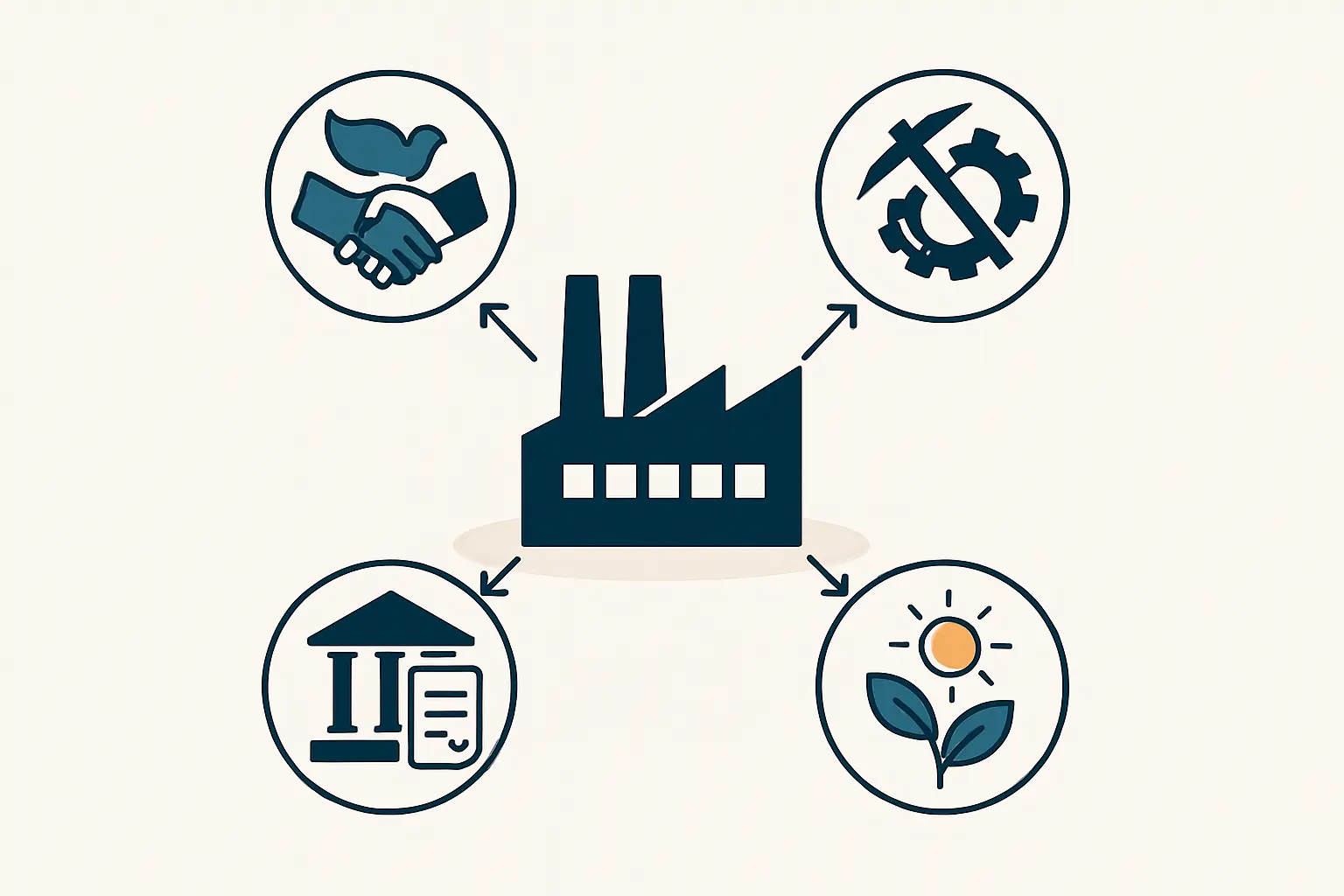
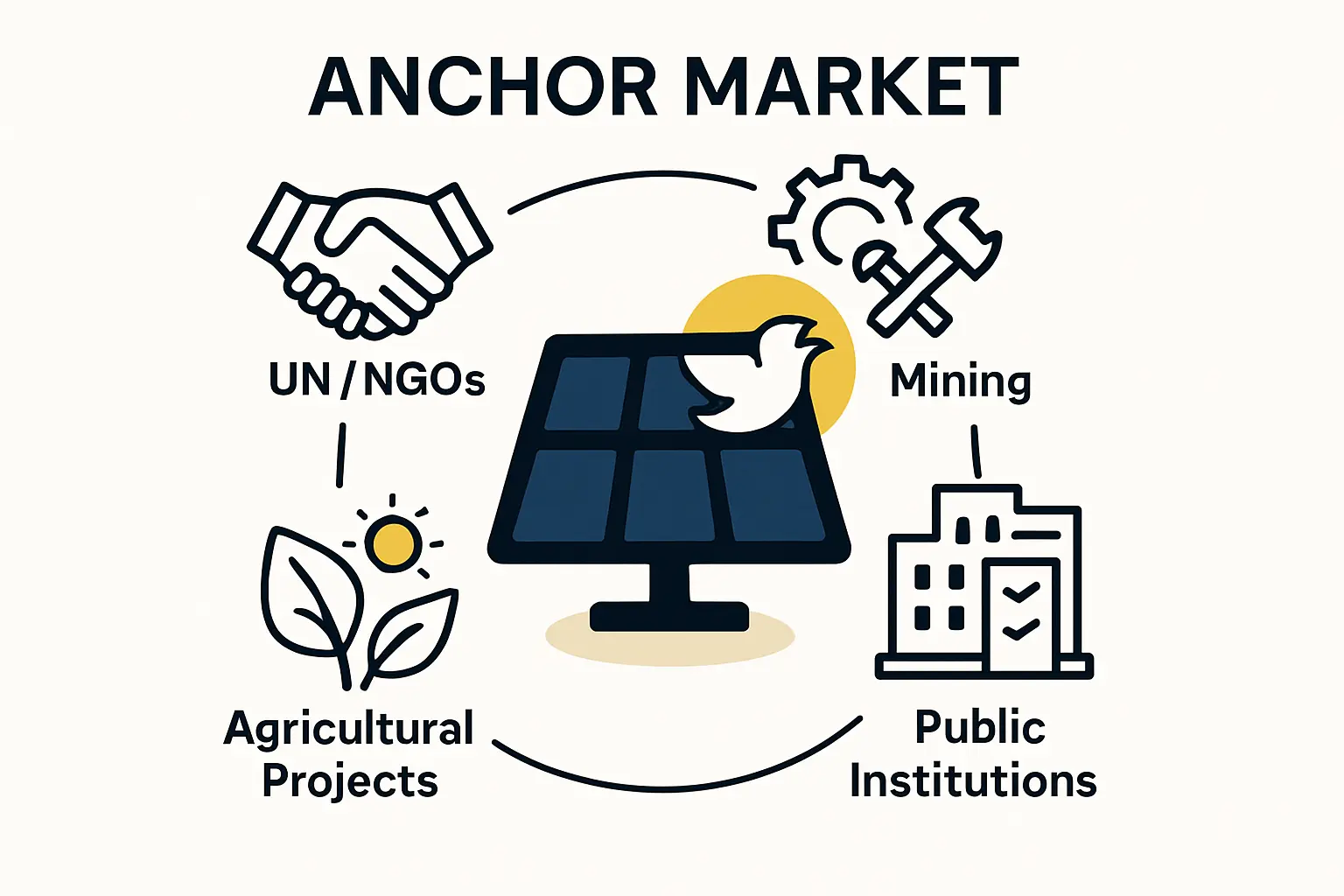
The most immediate and viable customers for a new solar module factory would not be individual households, but rather larger organizations with critical power needs and the capacity to invest. These fall into four primary groups.
1. The Mining Sector
The CAR’s economy is significantly driven by the extraction of natural resources, particularly gold and diamonds. Mining operations are typically located in remote, off-grid areas with no alternative to running diesel generators 24/7.
For these companies, fuel represents a major operational expense, compounded by logistical challenges and price volatility. Solar power offers a direct path to reducing these costs and enhancing energy independence. A local supplier holds a distinct advantage over importers, offering faster delivery, on-the-ground technical support, and modules potentially better suited to local conditions. This makes the mining industry a prime anchor client base.
2. NGOs and International Organizations
The Central African Republic hosts a significant presence of United Nations bodies (such as MINUSCA), international aid organizations, and non-governmental organizations (NGOs). These groups operate extensive infrastructure, including offices, residential compounds, warehouses, and health clinics.
Their operations demand uninterrupted power, which is overwhelmingly supplied by diesel generators. However, many of these organizations now operate under mandates to reduce their carbon footprint and operational costs. They represent a creditworthy and stable customer base actively seeking sustainable energy solutions.
A local manufacturer that can demonstrate quality and reliability is well-positioned to become a preferred supplier for this influential market. For any new manufacturer, identifying such stable, high-volume clients is a critical first step.
3. Public Institutions and Social Infrastructure
The government and its international partners are focused on expanding essential services, including healthcare and education. Yet, a vast number of schools, hospitals, and local government administrative buildings—especially outside the capital, Bangui—lack reliable electricity.
Powering this social infrastructure is a national development priority. Projects to electrify rural clinics for vaccine refrigeration or to enable evening classes in schools are common initiatives funded by development banks and aid programs. A local solar module factory could position itself as a key partner in these national development efforts, supplying the core components for projects with both high social impact and secured funding.
4. The Agricultural Sector
Agriculture forms the backbone of the CAR’s rural economy. However, productivity is often constrained by a lack of energy for essential activities like irrigation and post-harvest processing. Solar-powered water pumps can transform arid land into productive farms, and solar-powered mills can help process crops locally, adding value and reducing spoilage.
While individual smallholder farmers may not be direct customers, cooperatives, agricultural development projects, and commercial farms represent a growing market. These groups require robust, reliable energy solutions to improve yields and economic outcomes. This sector’s long-term growth potential makes it a key component of any forward-thinking business plan.
Translating Market Demand into a Viable Business
Identifying these customer segments is the first step; the next is building a production strategy aligned with their needs. A new entrant does not need to compete with massive global manufacturers on volume. Instead, its strategy should focus on agility, local presence, and customization.
A small- to medium-scale production line (e.g., 20–50 MW annually) can be highly effective. This setup requires a careful selection of solar panel manufacturing machines capable of producing modules that meet international standards. For many investors, a turnkey solar manufacturing line provides a structured and efficient path from planning to production, ensuring the factory is well-equipped to serve these diverse off-takers from day one.
Frequently Asked Questions (FAQ)
Q: Why is local manufacturing advantageous over simply importing modules?
A: Local production offers several key benefits in the CAR: reducing transportation costs and logistical complexity, lowering exposure to import tariffs, creating local employment, and allowing for greater responsiveness to customer needs. It also demonstrates a long-term commitment to the market, which is valuable when dealing with government and international partners.
Q: What is the single biggest challenge for a solar manufacturer in the CAR?
A: Beyond the initial investment, the most significant challenge is often navigating the logistical and political landscape. However, the immense and unmet demand for energy creates a powerful commercial incentive that can outweigh these risks, especially for well-prepared investors.
Q: Can a local factory compete on price with large-scale international producers?
A: While a local factory may not compete on the per-watt production cost alone, its overall value proposition can be superior. Savings on international shipping, insurance, and import duties, combined with the availability of local service and support, make the final installed cost highly competitive, particularly for the B2B and B2G segments identified above.
Q: What type of solar module is best suited for this market?
A: Robustness and durability are key. Glass-glass modules, for example, may offer better longevity in harsh climates. A local factory has the flexibility to produce modules specifically tailored to the environmental conditions and market demands of the region.
Conclusion: A Market Driven by Necessity
The demand for solar modules in the Central African Republic is not speculative; it is rooted in the fundamental economic and developmental needs of the country. The reliance on costly and unreliable diesel power across critical sectors—from mining and international aid to public services and agriculture—creates a ready-made market for a local manufacturer.
For the discerning entrepreneur, the opportunity lies in transforming this clear and urgent need into a structured business. By focusing on these key off-taker segments, an investor can build a resilient enterprise that not only achieves commercial success but also contributes directly to the nation’s energy security and economic development.