An entrepreneur looking at Central Africa sees immense potential. Growing economies, abundant sunshine, and a clear demand for reliable energy present a compelling case for local solar manufacturing.
However, the path forward is often complicated by questions about regulations, taxes, and import duties. To resolve these uncertainties and attract new industrial investment, the Republic of Congo (Congo-Brazzaville) has created a clear and highly attractive pathway through its Special Economic Zones (ZES).
This guide outlines the structure of Congo-Brazzaville’s ZES framework, detailing the fiscal and customs incentives that can significantly lower the investment and operational costs for a new solar module production facility. It is designed for business professionals who recognize the market opportunity but need a clear understanding of the regulatory landscape.
Table of Contents
Understanding the Special Economic Zone (ZES) Concept
A Special Economic Zone (ZES) is a designated geographical area where business and trade laws differ from the rest of the country. These zones are created with a clear purpose: to attract foreign direct investment, stimulate manufacturing, create jobs, and diversify the national economy.
For an investor, operating within a ZES offers a predictable and financially advantageous environment. Congo-Brazzaville has made the development of these zones a central pillar of its 2022–2026 National Development Plan, signaling a strong government commitment to shifting its economic base beyond oil and gas revenues.
Congo-Brazzaville’s ZES Framework: The Strategic Opportunity
Established under Law n°19-2017, Congo’s ZES framework includes several zones, most notably in Brazzaville, Ouesso, Oyo-Ollombo, and Pointe-Noire. For manufacturers reliant on international supply chains, the Pointe-Noire ZES stands out as the most strategic choice.
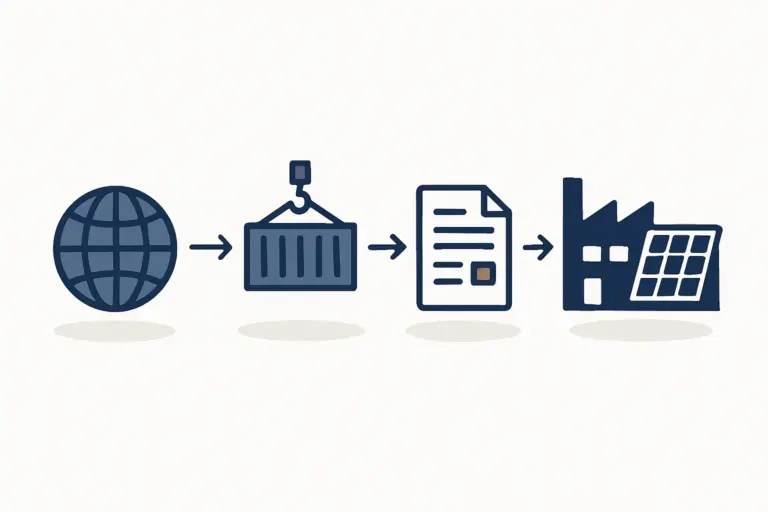
Its location adjacent to the country’s primary deep-water port is a critical logistical advantage. A solar module assembly line depends on the efficient importation of raw materials and components. Proximity to the port simplifies the supply chain, reduces transport costs, and is essential for accessing both domestic and regional export markets.

Understanding the cost and logistics of the necessary solar panel manufacturing machines and equipment is a foundational step in planning any operation. The Pointe-Noire ZES is specifically structured to streamline this process.
Key Fiscal and Customs Incentives for Solar Manufacturers
The primary appeal of the ZES for a new business venture lies in its substantial financial incentives. These benefits are designed to de-risk the initial investment and give the business a long runway to establish itself and become profitable.
Tax Exemptions: The First Decade of Operation
Companies approved to operate within the ZES benefit from a comprehensive set of tax exemptions for their first ten years:
- Corporate Income Tax (IS): Complete exemption from corporate income tax.
- Property Tax: Full exemption from taxes on land and buildings constructed within the zone.
- Value Added Tax (VAT): Total exemption on goods and services purchased within the Congolese domestic market.
Customs Advantages: Streamlining Your Supply Chain
For a solar module manufacturer, customs duties on imported machinery and materials represent a significant portion of the initial capital expenditure. The ZES addresses this directly.
- Duty-Free Imports: All capital goods, equipment, and raw materials needed for production are exempt from customs duties and taxes upon importation. This includes essential machinery like a laminator for solar panel production, as well as recurring material shipments of solar cells, glass, and aluminum frames.
- Simplified Procedures: The ZES operates under a ‘free point’ or ‘free warehouse’ customs regime. This means goods can enter the zone with simplified administrative processes, reducing delays and associated costs.
Long-Term Benefits: Beyond the Initial 10 Years
The favorable conditions extend beyond the first decade. For the following five years (years 11 through 15), the corporate income tax rate is fixed at a reduced 15 percent, offering continued financial predictability.
The Practical Steps: How to Qualify for ZES Status
Accessing these benefits requires a structured application process managed by Congo’s investment promotion agencies.
- Establish a New Legal Entity: The investor must form a new company under Congolese law that will operate exclusively within the ZES.
- Meet Investment and Activity Criteria: The project must meet a minimum investment threshold, typically specified by government decree. The business activity—in this case, manufacturing—must align with the strategic goals of the ZES.
- Submit an Application: A formal application, including a detailed business plan and proof of financial capacity, must be submitted to the Agency for the Promotion of Investments (API-Congo) and the ZES Planning and Development Agency (APDZES).
The approval process grants the company ZES status, making it eligible for the full range of fiscal and customs benefits.
A Realistic Perspective: Business Considerations
While the incentives are compelling, a successful venture requires a holistic view.
- Infrastructure: The ZES is developed with dedicated infrastructure, including reliable power and transport links. However, business plans should account for the logistics of distributing finished products to markets outside the zone.
- Labor and Training: While Congo offers a young and available workforce, implementing a robust training program for local technicians and operators is a critical success factor. A solar module’s quality is directly tied to the skill of its assembly team. Experience from turnkey projects in emerging markets shows that a strong local training program is just as critical as sourcing the right machinery. Planning for a factory’s human resources should be a core part of the initial strategy.
Frequently Asked Questions (FAQ)
What is the primary advantage of the Pointe-Noire ZES for a solar factory?
Its primary advantage is its strategic port location for duty-free imports and exports, combined with the 10-year complete exemption from corporate income tax, customs duties, and property tax.
Are these benefits guaranteed?
Yes, the incentives are legally mandated by Law n°19-2017. Compliance with the terms of the ZES agreement, as submitted in the business plan, is necessary to maintain eligibility.
Can I sell my solar modules within Congo?
Yes, but when goods are moved from the tax-exempt ZES into the domestic Congolese market, they become subject to the country’s standard customs duties and taxes. While the framework is optimized for manufacturing and export, domestic sales are a viable part of the business model.
What level of investment is required?
While the government sets specific minimum investment thresholds for ZES approval, the total capital required depends on the factory’s desired production capacity. Developing a comprehensive solar panel manufacturing business plan is the only way to accurately determine the financial requirements for machinery, buildings, and operational setup.
Conclusion: The Next Step in Your Investment Journey
Congo-Brazzaville’s Special Economic Zones, particularly the one in Pointe-Noire, offer one of the most structured and financially attractive frameworks in Central Africa for establishing a solar module manufacturing facility. The 10-year tax holiday and duty-free import regime are powerful tools that significantly improve a project’s financial viability and shorten its path to profitability.
For entrepreneurs and investors ready to explore this opportunity, the next step is to develop detailed feasibility studies and financial models that incorporate these specific incentives. With careful planning and expert guidance, this framework provides a solid foundation for building a successful industrial venture in Africa’s growing solar energy market.