An investor receives a business plan for a 50 MW solar module factory. With clear equipment costs from Europe and Asia and standard figures for raw materials, he populates the model, calculates the return on investment, and secures initial interest. Yet, six months into the project, the budget is already over by 40%. The reason? His model accounted for the factory, but not for the specific realities of operating it in the Democratic Republic of Congo.
It’s an all-too-common scenario. While international suppliers provide excellent data on capital expenditures (CAPEX), a project’s true viability hinges on its operational expenditures (OPEX)—many of which are intensely local. A financial model that overlooks these DRC-specific costs is not a plan; it’s a hypothesis waiting to be disproven by reality.
This guide outlines the critical, often-underestimated local cost inputs essential for building a realistic and resilient financial model for a solar manufacturing venture in the DRC.
Beyond the Bill of Materials: Why Standard Models Fall Short
A standard financial model provides an excellent starting point—a universal framework for understanding the costs of machinery and materials. But applying it in the DRC requires significant localization. The country’s vast geography, developing infrastructure, and distinct regulatory environment introduce variables absent from models designed for Europe or Asia.
Consider a logistics operation. You can calculate the cost of a truck and its fuel (the CAPEX), but the true cost of the journey depends on the quality of the roads, the number of tolls, the need for security, and time spent at customs checkpoints (the OPEX). Without accounting for the terrain, the budget is incomplete. A solar factory’s success in the DRC hinges on mastering these same on-the-ground operational costs.
Key Local Cost Categories for Your DRC Solar Factory Budget
A robust financial forecast moves beyond international price lists and builds in a granular, bottom-up analysis of local operational expenses. The following categories demand particularly close attention.
Labor Costs: More Than Just Salaries
While wage levels in the DRC may seem advantageous, the total cost of employment extends far beyond an employee’s net salary. A comprehensive budget must include:
-
Skilled vs. Unskilled Labor: Differentiate between assembly line operators and the more highly-trained technicians and engineers required to maintain sophisticated machinery. Securing and retaining skilled technical staff may require a premium compensation package.
-
Statutory Contributions: Factor in mandatory employer contributions to the National Social Security Institute (INSS) and other state funds.
-
Ancillary Benefits: In many professional contexts, employers are expected to provide or subsidize transportation, meals, and basic health coverage. These aren’t optional perks but essential components for attracting a reliable workforce.
-
Training and Development: Given the specialized nature of solar manufacturing, a significant budget for initial and ongoing training is a necessity, not a luxury.
Data from J.v.G. Technology GmbH feasibility studies in the region shows that these mandatory and practical overheads can add 30–50% to base salary figures.
Inland Logistics and Supply Chain Resilience
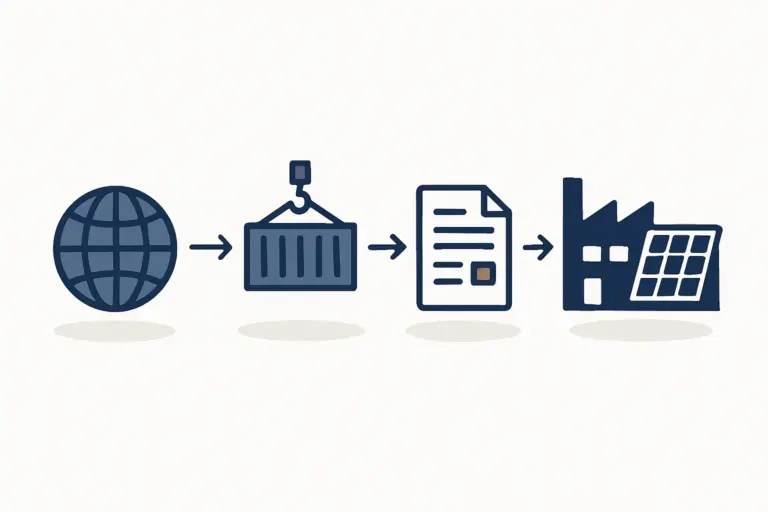
The journey of raw materials and spare parts doesn’t end when a container ship docks at the port of Matadi. The cost and complexity of moving goods inland to cities like Kinshasa, Lubumbashi, or Kisangani represents a major operational hurdle.
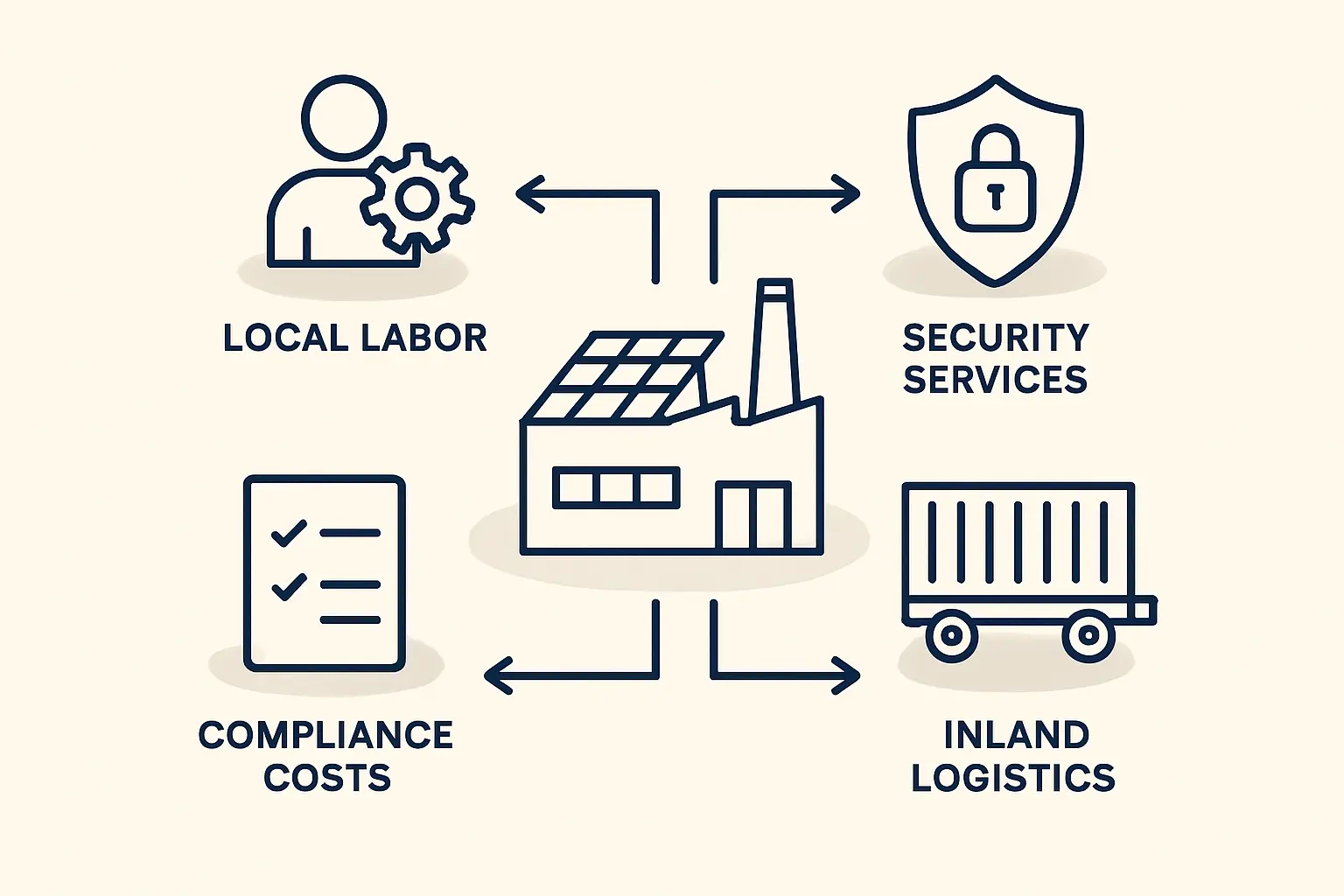
Your financial model must account for:
-
High Inland Freight Costs: The cost per kilometer for road or rail transport within the DRC is substantially higher than international norms due to poor infrastructure and limited competition.
-
Customs and Clearance Delays: Beyond the main port, goods may undergo further checks and administrative processes, leading to delays that impact production schedules.
-
Buffer Stock: To mitigate the risk of supply chain disruptions, a successful factory must maintain a larger-than-usual inventory of critical raw materials (e.g., EVA, backsheets, glass). This ties up working capital and requires adequate, secure warehousing.
A prudent financial model will account for inevitable delays by including a logistics contingency fund of 15-20%. This is especially important for any turnkey solar module manufacturing line where ongoing supply is critical.
Security: A Non-Negotiable Operational Expense
Security is a significant line item in many global business environments, and the DRC is no exception. It should be treated as a core operational cost, just like electricity or water.
-
Facility Protection: A manufacturing plant with millions of dollars in equipment and inventory requires professional, 24/7 security.
-
Cost Components: This includes salaries for guards from a reputable private firm, investment in physical security (perimeter fencing, lighting, access control, surveillance systems), and potentially secure transport for key personnel or valuable shipments.
One client establishing a facility near Goma initially underestimated security, viewing it as an ancillary cost. It ultimately accounted for nearly 8% of his annual operational budget—a figure that, once planned for, made the project both viable and secure.
Energy and Utilities: The Irony of Powering a Solar Factory
The DRC’s energy infrastructure presents a unique challenge. While the country has immense hydropower potential, the grid managed by SNEL is often unreliable, with frequent fluctuations and outages.
For a solar factory requiring stable, continuous power, this means:
-
Mandatory Backup Generation: High-capacity diesel generators are not optional; they are a primary component of the energy system.
-
The True Cost of Power: The budget must include the capital cost of generators, ongoing fuel expenses (which are high, especially inland), fuel storage, and a dedicated maintenance schedule. The effective cost per kilowatt-hour is often three to five times the official grid tariff.
Understanding the specific power consumption of key equipment, such as the solar cell stringer and bussing machine, is critical for sizing backup generators correctly and forecasting fuel usage accurately.
Regulatory Compliance and Administrative Fees
Operating legally in the DRC involves navigating a multi-layered administrative landscape. These costs go far beyond a single business registration fee.
-
Multiple Permits: A factory requires permits from various national and provincial bodies, including the Ministry of Industry, the Ministry of Environment, and local urban planning authorities.
-
Annual Taxes and Levies: The model must account for a range of recurring taxes beyond corporate income tax, such as property taxes, provincial levies, and sector-specific fees.
-
Professional Services: To navigate this complexity, engaging a reputable local legal and accounting firm is essential. Their fees are a necessary investment to ensure compliance and avoid costly penalties or operational interruptions.
Integrating Local Costs into a Robust Financial Model
A credible business plan for the DRC requires a bottom-up approach to OPEX. Instead of applying a generic “overheads” percentage, create specific line items for security, backup power, inland logistics, and local compliance. This level of detail demonstrates a thorough understanding of the operating environment and delivers the kind of well-structured financial projections that serious investors and financial institutions demand.
Frequently Asked Questions (FAQ)
How can I find reliable local salary data for the DRC?
Partnering with established local recruitment agencies, consulting with business chambers like the Fédération des Entreprises du Congo (FEC), and reviewing labor market reports from international organizations are effective starting points.
Is it better to lease or buy the land for the factory?
This decision depends on capital availability and complex local land tenure laws. Leasing can reduce significant upfront capital expenditure, but purchasing may offer greater long-term security. In either case, thorough legal due diligence by a local expert is absolutely essential before making a commitment.
What is a realistic contingency percentage for a project in the DRC?
While every project is different, a contingency fund of 15–25% of the total initial investment is a common and advisable benchmark for new industrial ventures in the DRC. This buffer helps cover unforeseen logistical, administrative, or supply chain challenges.
How does political risk factor into the financial model?
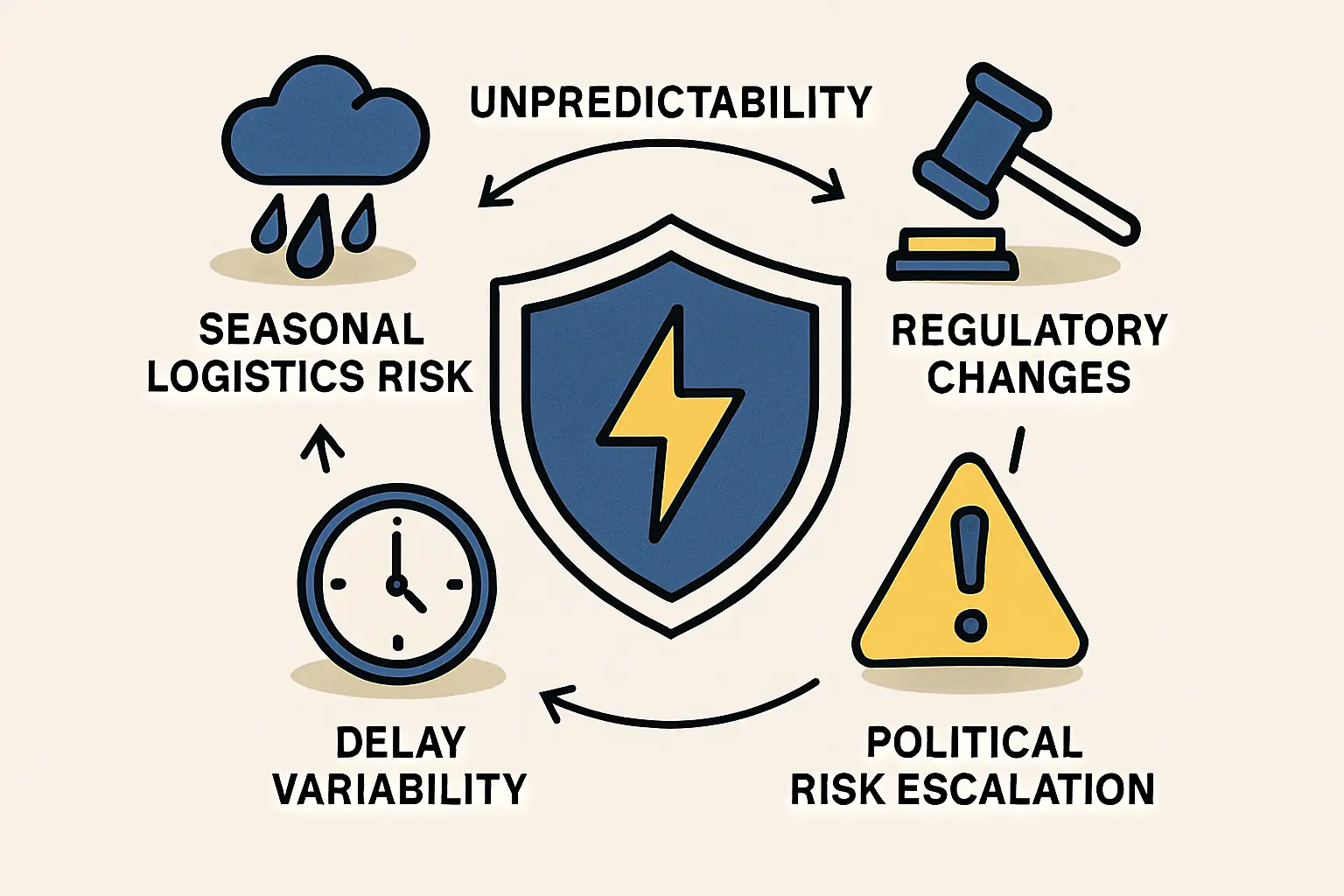
Political risk is typically quantified through higher insurance premiums (specifically, Political Risk Insurance), an increased budget for security, and financial modeling that accounts for potential supply chain disruptions by planning for larger buffer stocks of raw materials.
From Plan to Reality
Success in the DRC’s emerging solar manufacturing sector depends as much on mastering the local operational environment as it does on deploying the latest technology. By building a financial model grounded in the realities of local labor, logistics, security, and compliance, an investor transforms a standard template into a powerful tool for navigating the market with confidence.
For entrepreneurs seeking a structured approach to these complexities, the pvknowhow.com platform provides comprehensive resources and courses designed to bridge the gap between international technical standards and local operational realities. A plan built on this foundation is the first and most critical step toward building a profitable, sustainable enterprise.