Disclaimer: This case study represents a composite example derived from real-world
consulting work by J.v.G. Technology GmbH in solar module production and factory optimization. All data points are realistic but simplified for clarity and educational purposes.
The global solar market offers vast opportunities, yet accessing its most valuable segments, like the United States, is often complicated by trade barriers. For entrepreneurs and investors, particularly in the Middle East and surrounding regions, navigating anti-dumping and countervailing duties (AD/CVD) can be a daunting prospect. However, a long-standing international agreement offers a clear, strategic path for duty-free access to the U.S. market: the U.S.-Jordan Free Trade Agreement (FTA).
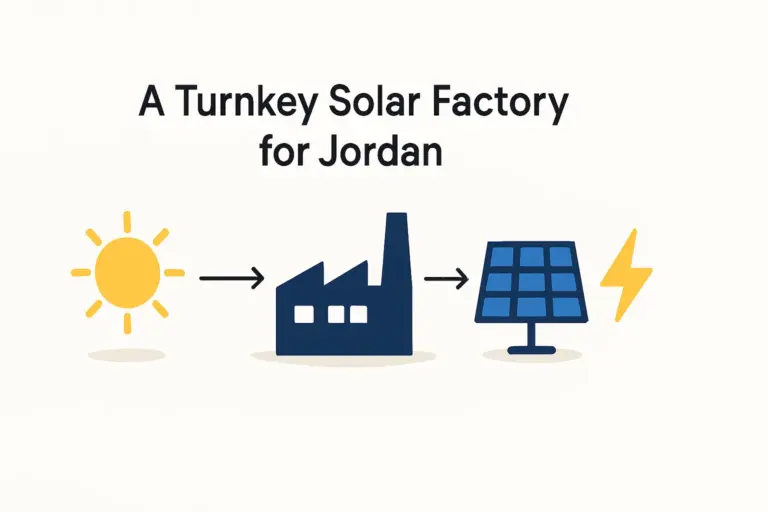
This agreement makes a compelling case for establishing a solar module factory in Jordan specifically to export to North America. It allows manufacturers to bypass the tariffs imposed on solar products from other major production hubs, creating a significant competitive advantage. This article outlines the operational and investment model for such a venture, managed through a turnkey factory setup.
Understanding the Strategic Opportunity
The appeal of a Jordanian manufacturing base lies in a combination of legal frameworks, logistical advantages, and market demand. For business professionals entering the solar industry, understanding these interconnected factors is the first step to capitalizing on this opportunity.
The U.S. Market Challenge: Tariffs and Trade Barriers
The United States remains one of the largest and fastest-growing solar markets in the world. However, to protect domestic manufacturing, it has implemented AD/CVD tariffs on solar cells and modules from several countries, primarily in Southeast Asia.
These tariffs can add a substantial percentage to the final cost of a solar module, making it difficult for many international producers to compete on price. This protectionism creates a high-value opening for producers who can legally access the market without these duties.
Jordan’s Unique Advantage: The Free Trade Agreement
Signed in 2001, the U.S.-Jordan FTA is one of the most comprehensive trade agreements of its kind. A key provision allows qualifying goods produced in Jordan to enter the United States completely duty-free. For solar modules, the primary requirement is the ‘Rule of Origin,’ which mandates that at least 35% of the product’s appraised value must originate from Jordan.
This 35% threshold can be met through:
- The cost of Jordanian labor and manufacturing processes.
- The cost of locally sourced components or materials, if available.
- The overhead and profit attributed to the Jordanian operation.
A well-structured factory operation can comfortably meet this threshold, making the FTA a reliable and powerful tool for market access.
Beyond Tariffs: Jordan’s Logistical and Economic Position
Jordan offers more than just a legal pathway. Its strategic location provides excellent logistical access to ports on the Red Sea, facilitating efficient shipping to North American markets. The country also has a history of political stability in the region, a well-educated workforce, and government incentives for foreign investment, creating a favorable environment for establishing a high-tech manufacturing facility.
The Turnkey Factory Model for FTA Compliance
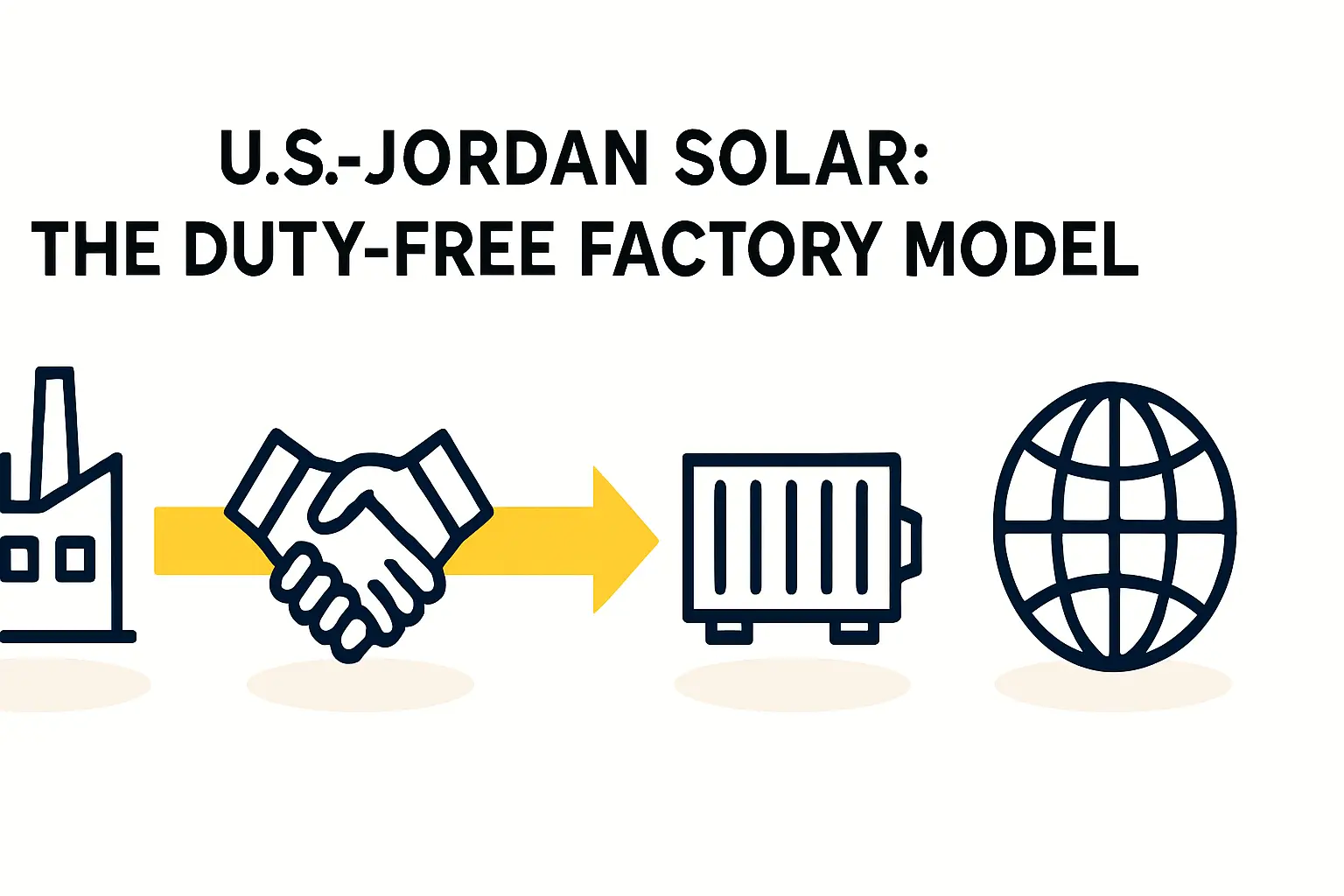
Setting up a factory to meet the specific requirements of both the FTA and the demanding U.S. market requires specialized expertise. A turnkey approach, where a single partner manages the entire project from design to operation, de-risks the investment and accelerates the timeline. Based on experience gained from European PV manufacturers’ turnkey projects, this model is built on three core pillars.
1. Designing a Production Line for UL Certification
Entry into the U.S. market isn’t just about tariffs; it’s also about meeting stringent quality and safety standards. The most critical of these is the UL (Underwriters Laboratories) certification. A production line must be designed from the ground up with equipment, processes, and a Bill of Materials (BOM) that are pre-qualified for UL standards.
A turnkey partner ensures that every component—from the choice of EVA film to the specific brand of junction boxes—is selected to ensure a smooth and successful certification process. Attempting to achieve this without prior experience can lead to costly delays and rework. You can find more details on the typical setup of a turnkey solar production line.
2. Sourcing Strategy: Meeting the 35% Rule of Origin
The factory’s operational plan must be structured to consistently meet the 35% local content requirement. A turnkey consultant develops an optimized financial and sourcing model to achieve this. Since high-value components like solar cells are typically imported, the 35% is met primarily through:
- Labor and Manufacturing Costs: The value added by the factory’s workforce during assembly, testing, and packaging.
- Factory Overhead: A portion of the facility’s operational costs, including utilities, rent, and administrative support.
- Local Sourcing: Utilizing locally produced components where feasible, such as aluminum frames or packaging materials.
This financial engineering is a critical part of the initial business plan and ensures that every shipment qualifies for duty-free status.
3. Navigating Logistics and Documentation
Compliance with the FTA requires meticulous documentation for every shipment. U.S. Customs and Border Protection can audit shipments to verify the 35% Rule of Origin claim. A turnkey solution includes setting up the necessary enterprise resource planning (ERP) systems and administrative processes to automatically generate compliant paperwork, minimizing the risk of customs delays or penalties.
Investment and Operational Framework
For business professionals, understanding the tangible metrics of such a project is crucial. While every project is unique, a typical export-focused factory in Jordan follows a predictable framework.
Typical Investment for a 50-100 MW Export-Focused Factory
A semi-automated production line with an annual capacity of 50 to 100 MW is an ideal starting point for this business model. It offers a balance between capital investment and production volume sufficient to serve U.S. distribution channels.
- Estimated Capital Investment: The total investment for machinery, setup, training, and initial working capital for a 50-100 MW factory typically ranges from $3 million to $5 million USD.
- Factory Footprint: A facility of this size requires approximately 2,500 to 4,000 square meters of industrial space.
These figures represent a well-defined investment case with clear returns, driven by the premium pricing and stable demand in the U.S. market.
Project Timeline: From Planning to First Shipment
With a dedicated turnkey partner, the timeline for establishing a fully operational and certified factory is remarkably efficient.
- Phase 1: Planning & Design (2-3 Months): Finalizing the business plan, factory layout, and equipment specifications.
- Phase 2: Equipment Manufacturing & Logistics (4-5 Months): Production and shipment of the manufacturing line.
- Phase 3: Installation & Commissioning (2-3 Months): Setting up the machinery, training local staff, and producing the first test modules for UL certification.
- Phase 4: Certification & Production Ramp-Up (2-3 Months): Completing the UL certification process and scaling up to full production capacity.
A realistic end-to-end timeline, from initial agreement to the first commercial shipment, is approximately 10 to 12 months. Further details can be found in this guide on the investment for solar panel manufacturing.
Staffing and Training
The operation would typically require around 40 to 60 local employees for production, quality control, and administration. A key component of the turnkey service is providing on-site training for the local workforce. Experienced engineers conduct this training to ensure production quality meets international standards from day one.
Frequently Asked Questions (FAQ)
-
Do I need a technical background in solar to start this business?
No. The turnkey model is specifically designed for business professionals and investors who bring commercial and financial expertise. The technical partner, such as an established European industrial solutions provider, manages all aspects of engineering, certification, and process optimization. -
What are the main business risks involved?
The primary risks are failing to achieve UL certification and not properly documenting the 35% Rule of Origin. Both are directly mitigated by partnering with an experienced turnkey provider who has successfully navigated these processes on multiple continents. -
Is the 35% ‘Rule of Origin’ difficult to calculate and prove?
While the calculation is detailed, it is a standard process. It involves a cost-accounting breakdown of every module produced. A turnkey solution sets up a system to track these costs from the start, making documentation straightforward and auditable. -
How stable is the U.S.-Jordan Free Trade Agreement?
The agreement has been in force for over two decades and enjoys strong bipartisan support in the United States. It is considered one of the most stable and successful FTAs and is not subject to the frequent political reviews that affect other trade policies. -
What is the role of pvknowhow.com and an EU-Based Photovoltaic Manufacturing Solutions Partner in this process?
pvknowhow.com provides educational resources to help investors understand the opportunity. A European PV manufacturing line integrator acts as the turnkey execution partner, delivering the A-to-Z solution: designing the factory, supplying the machinery, managing installation, training staff, and guiding the facility through UL certification to ensure it is ready for export.
The Path Forward
Establishing a solar module factory in Jordan to serve the U.S. market is a highly strategic and financially sound venture. It transforms a significant trade barrier into a unique competitive advantage. By leveraging the U.S.-Jordan FTA and a proven turnkey factory model, investors can enter one of the world’s most lucrative solar markets with a clear, de-risked, and profitable business plan. The key lies not in being a solar expert, but in partnering with one.
Download the U.S.-Jordan FTA Solar Export Case Study (PDF)
Author: This case study was prepared by the
turnkey solar module production specialists at J.V.G. Technology GmbH
It is based on real data and consulting experience from J.v.G. projects
worldwide, including installations ranging from 20 MW to 500 MW capacity.