Disclaimer: This case study represents a composite example derived from real-world
consulting work by J.v.G. Technology GmbH in solar module production and factory optimization. All data points are realistic but simplified for clarity and educational purposes.
Morocco has established itself as a global leader in solar energy, most notably through large-scale concentrated solar power projects like the Noor Ouarzazate complex. Yet the nation faces an equally strategic challenge: water scarcity. With over 140 large dams and reservoirs critical to its agricultural and potable water supply, this presents an opportunity to address both energy and water security at once. This study outlines the feasibility of launching a specialized factory in Morocco dedicated to producing high-durability floating solar (floatovoltaic) modules, designed specifically for the country’s vast reservoir infrastructure.
This approach transforms water reservoirs from single-use assets into dual-purpose power plants, while also conserving the vital resource they contain.
The Strategic Case for Floating Solar in Morocco
Floating solar installations offer compelling advantages that align directly with Morocco’s national priorities. Beyond generating clean electricity, they mitigate the effects of evaporation—a significant concern in an arid climate. By covering a portion of a reservoir’s surface, these plants can reduce water loss by up to 80% in the covered area.
The operational benefits are also substantial:
- Increased Efficiency: Water provides a natural cooling effect on the solar modules, increasing their energy yield by 8–10% compared to identical land-based installations.
- Land Preservation: In a country where arable land is a precious commodity, floatovoltaics eliminate the land-use conflict between agriculture and energy production.
- Existing Infrastructure: The proximity of reservoirs to existing grid infrastructure, managed by the Office National de l’Electricité et de l’Eau Potable (ONEE), can reduce transmission costs and complexity.
The Technical Imperative: Why Standard Solar Modules Are Not Sufficient
An aquatic environment presents a far harsher operating reality than a terrestrial one. Standard solar modules, designed for rooftops or ground-mounted arrays, are ill-equipped to handle the relentless humidity, corrosion, and unique electrical stresses of a floating installation. Deploying a standard product in such an environment is a business risk that often results in premature failure.
Key Failure Points for Standard Modules in Water Environments
- Potential-Induced Degradation (PID): Constant high humidity accelerates PID, a phenomenon where voltage potential differences cause power loss. This can degrade module output far faster than specified in standard warranties.
- Corrosion: Moisture, combined with potential salinity or high mineral content in the water, can corrode module frames, junction boxes, and electrical connections, compromising both safety and performance.
- Encapsulant & Sealant Failure: The materials used to laminate and seal standard modules, typically EVA (Ethylene Vinyl Acetate), can be susceptible to moisture ingress over time, leading to delamination and internal cell corrosion.
The Engineering Solution: Purpose-Built Floatovoltaic Modules
A specialized factory would produce floatovoltaic modules engineered to overcome these challenges. The core of this solution is a more robust and resilient product.
- Double-Glass Construction: Using glass on both the front and back of the module (glass-glass) creates a superior seal against moisture, making it virtually impervious to humidity. This is a primary defense against PID and delamination.
- Advanced Encapsulants: Using Polyolefin Elastomer (POE) instead of EVA provides significantly lower water vapor transmission rates and higher resistance to degradation, ensuring the solar cells remain protected for decades.
- IP68-Rated Components: Junction boxes and connectors must be rated IP68, guaranteeing complete protection against dust and long-term immersion in water.
- Corrosion-Resistant Framing: Anodized aluminum or specialized coatings for the frames ensures structural integrity over a 30-year lifespan in a wet environment.
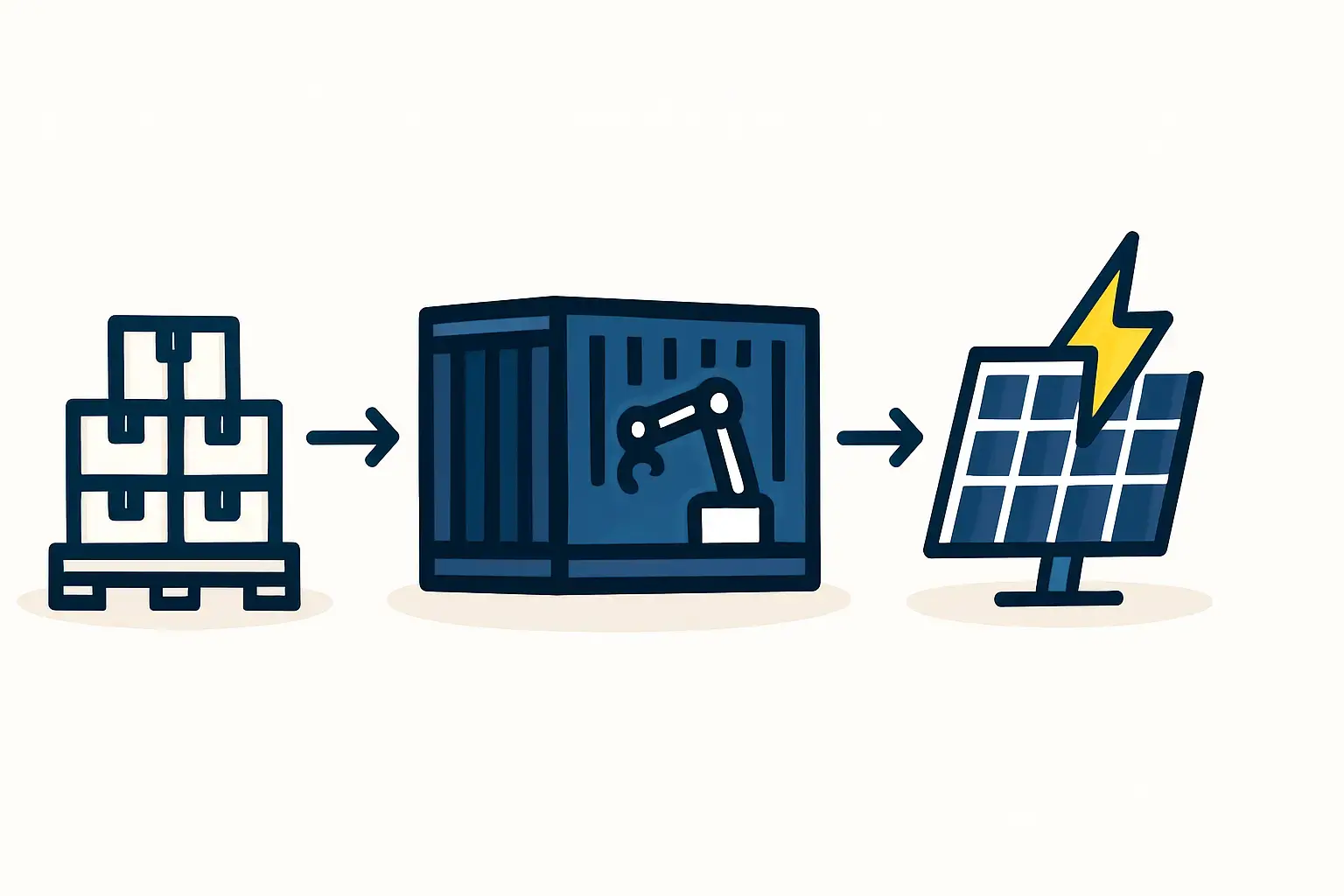
A complete overview of the solar panel manufacturing process provides context for where these specializations fit into the production line.
Blueprint for a Specialized 100 MW Floatovoltaic Factory
Establishing a local manufacturing facility tailored to these specifications is a viable business venture. Drawing on experience gained from European PV manufacturers’ turnkey projects, a semi-automated 100 MW production line offers a balanced entry point for a market like Morocco.
Investment and Infrastructure
The initial investment is manageable for established entrepreneurs or public-private partnerships.
- Estimated Capital Investment: Approximately $6–8 million USD for a semi-automated 100 MW line. A complete overview of the investment costs for solar manufacturing can provide a more detailed breakdown.
- Building Requirements: A factory floor of around 4,000 square meters is sufficient to house the production line, warehousing for raw materials, and finished goods storage.
- Location: Proximity to a major industrial port like Casablanca or Tangier Med would be advantageous for sourcing specialized raw materials not available locally.
Specialized Machinery and Production Flow
While the core process resembles standard module manufacturing, key machinery must be selected to handle the more robust materials.
- Laminator: Must be capable of handling heavier double-glass modules and optimized for the higher curing temperatures required for POE encapsulants.
- Automated Bussing & Stringing: High-precision stringers are essential for ensuring cell integrity, especially when producing high-efficiency modules.
- Framing Station: The station must accommodate robust, corrosion-resistant frames and apply sealants with exceptional precision.
For entrepreneurs new to the industry, exploring a turnkey solar panel production line ensures that all machinery is correctly specified and integrated from the start.
Workforce and Technical Expertise
A 100 MW facility can create significant local employment.
- Total Staff: Approximately 50–70 employees across two shifts, including operators, technicians, and administrative staff.
- Key Roles: The most critical hires are the Quality Control Manager and the Head of Production. These roles require a strong technical background to ensure every module meets the stringent durability standards required for floatovoltaic applications. To help train key personnel for these positions, pvknowhow.com provides structured e-courses.
Market Opportunity and Business Case
The primary offtaker for these specialized modules would be Morocco’s national and regional authorities responsible for water and power. Establishing a local factory positions the business as a strategic national partner, offering a domestically produced, high-reliability solution for critical infrastructure projects.
This “Made in Morocco” approach not only supports industrial development but also provides the government with greater supply chain security for its renewable energy ambitions. The business case is built not on competing for the lowest price per watt, but on delivering the lowest Levelized Cost of Energy (LCOE) over the project’s lifetime through superior reliability and longevity.
Frequently Asked Questions
What is the main difference between a standard and a floating solar module?
The primary difference lies in durability and moisture resistance. A floating module uses materials like double-glass construction and POE encapsulant to provide a near-hermetic seal against constant humidity—the main cause of failure for standard modules in aquatic environments.
Can a standard module factory be retrofitted to produce floatovoltaic modules?
It is possible, but it requires significant investment in key machinery, particularly the laminator and framing station. It is often more cost-effective to design the factory for double-glass and POE production from the outset. Learning how to start a solar module factory with the end product in mind is the most efficient path.
What are the essential certifications for floatovoltaic modules?
In addition to standard certifications like IEC 61215 and IEC 61730, modules for floating applications should undergo extended damp-heat testing and demonstrate high resistance to PID (Potential-Induced Degradation), often verified by TÜV Rheinland or similar independent bodies.
How long does it typically take to set up such a factory?
From initial planning to the first certified module coming off the line, a timeline of 10–14 months is realistic. This includes site preparation, machinery procurement and installation, staff hiring and training, and product certification.
Is the supply chain for specialized materials like POE readily available?
While POE is a more specialized material than EVA, it is available from several major global suppliers. Establishing a reliable supply chain is a critical step in the initial business planning phase. A local factory could also stimulate domestic production of other components, such as frames and glass.
Download the Morocco Floating Solar Factory Case Study (PDF)
Author: This case study was prepared by the
turnkey solar module production specialists at J.V.G. Technology GmbH
It is based on real data and consulting experience from J.v.G. projects
worldwide, including installations ranging from 20 MW to 500 MW capacity.