Many entrepreneurs exploring solar manufacturing are drawn to regions offering compelling financial incentives and low operational costs. Paraguay, with its Maquila regime offering significant tax advantages and an abundance of clean energy, is a prime example.
However, its landlocked geography often raises a critical question for investors: Is it feasible to manage a global supply chain for a sophisticated manufacturing operation from the heart of South America?
The key is strategic planning. While a landlocked position presents distinct logistical challenges, it is far from an insurmountable barrier. With a clear understanding of available corridors, transport modes, and regulatory frameworks, a Paraguayan solar factory can be efficiently integrated into global supply chains.
This article examines the practical strategies for sourcing machinery and raw materials and exporting finished solar modules from a landlocked base.
The Landlocked Challenge: A Strategic Overview
For a solar module manufacturer, logistics are twofold: inbound for sourcing equipment and materials, and outbound for shipping finished products to market. A landlocked country like Paraguay relies entirely on the road, river, and port infrastructure of its neighbors—primarily Brazil, Argentina, and Uruguay.
Success, therefore, hinges on transforming this potential vulnerability into a calculated strength. This involves:
- Diversifying Routes: Relying on a single corridor creates unnecessary risk. A robust logistical plan must include primary and secondary options for both imports and exports.
- Optimizing Transport Modes: Balancing the speed and cost of road freight against the volume and economy of river barges is essential.
- Leveraging Trade Agreements: Paraguay’s membership in Mercosur provides tariff-free access to a regional market of over 260 million people, a significant advantage for finished goods.
Inbound Logistics: Sourcing Machinery and Raw Materials
The initial, most critical logistical operation is the delivery of the factory itself—the complete set of solar panel manufacturing equipment. This machinery, along with raw materials like solar glass, EVA foil, and aluminum frames, is typically sourced from Asia or Europe and must traverse an ocean before beginning its overland journey.
Key Import Corridors
Two primary corridors serve as the lifeline for a Paraguayan solar factory.
1. The Atlantic Route via Brazil
The most common route involves ocean freight to a major Brazilian port, with the Port of Paranaguá being a frequent choice due to its relative proximity and efficiency. From Paranaguá, goods are loaded onto trucks for the final 600–700 km journey to manufacturing hubs in Paraguay, such as Ciudad del Este. While road transport is faster, it can be more expensive and subject to road conditions and border congestion.

2. The Paraná-Paraguay Waterway
This extensive river system offers a cost-effective alternative for bulk materials and containerized cargo. Goods arrive at ports in Uruguay (Montevideo) or Argentina (Buenos Aires) and are transferred to river barges for the journey upriver to Paraguayan river ports like Asunción or Villeta.
While significantly slower than trucking (a river journey can take weeks), the waterway is often more economical for heavy, non-urgent shipments. Based on experience from J.v.G. turnkey projects, a combination is often optimal: time-sensitive machinery via the faster road corridor and bulk raw materials via the more economical waterway.

Customs and the Maquila Regime
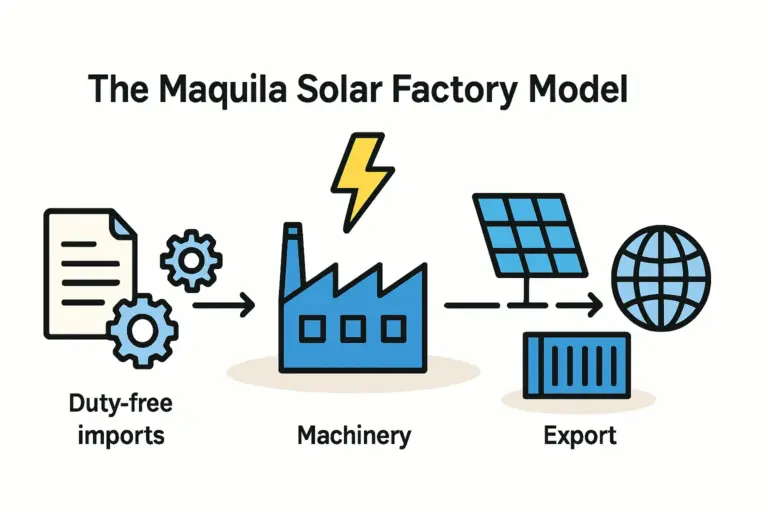
Paraguay’s Maquila program is a powerful enabler for manufacturing logistics. Under this regime, companies can import capital goods, machinery, and raw materials tax-free, provided the finished products are primarily for export. This dramatically simplifies the financial side of importation, but it also reinforces the need for meticulous customs documentation and reliable local customs brokers to ensure smooth clearance at the border.
Outbound Logistics: Exporting Finished Solar Modules
Once production is underway, the logistical focus shifts to delivering finished solar panels to customers, a strategy dictated by the target market.
Targeting Regional and Global Markets
For sales within the Mercosur bloc (Brazil, Argentina, Uruguay), road transport is the most direct and logical method. The absence of import tariffs within the bloc makes Paraguayan-made modules highly competitive.
For markets in North America, Europe, or other parts of the world, finished goods must travel back out through the same corridors used for imports. The choice of export port is a critical decision that impacts cost, transit time, and reliability.
The selection involves a trade-off:
- Port of Paranaguá (Brazil): Often faster for reaching North American and European markets but can face congestion.
- Port of Montevideo (Uruguay): Known for being a stable and efficient free-trade port, making it a reliable, though sometimes longer, option.
- Port of Buenos Aires (Argentina): A major hub, but its operational efficiency can be subject to local economic and political factors.

The Future: The Bioceanic Corridor
A transformative infrastructure project, the Bioceanic Corridor, is currently under construction. This roadway will connect Brazil’s Atlantic coast with ports in Chile on the Pacific coast, passing directly through the Paraguayan Chaco region.
Once complete, it will provide Paraguayan manufacturers with unprecedented access to Asian markets, significantly reducing shipping times and costs compared to the Panama Canal route. For investors currently setting up a solar panel production line, this future development represents a major strategic opportunity.
A Practical Perspective from a Turnkey Provider
Establishing and managing these complex supply chains requires deep local knowledge. Insights from J.v.G. Technology’s turnkey factory projects in Paraguay underscore the importance of meticulous planning.
A common challenge is coordinating multimodal transport—ensuring that a container arriving by sea is met promptly by the correct truck or barge, with all customs paperwork pre-cleared to avoid costly delays and demurrage fees at the port. A comprehensive solar panel manufacturing business plan must, therefore, include a detailed logistics chapter with vetted transport partners, customs agents, and contingency plans for each stage of the journey.
Frequently Asked Questions (FAQ)
How long does it typically take to ship manufacturing equipment to a factory in Paraguay?
From a port in Asia or Europe, the entire journey can take 60 to 90 days. This includes 30–45 days of ocean freight, plus one to two weeks for port clearance and inland transport via road or waterway. Delays at ports or customs can extend this timeline.
Are there hidden logistical costs an investor should be aware of?
Yes. Beyond freight charges, a budget should account for port fees, customs brokerage fees, demurrage (if cargo is not cleared on time), container detention, and comprehensive inland freight insurance to cover goods during road or river transit.
Is river transport on the Paraná-Paraguay Waterway reliable year-round?
For the most part, yes. However, in years of extreme drought, water levels can fall, occasionally restricting the passage of fully laden barges in certain sections. A sound logistical plan should include alternative road transport options as a contingency.
How does the Maquila regime affect the logistics paperwork?
The Maquila regime greatly simplifies the tax and duty component of imports. However, it requires precise documentation to prove that the imported goods are for a registered Maquila factory and that the finished products will be exported. While the regime streamlines the financial process, it heightens the need for accuracy in all customs declarations.
From Landlocked to Land-Linked: A Strategic Advantage
Paraguay’s landlocked status presents a logistical puzzle that demands careful consideration. Yet, with its robust river network, improving road infrastructure, and strategic trade agreements, the country is more accurately described as ‘land-linked.’
For the informed investor, these logistical pathways are not obstacles but rather manageable components of a business plan. By carefully selecting transport corridors, leveraging the benefits of the Maquila regime, and partnering with experienced local logistics providers, a solar manufacturing facility in Paraguay can operate efficiently and compete effectively on a global scale.