When considering a new manufacturing venture, an investor’s first questions often turn to capital or technology. Experience shows, however, that the most critical factor for long-term success is the local workforce.
For a solar module factory in the Kingdom of Tonga, a thorough assessment of the labor market is not just a preliminary step—it is the foundation of a sustainable business plan. This analysis explores the skills, costs, and training strategies for building a technical team in Tonga.
The Economic and Demographic Landscape of Tonga
To understand the labor potential, one must first appreciate the national context. Tonga’s economy is largely based on remittances from its significant diaspora, alongside agriculture and tourism. With a population of approximately 100,000, the available labor force is around 35,000.
A key challenge for the nation is its youth unemployment rate, which hovers around 11.3%. While this figure represents an economic hurdle for the country, it also creates an opportunity for new industries. This creates a pool of young, motivated individuals seeking stable employment.
Perhaps the most compelling statistic for any technology-focused enterprise is Tonga’s literacy rate, which is exceptionally high at over 99%. This indicates a population with a strong educational foundation, capable of absorbing new technical information and adhering to complex procedures—a crucial prerequisite for high-quality manufacturing.
Evaluating Existing Technical Skills for Solar Assembly
A common misconception is that a solar panel factory requires a workforce of highly specialized engineers. The reality is that the majority of roles involve precise, process-driven assembly tasks. Ideal candidates are not necessarily those with prior solar experience, but rather individuals who are trainable, detail-oriented, and have good manual dexterity.
The Tongan workforce already has a solid base of relevant, transferable skills. The country has a well-established community of tradesmen, including:
- Electricians
- Mechanics
- Construction workers
- Artisans skilled in detailed craftwork
These professions cultivate the very skills needed for solar module assembly: an understanding of electrical basics, experience with tools, and a methodical approach to complex tasks. This existing skill base significantly reduces the learning curve and provides a strong foundation upon which to build a specialized solar training program.

Labor Costs and Business Implications
Understanding operational costs is, of course, paramount for any business venture. In Tonga, the minimum wage ranges from approximately TOP 2.00 to TOP 3.50 per hour (roughly USD 0.85 to USD 1.50).
Ready to make big Profits?
The solar Industry is Booming
WE HELP NEWCOMERS to the solar industry start their own solar module production line. Customers can make BIG PROFITS by selling modules and finding investors, without wasting money and time on things they don't need!
This competitive labor cost structure enables a profitable manufacturing operation, even at a smaller scale of 20–50 MW per year. This allows a business to allocate a greater portion of its budget to comprehensive training and high-quality raw materials—the true drivers of product excellence and long-term brand reputation. This strategic allocation is a key differentiator between factories that merely produce and those that succeed.
Designing an Effective Training Program for Local Technicians
A structured and intensive training program is the key to transitioning workers from general technical skills to specialized solar manufacturing proficiency. A successful program does not happen by chance; it must be meticulously designed and executed.
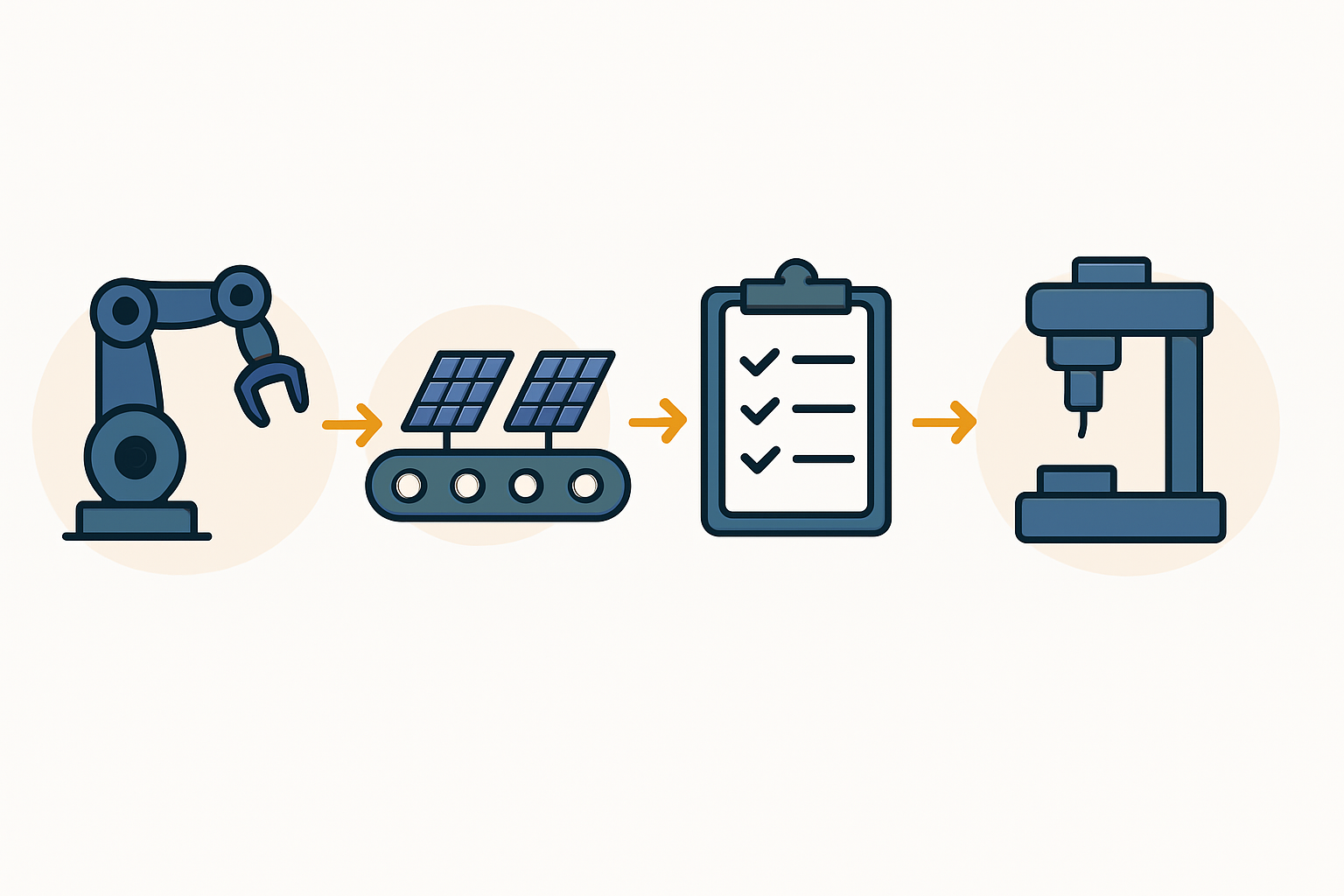
Based on experience from J.v.G. turnkey projects, a comprehensive training curriculum focuses on the core stages of the solar panel manufacturing process. Key modules include:
- Cell Handling and Stringing: Training employees to handle fragile solar cells and operate semi-automated stringer machines.
- Layup and Bussing: Teaching the precise layering of materials (glass, EVA, cells, backsheet) before lamination.
- Lamination and Curing: Operating the laminator, a critical piece of equipment that requires strict adherence to time and temperature protocols.
- Framing and Junction Box Installation: The final assembly steps that require both precision and efficiency.
- Quality Control and Electroluminescence (EL) Testing: Training staff to identify microcracks, soldering defects, and other anomalies using specialized testing equipment is arguably the most critical skill. Effective quality control in solar manufacturing is non-negotiable for producing bankable, certified modules.
Institutions like the Tonga Institute of Science and Technology (TIST) and the Tonga National University (TNU) provide a strong foundation in vocational skills. A partnership with these institutions can create a pipeline of pre-vetted candidates, further streamlining the recruitment and training process. Typically, experienced engineers deliver the hands-on training for a new team as an integral part of commissioning a turnkey solar manufacturing line.
Cultural Considerations for Management and Operations
Technical training alone, however, is not enough. Successful management in Tonga, as in any cultural context, requires an approach that respects local customs. Tongan society is characterized by strong community ties and a well-defined social hierarchy.
An effective management style is collaborative, respectful, and emphasizes the team’s collective success. Investing time in building personal relationships and understanding local communication norms will yield significant returns in employee loyalty, motivation, and overall operational harmony.
Frequently Asked Questions
Do we need to hire experienced solar engineers from abroad?
For core assembly and operator roles, the focus should be on training the local Tongan workforce. It is standard practice, however, to bring in one or two experienced expatriate engineers for initial management, process optimization, and to lead the ongoing training of local supervisors.
What is the typical duration of a training program?
An intensive, hands-on training program for line operators typically lasts between four to six weeks. This is followed by a period of supervised production for several months to ensure processes are stable and quality standards are consistently met.
How does the Tongan government support new renewable energy industries?
The government’s Tonga Energy Road Map (TERM), which aims for 70% renewable energy generation by 2030, demonstrates strong policy support for the sector. This creates a favorable environment for investment and signals long-term domestic demand for solar products.
From Potential to Production: Next Steps
The Tongan labor market presents a compelling case for establishing a solar module manufacturing facility. A literate, trainable population with a foundation in relevant technical skills, combined with a competitive wage structure, creates a solid platform for success.
The critical variable is not the pre-existing skill of the workforce, but the quality and structure of the training program itself. With the right approach to skill development and management, a Tongan solar factory can produce world-class modules while creating valuable local employment.