An entrepreneur in Tashkent watches as large-scale solar farms, driven by international firms like Masdar and ACWA Power, spring up across the country. He sees a clear opportunity—not in building power plants, but in supplying them. This raises a crucial question: ‘With a government push for local industry, what does it take to establish a solar panel assembly line here, and where would the raw materials come from?’
The answer is far from simple. While assembling solar modules is a feasible industrial venture, its success hinges on a robust and reliable supply chain. For any entrepreneur entering this sector in Uzbekistan, understanding the logistics of sourcing raw materials is the first critical step. This guide provides a clear overview of the key components required, explores the strategic choice between local and international sourcing, and outlines what it takes to build a resilient supply chain in the heart of Central Asia.
Uzbekistan’s Solar Ambition: The Foundation for a New Industry
The Uzbek government has set an ambitious target: to generate 25% of its electricity from renewable sources by 2030, which includes installing 8 GW of solar power. This national strategy has created a powerful demand signal for solar modules, attracting billions in foreign investment for utility-scale projects.
This top-down push for solar energy creates fertile ground for a domestic manufacturing ecosystem. However, a local assembly plant is only as strong as its access to high-quality, cost-effective raw materials. An entrepreneur’s success will depend on navigating the complexities of sourcing these components.
Deconstructing a Solar Module: The Bill of Materials
A modern photovoltaic (PV) module is a sophisticated product assembled from several layers of specialized materials. Each component plays a critical role in the panel’s performance, durability, and safety. Understanding this ‘bill of materials’ is essential before developing a sourcing strategy.
Critical High-Tech Components (Primarily Imported)
Certain components require immense economies of scale and advanced chemical or electronic engineering, which makes international sourcing the only viable option for a new assembly plant.
Solar Cells: These are the ‘engines’ of the solar panel, converting sunlight into electricity. The global market is dominated by a handful of large-scale manufacturers, primarily in China and Southeast Asia. For a new venture in Uzbekistan, importing high-efficiency solar cells is standard practice.
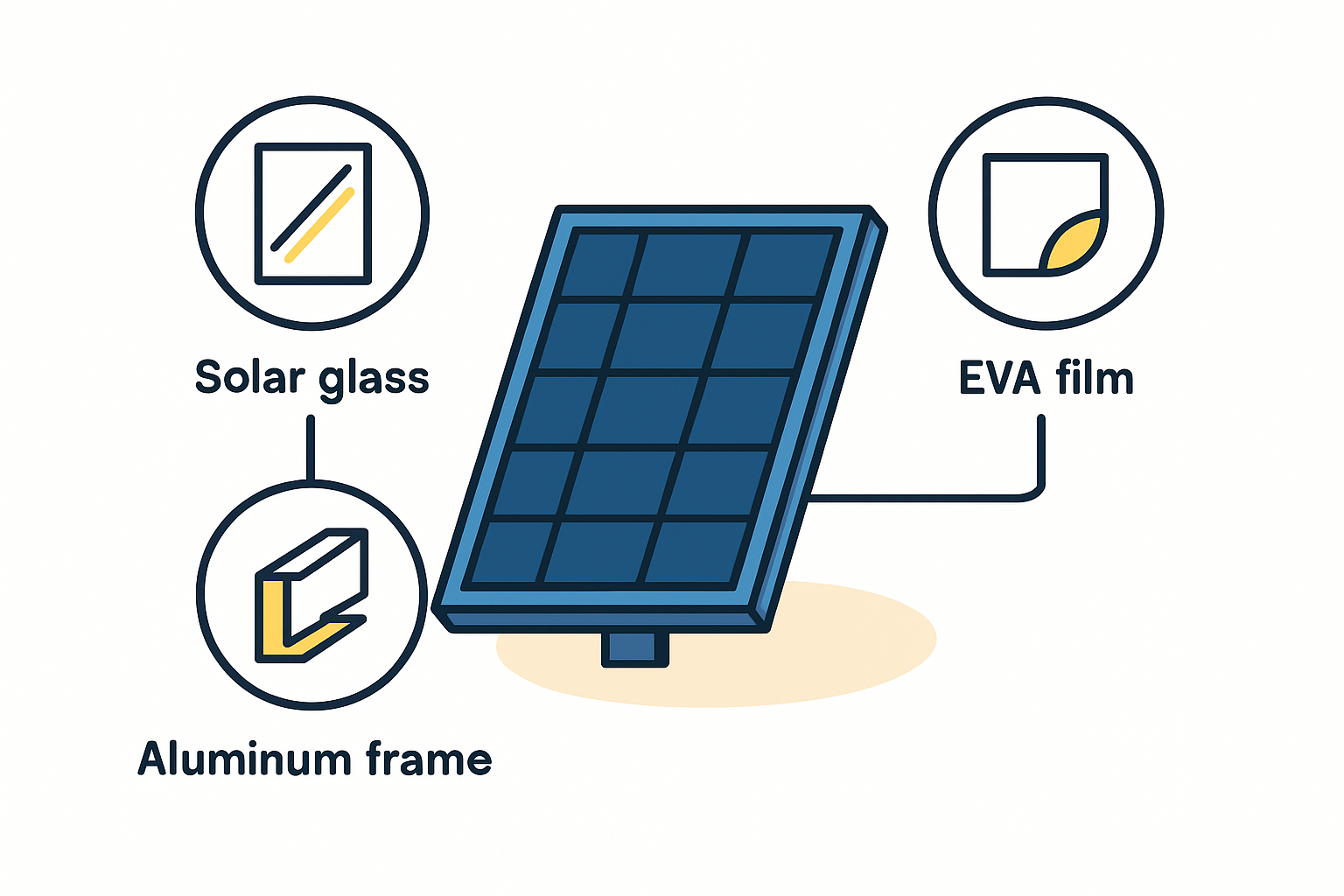
Encapsulant Film (EVA/POE): This specialized polymer film (Ethylene-vinyl Acetate or Polyolefin Elastomer) laminates the solar cells, protecting them from moisture, vibration, and thermal stress for over 25 years. Its quality is non-negotiable for panel longevity. Major producers are concentrated in China, South Korea, and Japan.
Solar Glass & Backsheet: The front glass must be a low-iron, high-transparency, tempered material designed to maximize light transmission while withstanding harsh weather. The backsheet is a multi-layered polymer film that provides electrical insulation and mechanical protection. Both are specialized products sourced from established international suppliers.
Components with Localization Potential
Other components are based on more conventional industrial processes, creating a realistic opportunity for local or regional sourcing.
Ready to make big Profits?
The solar Industry is Booming
WE HELP NEWCOMERS to the solar industry start their own solar module production line. Customers can make BIG PROFITS by selling modules and finding investors, without wasting money and time on things they don't need!
Aluminum Frames: These frames provide structural integrity to the module. The manufacturing process, aluminum extrusion, is a mature technology. While Uzbekistan has an aluminum industry, a new solar manufacturer will need to ensure local suppliers can meet the precise dimensional tolerances and quality standards required for automated assembly.
Junction Boxes & Cables: The junction box houses the bypass diodes and connects the module to the rest of the solar array. While the electronic components inside are often imported, the plastic housing and assembly could potentially be sourced or performed locally.
Based on experience from J.v.G. turnkey projects, securing a reliable and cost-effective supply of solar cells and EVA film is often the first and most significant logistical hurdle a new manufacturer must clear.
Building Your Supply Chain: Local Sourcing vs. International Imports
The central strategic decision for any new solar assembly business in Uzbekistan is balancing imported components with the development of a local supply chain. Each approach has distinct advantages and disadvantages.
The Case for International Imports
For critical components, importing is less a choice than a necessity. The established global supply chain offers quality, reliability, and scale that cannot be replicated locally in the short term. The advantages are clear: access to certified, high-performance components from world-leading manufacturers, plus the cost benefits of their massive production scale.
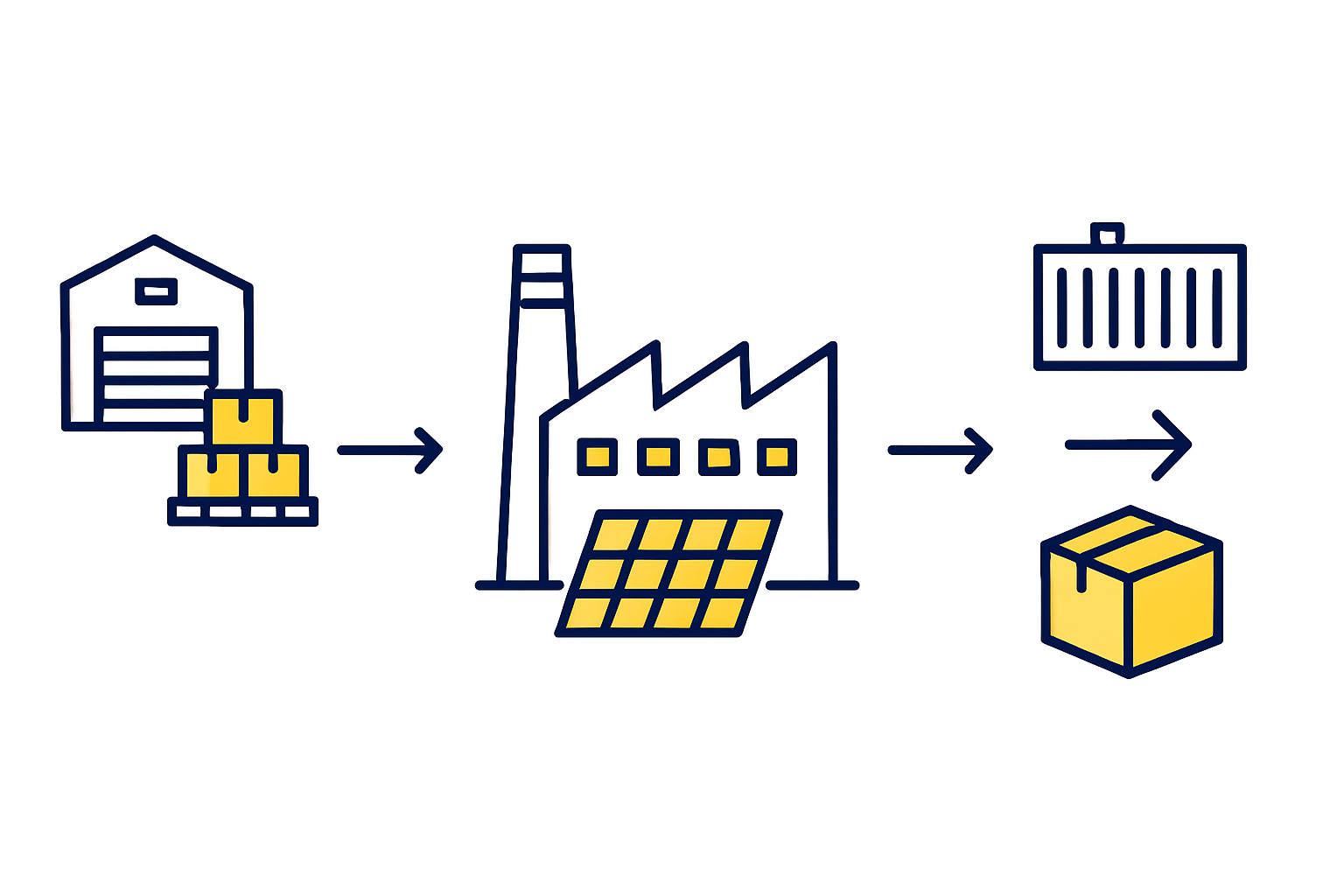
However, the disadvantages are equally significant. Logistics are long and complex—involving sea, rail, or road freight—leading to longer lead times and exposure to currency fluctuations. This approach also requires significant working capital to fund inventory in transit and in the warehouse, and navigating customs clearance can present additional challenges.
The primary sourcing channel for cells, glass, and specialized films is China, with logistics flowing through the China-Kyrgyzstan-Uzbekistan road corridor or via rail. For high-quality aluminum frames, Turkey is a strong and geographically closer alternative.
The Opportunity in Local Sourcing
The Uzbek government’s ‘Made in Uzbekistan’ initiative provides a strong incentive to develop local suppliers. While sourcing all components locally from day one is not feasible, a phased approach can yield significant benefits. The main advantages include reduced transportation costs, shorter lead times, and less capital tied up in inventory. Local sourcing also offers the potential for government support and a stronger position when supplying state-funded projects.
The primary drawbacks, however, are a limited pool of qualified local suppliers for solar-grade materials and the risk of inconsistent quality that can compromise the final product’s performance and bankability. A substantial investment in supplier qualification and quality control is therefore essential.
A prudent strategy is to begin by importing all critical materials while simultaneously partnering with local companies, such as an aluminum extruder, to develop and qualify components like frames that meet international standards. This dual approach mitigates risk while building a long-term competitive advantage—a strategy particularly well-suited to regions like Uzbekistan where high solar irradiation coincides with developing industrial capabilities.
Key Considerations for Your Business Plan
A successful sourcing strategy must be deeply integrated into the overall business model, directly impacting financing, operations, and market positioning.
Quality Control and Supplier Vetting
The long-term reputation of a solar module brand rests on its field performance over decades. Sourcing components from a new supplier without rigorous vetting and batch testing invites significant risk. A single bad batch of EVA, for instance, can lead to widespread delamination and costly warranty claims years after installation.
Logistics and Working Capital
Importing materials from Asia means planning for lead times that can stretch for several months. This ties up a significant amount of cash as working capital to finance materials in transit and maintain a safety stock. A comprehensive business plan for solar panel manufacturing must accurately forecast these financial requirements.
The Role of Technology and Automation
The choice of raw materials is directly linked to the production equipment. For example, selecting larger M10 or G12 solar cells requires solar panel manufacturing machines specifically designed to handle those formats. The sourcing plan and the factory equipment plan must be developed in parallel.
A thorough feasibility study is essential to map out a reliable and cost-effective supply chain before committing significant capital. Such studies analyze supplier options, logistics costs, and quality control requirements to form a bankable plan.
Frequently Asked Questions (FAQ)
Can I source everything from one country, like China?
While China is the dominant global supplier for most PV components, diversifying the supply chain is a wise risk management strategy. For instance, sourcing aluminum frames from a regional partner in Turkey could reduce shipping costs, shorten lead times, and provide an alternative should primary supply lines be disrupted.
How much working capital is needed for raw materials?
This is highly dependent on production volume, supplier payment terms, and shipping times. As a general rule, a new manufacturer should plan to hold two to three months’ worth of key imported materials in inventory. This can represent a substantial portion of the initial operational investment.
What is the biggest mistake new manufacturers make in sourcing?
The most common and damaging mistake is prioritizing the lowest price over verified, consistent quality. Using substandard encapsulants, backsheets, or junction boxes can lead to premature panel failure in the field, resulting in catastrophic warranty claims and irreparably damaging a new company’s brand and reputation.
Is it realistic to aim for 100% local sourcing in Uzbekistan?
In the short to medium term, this is not realistic for high-technology components like solar cells and specialized polymer films. A more practical and successful strategy is progressive localization: starting with components like frames, cables, and packaging while systematically working to develop and qualify local suppliers for more complex materials over time.
Next Steps in Your Manufacturing Journey
Entering the solar module assembly industry in Uzbekistan is a compelling business opportunity, backed by strong national demand. But success isn’t guaranteed. It is built on a foundation of strategic planning, with a well-researched and resilient supply chain strategy at its core.
The journey from concept to a fully operational factory is complex. For those ready to explore this path further, the logical next step is to gain a deeper understanding of the entire process. A structured overview of how to start a solar panel manufacturing business provides the comprehensive framework needed to turn entrepreneurial ambition into a viable industrial enterprise.