Designing for Resilience: Solar Factory and Module Specifications for Cyclone-Prone Regions
The Kingdom of Tonga, an archipelago of immense natural beauty, faces a significant energy paradox. With abundant sunshine, it has the potential to be a leader in renewable energy. Yet, this potential is tested by its location in the South Pacific cyclone belt.
For any entrepreneur considering the Tongan solar market, the devastating impact of Cyclone Gita in 2018—with wind speeds exceeding 177 km/h—is a stark reminder: in this environment, standard solutions are destined to fail.
Success in such a market is not merely about manufacturing solar panels; it is about engineering resilience. This requires a dual focus that begins long before the first solar cell is handled, starting with the very design of the factory and extending to the detailed specifications of every module produced within it. This article outlines the essential engineering and business considerations for establishing a durable solar manufacturing operation in a cyclone-prone region.
The Tongan Context: Opportunity Meets Environmental Challenge
Understanding the local conditions is the first principle of sound investment. In Tonga, the business case for solar energy is compelling, driven by a clear need and strong government support. However, this opportunity is inseparable from the region’s environmental risks.
According to data from the International Renewable Energy Agency (IRENA) and the World Bank, Tonga’s energy landscape is shaped by two key realities:
-
High Dependency on Fossil Fuels: The nation relies on imported diesel for approximately 97% of its electricity generation, creating economic vulnerability and high energy costs for its citizens and businesses.
-
Ambitious Renewable Energy Targets: The Tongan government has set a goal to achieve 70% of its electricity generation from renewable sources by 2030, signaling strong political will and creating predictable demand for solar infrastructure.
This clear market opportunity, however, exists under the constant threat of tropical cyclones. A solar manufacturing investment that cannot withstand these events is simply not viable. The factory, the equipment, and the final products must all be designed with survival as a core principle.
Fortifying the Foundation: Engineering a Cyclone-Resistant Solar Factory
A common oversight for new investors is to view the factory as a simple industrial shell. In a cyclonic region, the factory is the first line of defense for the entire capital investment. A standard warehouse design is insufficient; the structure must be engineered from the ground up to withstand extreme wind loads and associated weather events.

Ready to make big Profits?
The solar Industry is Booming
WE HELP NEWCOMERS to the solar industry start their own solar module production line. Customers can make BIG PROFITS by selling modules and finding investors, without wasting money and time on things they don't need!
Structural Integrity and Wind Load Calculations
The core of a resilient factory lies in its structural design. This goes far beyond meeting basic building regulations and involves specialized engineering principles for high-wind zones. Key considerations include:
-
Reinforced Foundations and Framing: The use of deep-set reinforced concrete foundations and a robust steel frame is non-negotiable.
-
Adherence to Cyclonic Codes: The design of a solar module factory building must account for extreme wind loads from the very first blueprint. This often means designing to standards like the Australian/New Zealand AS/NZS 1170.2, which provides detailed methodologies for calculating wind actions on structures.
-
Secure Cladding and Roofing: The building’s exterior, including wall panels and roofing, must be fastened to withstand significant negative pressure (suction forces) that can peel materials from the structure during a storm.
Securing the Supply Chain and Inventory
A cyclone threatens not only the building but also the high-value materials and finished products inside. Water damage or impact from debris can ruin entire stocks of solar cells, glass, and encapsulants. A resilient factory design incorporates designated secure storage areas, often located in the most structurally sound part of the building, to protect these assets.
Operational Continuity and Backup Systems
Grid failure is a near certainty during and after a major cyclone. A manufacturing facility must have independent power generation (typically a diesel generator paired with a battery storage system) to ensure it can safely shut down production lines and maintain essential systems like security and climate control for sensitive materials.
Building a Better Panel: Key Specifications for Cyclone-Resilient Solar Modules
Once the factory’s integrity is assured, the focus shifts to the product itself. A solar module produced for the Tongan market must be fundamentally more robust than a standard panel.
This durability isn’t achieved by a single feature, but through a series of specific material and design choices made during the solar panel manufacturing process.
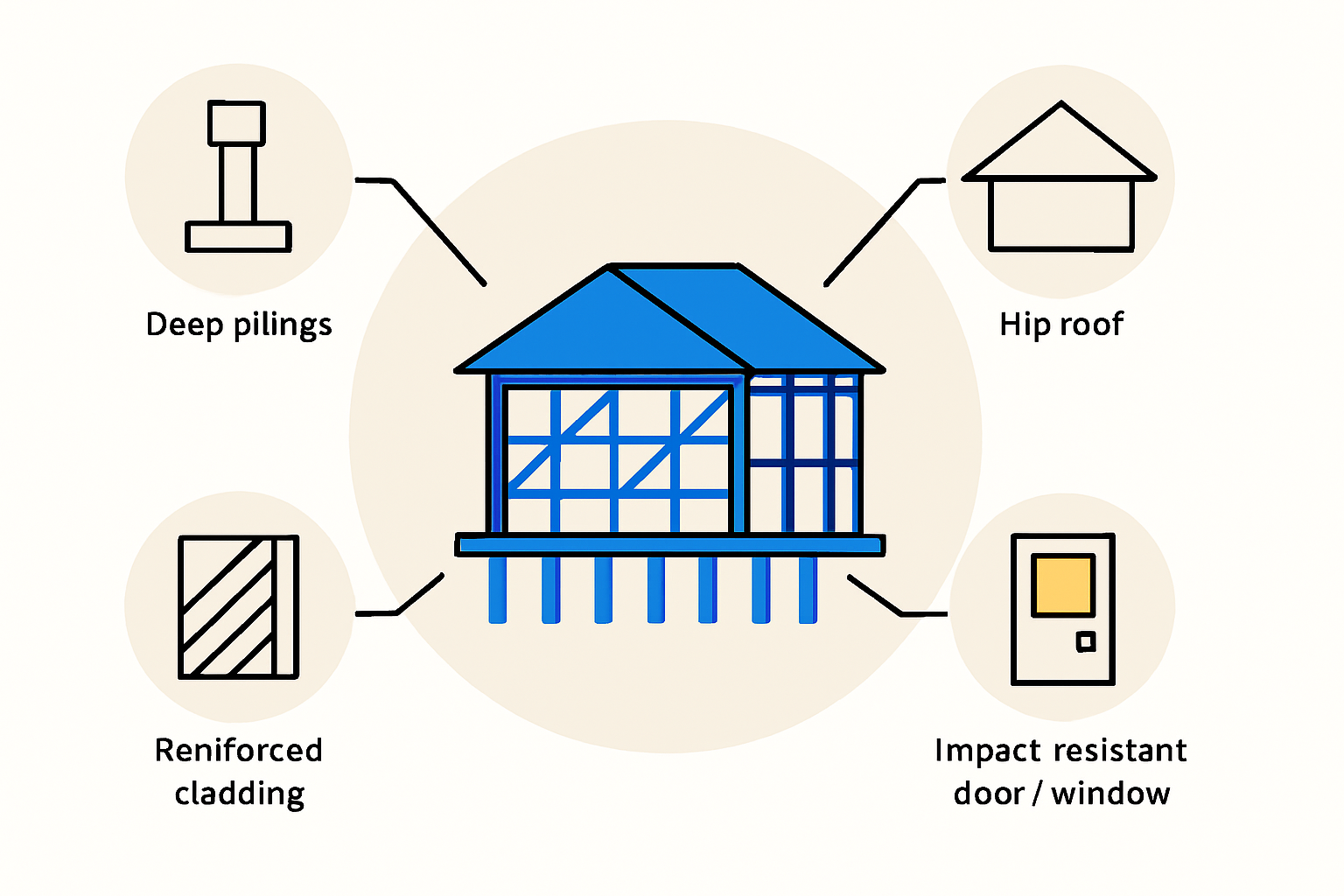
Mechanical Load Rating: The Core Metric
The most critical specification for a cyclone-resistant module is its mechanical load rating, measured in Pascals (Pa). This value indicates the amount of physical pressure—both positive (from wind pushing on it) and negative (from suction pulling on it)—the panel can endure without catastrophic failure.
-
Standard Modules: Often rated to 2400 Pa for negative load (wind suction).
-
Cyclone-Resistant Modules: Should be specified and tested to a minimum of 5400 Pa, with higher ratings providing an even greater safety margin.
Strengthened Frames and Thicker Glass
Achieving a high mechanical load rating requires tangible upgrades to the module’s core components:
-
Robust Frame Design: A thicker, reinforced aluminum alloy frame (e.g., 40mm depth instead of 30-35mm) with engineered corner keys prevents the panel from twisting and flexing under extreme wind forces.
-
Increased Glass Thickness: Using 3.2mm or even 4.0mm heat-strengthened front glass, instead of a standard 2.8mm, significantly improves resistance to both wind pressure and impacts from wind-borne debris.
Advanced Encapsulation and Backsheet Materials
Beyond wind, Tonga’s tropical marine environment presents its own challenges: high heat, humidity, and salt mist. These factors accelerate material degradation. Therefore, premium-grade materials are essential to ensure a 25-year lifespan:
-
High-Quality Encapsulant: Using POE (Polyolefin Elastomer) instead of standard EVA (Ethylene Vinyl Acetate) can offer superior resistance to moisture ingress and potential-induced degradation (PID), which is crucial in humid climates.
-
Durable Backsheet: A high-quality, multi-layer backsheet is vital to protect the cells from moisture from the rear, preventing corrosion and delamination over time.
The Business Implications of Building for Durability
Undoubtedly, specifying a cyclone-resistant factory and module design carries a higher upfront investment cost. Based on experience from J.v.G. turnkey projects, the initial capital expenditure for a resilient design can be 15–20% higher than for a standard setup.
However, this additional cost should not be viewed as an expense, but as a critical investment in risk mitigation. For entrepreneurs and investors, this approach delivers several compelling advantages:
-
Project Bankability: Financial institutions and insurers are far more likely to support a project that has demonstrably accounted for the primary business risk in the region.
-
Lower Total Cost of Ownership: A factory that survives a cyclone has an infinitely better return on investment than a cheaper facility that is destroyed, resulting in a total loss.
-
Significant Market Advantage: A local manufacturer in Tonga that can produce certified, high-load-bearing modules has a decisive edge. It becomes the preferred supplier for government tenders, critical infrastructure projects (hospitals, airports, communication towers), and international development programs that mandate resilience.
Frequently Asked Questions (FAQ)
What specific building codes should be followed in Tonga?
Tonga has its own national building code. However, for specialized industrial facilities in high-wind zones, it is standard practice to supplement this with internationally recognized standards like AS/NZS 1170.2 for cyclonic wind load calculations. Engaging a qualified local engineering firm with experience in cyclonic design is essential.
Are there international certifications for cyclone-resistant modules?
There is no single ‘cyclone-proof’ certificate. Instead, resilience is demonstrated through the standard IEC 61215 and IEC 61730 certification tests, specifically the results of the mechanical load test. For regions like Tonga, customers should demand test reports showing the module has passed static mechanical load tests of at least 5400 Pa.
How does this affect the choice of manufacturing equipment?
The core solar panel manufacturing equipment—such as stringers, bussers, and laminators—remains fundamentally the same. However, certain machines may need to be specified or calibrated for the more robust materials. For example, the framing station must be capable of handling thicker, stronger aluminum profiles, and the laminator’s parameters must be optimized for thicker glass and advanced encapsulants.
Can an existing building be retrofitted to be a cyclone-resistant solar factory?
Retrofitting an existing structure is sometimes possible but is often more complex and expensive than a purpose-built facility. It would require a thorough structural assessment by engineers to determine if the foundation, frame, and connections can be upgraded to meet cyclonic standards. In many cases, a new build is the more reliable and cost-effective long-term solution.
Conclusion: From Vulnerability to Viability
For entrepreneurs looking to support Tonga’s transition to renewable energy, the path to success is paved with resilience. In a market defined by both immense opportunity and significant environmental threats, engineering for durability is the cornerstone of a viable business strategy.
By focusing on both a fortified factory and robust module specifications, an investor can build a sustainable and profitable solar manufacturing business. Such an enterprise not only withstands the region’s greatest environmental challenges but also becomes a vital local asset, contributing directly to a more secure and independent energy future for the Kingdom of Tonga.