
Imagine a newly manufactured solar module, visually perfect, moving towards its final quality inspection. It was assembled with precision using high-quality materials. Yet, it fails the test. The cause isn’t a visible crack or a soldering error, but an invisible saboteur that infiltrated the production line days earlier: microscopic particles of dust and imperceptible traces of moisture.
This scenario is a common and costly challenge for new entrants to the solar manufacturing industry. The source of the problem often lies in a single, highly sensitive area: the lamination room. While the laminator machine itself is a marvel of engineering, its performance is entirely dependent on the quality of the air surrounding it.
This article explores the critical role of the Heating, Ventilation, and Air Conditioning (HVAC) system in the lamination area. It outlines the specific requirements for humidity, particle control, and air pressure that are essential for producing durable, high-performance solar modules.
Why the Lamination Environment is Mission-Critical
The lamination stage is where the delicate sandwich of glass, encapsulant (typically EVA), solar cells, and backsheet is fused into a single, robust unit. During this process, the materials are heated under a vacuum to bond them permanently. The integrity of this bond determines the module’s lifespan and performance.
Two primary environmental factors can compromise this process: airborne humidity and particulate contamination.
1. The Challenge of Humidity Control
The EVA (Ethylene Vinyl Acetate) encapsulant used in most solar modules is hygroscopic, meaning it naturally absorbs moisture from the surrounding air. If the ambient humidity in the lamination room is too high, the EVA sheets will absorb excess water vapor before they enter the laminator.
When the module is heated, this trapped moisture turns to steam, creating significant problems:
- Bubbles and Delamination: The steam creates gas pockets, leading to bubbles or areas where the layers fail to bond (delamination). These are immediate grounds for rejection.
- Long-Term Corrosion: Over years of operation in the field, trapped moisture can accelerate the corrosion of the solar cell’s delicate metal contacts, leading to a gradual loss of power output and premature failure.
Based on decades of manufacturing experience, industry best practice dictates that the relative humidity (RH) in the lamination room must be strictly controlled. While specific levels depend on the EVA supplier’s datasheet, a general upper limit is 70% RH. For operations in tropical or coastal regions, achieving and maintaining this level requires a robust, professionally designed HVAC and dehumidification system.
2. The Problem of Particle Contamination
Airborne dust, fibers, and other microscopic particles are the second major threat. If these particles settle on the solar cells or glass before lamination, they become permanently sealed inside the module.
This is not merely a cosmetic issue. Trapped particles can lead to severe and common solar module defects, including:
- Mechanical Stress: A larger particle can create a pressure point on the ultra-thin solar cell during lamination, causing micro-cracks that are invisible to the naked eye but reduce efficiency.
- Hotspots: Conductive particles can create small short-circuits, while non-conductive particles can cause shadowing. Both can lead to “hotspots”—areas that overheat and degrade the module over time, posing a safety risk.
- Optical Defects: Even small particles can be visible on the final product, leading to rejection for aesthetic reasons.
To prevent this, the lamination room must be treated as a controlled environment, often referred to as a “cleanroom.”
Engineering the Solution: Key HVAC Specifications
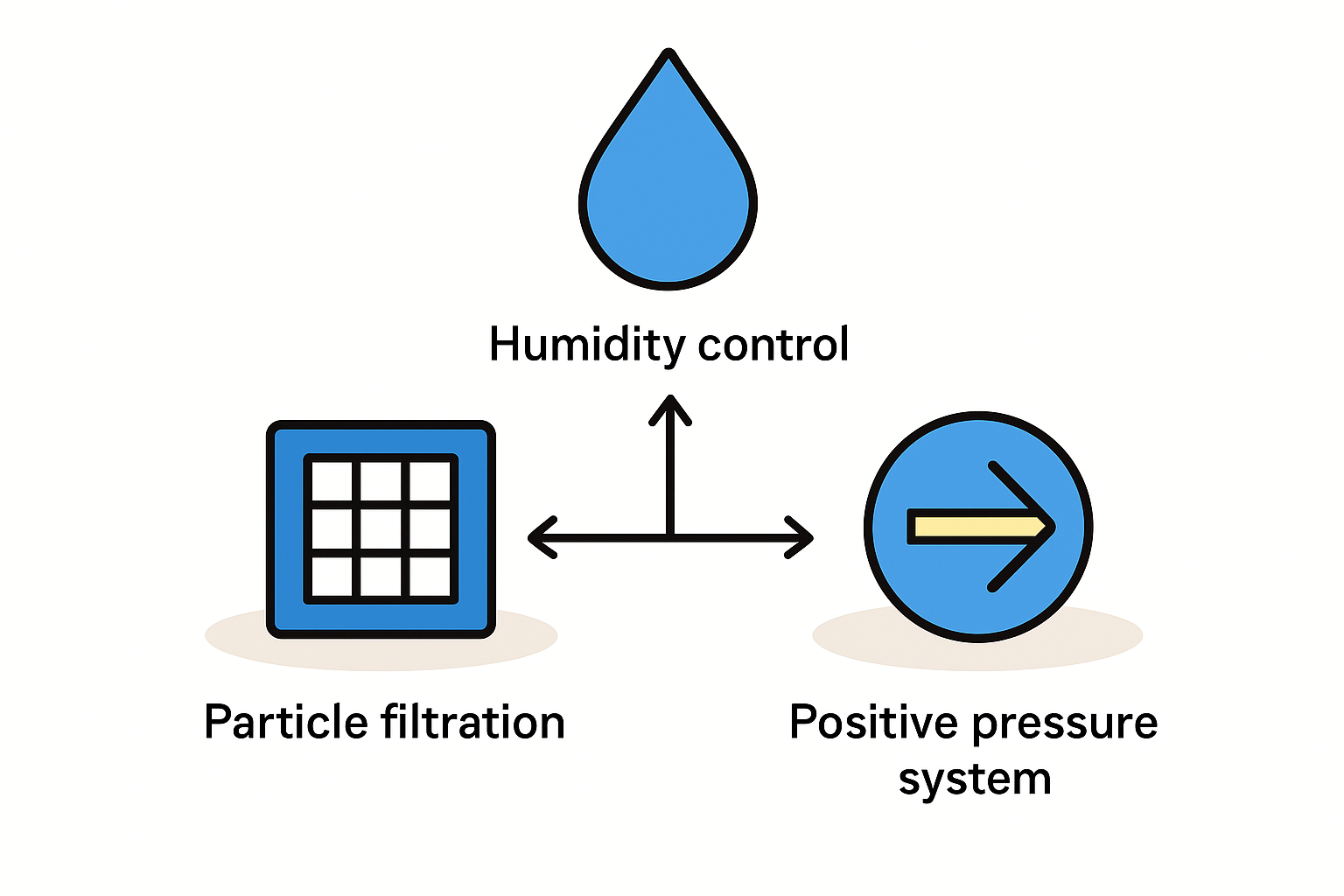
A standard office air conditioning system is entirely inadequate for a lamination room. A specialized industrial HVAC system is required to manage temperature, humidity, and air purity with precision. The design revolves around three core principles: positive pressure, air filtration, and air exchange.
Positive Air Pressure: The First Line of Defense
The most effective strategy for keeping dust out isn’t just to filter the air inside the room, but to prevent unfiltered air from entering in the first place. This is achieved through positive air pressure.
The HVAC system is designed to pump more filtered air into the lamination room than is extracted. This creates a slightly higher air pressure inside the room compared to adjacent areas. When a door is opened, clean air flows out of the room, preventing dust and contaminants from flowing in.
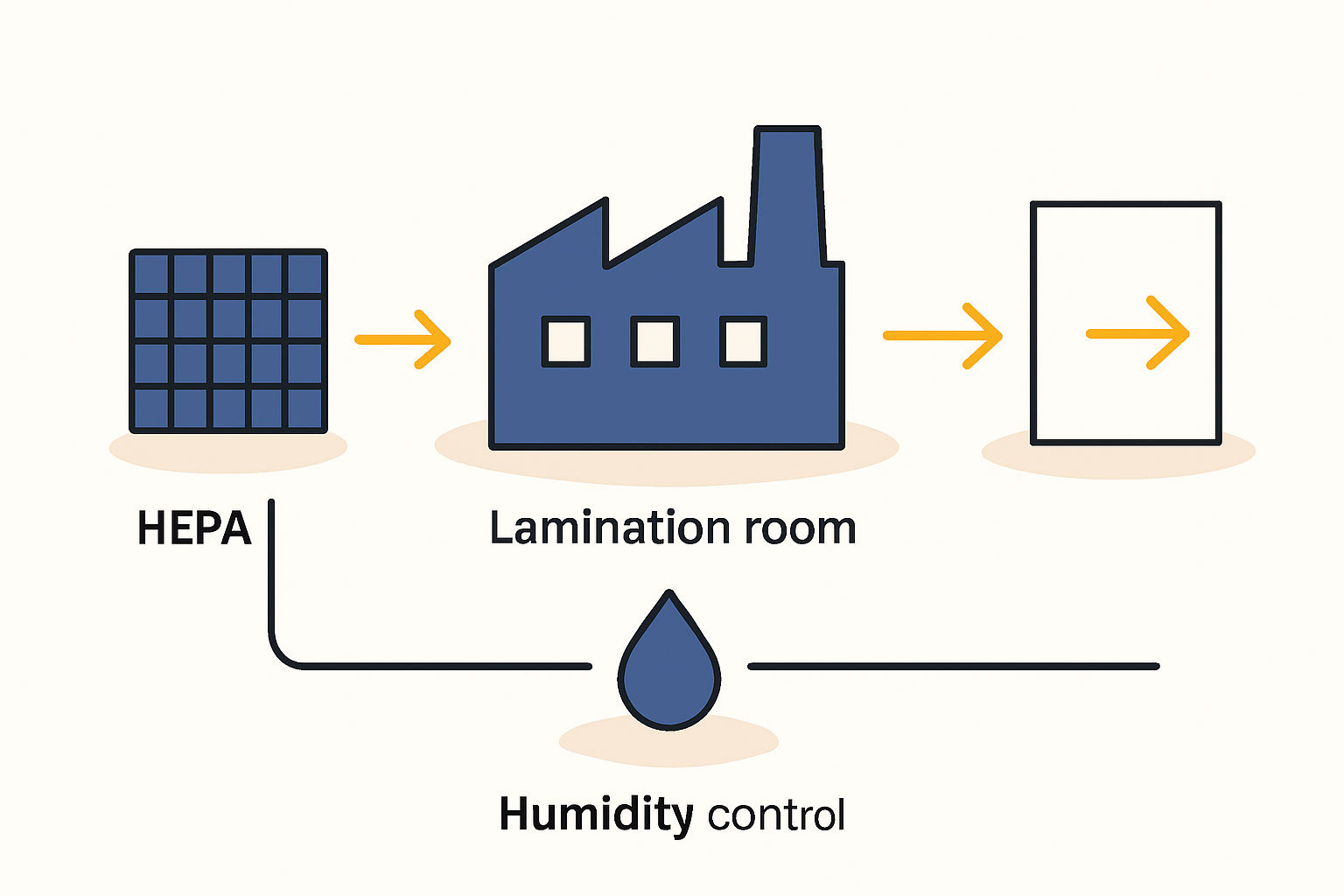
This simple yet powerful principle is a cornerstone of cleanroom design and is essential to maintaining a low-particle environment.
Air Filtration: The ISO Cleanroom Standard
To ensure the air entering the room is free of harmful particles, high-efficiency filters are required. The benchmark for a solar module lamination room is typically ISO 14644-1 Class 8.
This international standard specifies the maximum number of particles of a certain size allowed per cubic meter of air. For an ISO Class 8 cleanroom, this translates to no more than 3,520,000 particles 0.5 micrometers (µm) or larger per cubic meter. For perspective, a human hair is about 50–70 µm thick.
Achieving this level of cleanliness requires multi-stage filtration, culminating in HEPA (High-Efficiency Particulate Air) filters. These filters, often rated H13 or H14, are capable of trapping at least 99.95% of particles down to 0.3 µm in size.

Temperature and Air Exchange Rate
While humidity and particles are the primary threats to the product, temperature control is vital for process consistency and worker comfort. A stable temperature, typically maintained between 20°C and 25°C (68°F and 77°F), ensures that materials like the EVA encapsulant remain in a consistent state before processing.
The Air Changes per Hour (ACPH) rate is another critical design parameter. It defines how many times the total volume of air in the room is replaced with fresh, filtered air every hour. For an ISO Class 8 environment, an ACPH of 15 to 25 is common. This high rate ensures that any particles generated within the room are quickly removed.
Frequently Asked Questions (FAQ)
Q1: Why is controlling humidity so important for the EVA encapsulant?
The EVA polymer is hygroscopic, meaning it acts like a sponge for moisture in the air. If it absorbs too much water before lamination, that water turns to steam inside the hot laminator. This can cause delamination (layers separating), bubbles, and long-term degradation of the solar cells due to corrosion.
Q2: What exactly is a HEPA filter?
A HEPA filter is a mechanical air filter made of a fine mesh of fibers. It works by forcing air through this mesh, which traps microscopic particles like dust, pollen, and other contaminants. The standard is very strict: a true HEPA filter must trap at least 99.95% (for H13 grade) of particles that are 0.3 micrometers in size.
Q3: What happens if positive pressure is not correctly maintained?
Without positive pressure, every time a door to the lamination room is opened, unfiltered air from the factory floor is drawn inside. This influx of contaminated air can quickly overwhelm the filtration system, depositing dust and particles onto sensitive materials and compromising product quality, no matter how good the internal filters are.
Q4: Is designing and installing an ISO Class 8 cleanroom a complex process?
Yes, it requires specialized expertise. The investment in a properly designed HVAC system is a critical part of setting up a solar production facility. It’s not just a matter of buying filters; it involves calculating air volumes, pressure differentials, and humidity loads. Based on experience from J.v.G. turnkey projects, underestimating the HVAC budget and design complexity is a common oversight for entrepreneurs entering this industry.
Planning for Quality from Day One
The quality of a solar module is determined long before it reaches the final inspection. It is forged in the controlled environment of the lamination room, where invisible factors like humidity and dust are managed with engineering precision.
For any business professional planning to enter the solar manufacturing space, understanding these environmental requirements is not a minor detail—it is fundamental to the business case. A well-designed HVAC system is a direct investment in higher production yields, lower rejection rates, and a reputation for producing reliable, long-lasting products.