
Once an investor decides to enter the battery manufacturing sector, a foundational question arises: what kind of battery pack should the factory produce? This is no minor detail, but a strategic choice that dictates engineering philosophy, supply chain architecture, and market positioning. A battery pack designed for a utility-scale energy storage system is fundamentally different from one engineered for an electric vehicle.
A one-size-fits-all approach to pack design often leads to a product that excels in neither application, compromising its competitiveness and financial viability. This guide outlines the critical engineering and business distinctions between packs for stationary storage and electric mobility, offering a clear framework for investors to align their product strategy with a specific market need.
Core Engineering Philosophy: Longevity vs. Energy Density
A battery pack’s primary objective drives every subsequent design decision. For stationary storage, the goal is economic performance over a long operational life, while for electric mobility, it’s maximizing range and minimizing weight.
Stationary Storage (BESS): Designing for Endurance and Low LCOS
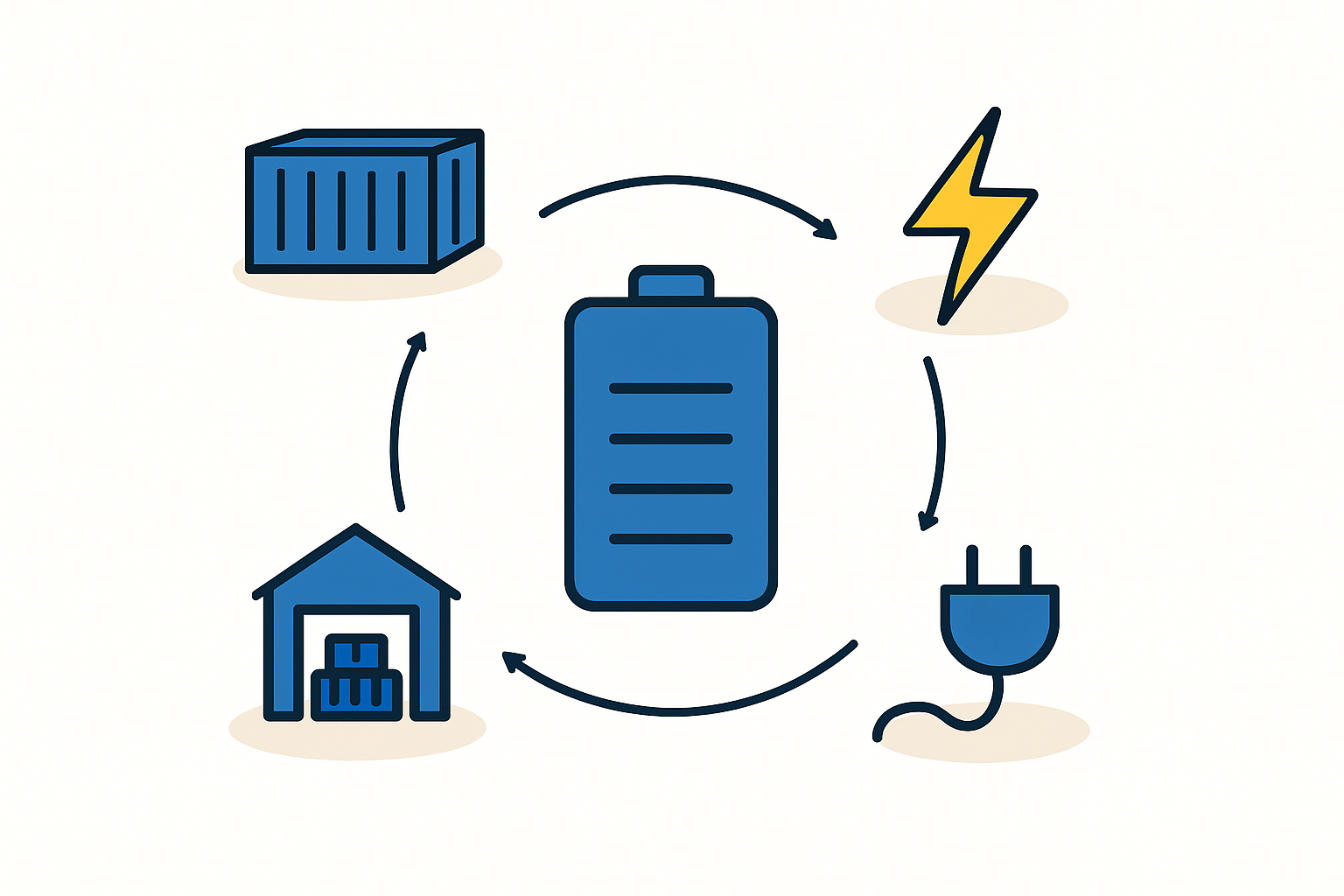
A Battery Energy Storage System (BESS) is a long-term infrastructure asset, its value measured by the ability to reliably perform thousands of charge-discharge cycles over 15 to 20 years. The key performance metric is the Levelized Cost of Storage (LCOS), which is heavily influenced by the pack’s cycle life.
This means BESS pack design prioritizes:
-
High Cycle Life: These packs must endure extensive cycling. Industry standards often demand a minimum of 6,000 cycles, with some utility-scale projects requiring up to 10,000 cycles while retaining significant capacity. This favors robust cell chemistries like Lithium Iron Phosphate (LFP), known for their exceptional longevity.
-
Thermal Stability: Operating continuously in a fixed location allows for controlled environmental conditions. The thermal management system is engineered for stability over decades, preventing cell degradation rather than managing the acute heat spikes seen in vehicles.
-
Modularity and Serviceability: BESS installations are large and designed for maintenance. Packs are typically designed as modular, rack-mounted units that can be easily accessed, monitored, and replaced if necessary, minimizing downtime.
Electric Mobility (EVs): Engineering for Range and Performance
An electric vehicle’s battery pack is a mobile power source where weight and volume are critical constraints. Its primary goal is to store the maximum amount of energy in the smallest, lightest package possible, extending the driving range crucial for consumer adoption.
As a result, EV pack design prioritizes:
-
High Energy Density: To maximize range, EV packs must have high gravimetric (Wh/kg) and volumetric (Wh/L) energy density. High-performance EV packs regularly exceed 160 Wh/kg, a metric where chemistries like Nickel Manganese Cobalt (NMC) have historically held an advantage. By contrast, stationary packs typically fall within the 120-160 Wh/kg range, as weight is not a primary concern.
-
Advanced Thermal Management: EVs experience dynamic conditions, including rapid acceleration and DC fast charging, which generate significant heat. A sophisticated active cooling system, usually liquid-based, is essential to manage these thermal loads, ensure passenger safety, and preserve battery health.
-
Structural Integration and Crashworthiness: The battery pack is often a structural component of the vehicle’s chassis. It must be engineered to be lightweight yet strong enough to contribute to the vehicle’s rigidity and withstand severe impacts and vibrations, adding significant mechanical complexity.
Translating Design Choices into Business Strategy
The engineering path chosen—whether for BESS or EVs—directly impacts the factory’s setup, supply chain relationships, and overall business model. Understanding these implications is crucial for accurate financial forecasting and risk management.
Impact on Cell Sourcing and Supply Chain
Focusing on BESS packs aligns a manufacturer with the LFP cell supply chain. LFP chemistry’s independence from cobalt and nickel can offer greater price stability and mitigate geopolitical supply risks. For investors in regions aiming to build a resilient domestic manufacturing base, this is a significant consideration.
Conversely, targeting the high-performance EV market requires sourcing NMC cells. This path involves engaging with a different set of suppliers and navigating the volatile markets for nickel and cobalt, introducing a different risk profile.
Manufacturing Complexity and Investment
The divergence in design directly affects the complexity and cost of the assembly line.
-
EV Pack Assembly: The integration of sophisticated liquid cooling circuits, intricate wiring harnesses, and structural components demands higher levels of automation and precision, increasing the battery factory CAPEX and requiring a workforce with specialized skills in automotive-grade manufacturing.
-
BESS Pack Assembly: While still requiring stringent quality control, the assembly of modular, air-cooled BESS packs is generally more straightforward. The process is often standardized, allowing for a phased investment and a quicker path to production.
A Framework for Your Strategic Product Decision
Choosing between stationary and mobility applications is less about determining which is “better” and more about aligning the product with a specific market opportunity and the investor’s operational strengths. Setting up a facility in a market like India or Nigeria involves different infrastructure, supply chain, and market demand considerations than a facility in North America.
An investor should evaluate several key factors:
-
Primary Market Need: Is the target region’s most pressing energy challenge grid instability and renewables integration (favoring BESS), or is it reducing transportation emissions and fossil fuel reliance (favoring EVs)?
-
Government Policy and Incentives: Are government programs supporting utility-scale storage projects and industrial energy independence, or are they promoting EV adoption through consumer subsidies and charging infrastructure development?
-
Supply Chain Access: How available and logistically feasible is sourcing LFP versus NMC cells and their respective raw materials in the region?
-
Existing Industrial Base: Does the region have a strong automotive manufacturing ecosystem that could serve as a customer base for EV packs, or is the industrial landscape more focused on power generation and infrastructure?
Frequently Asked Questions
Can a single factory produce both BESS and EV battery packs?
While technically possible, it’s operationally inefficient and strategically challenging. The two products require different assembly lines, engineering teams, quality control protocols, and supply chains. A factory attempting to do both without dedicated resources risks being uncompetitive in each market. A focused strategy is almost always more effective.
Which cell chemistry, LFP or NMC, is the better investment?
Neither chemistry is inherently superior; its suitability is application-dependent. The choice between LFP vs NMC battery production is purely strategic. LFP is often the optimal choice for stationary storage due to its long cycle life, safety profile, and lower cost. NMC is favored for EVs where high energy density is the most critical parameter. The “better” investment is the one that aligns with your chosen product and market strategy.
How critical is the Battery Management System (BMS) in pack design?
The BMS is the pack’s intelligence—a point of immense technical differentiation and value creation. In a BESS pack, the BMS software is optimized to maximize cycle life and manage grid interactions. For an EV pack, it must deliver precise range calculations and ensure safety during high-power operations like fast charging. A robust and well-designed BMS is critical to the performance, safety, and bankability of the final product in either application.
Conclusion: A Strategic Decision With Long-Term Impact
The choice between manufacturing battery packs for stationary storage or electric mobility is one of the first and most consequential decisions an investor will make. This industrial infrastructure decision defines the company’s technical roadmap, operational focus, and market identity for years to come. By carefully analyzing the distinct engineering requirements and aligning them with market needs and regional strengths, an investor can build a defensible and profitable position in the rapidly growing energy storage industry.
Structured orientation, such as that provided on pvknowhow.com, is essential for navigating these complex decisions and ensuring the long-term viability of the investment.