Sunshine and Strategy: The Realities of Setting Up Solar Manufacturing in Antigua and Barbuda
If you’re reading this, you probably already get it: Antigua and Barbuda isn’t stuck in the “someday greener” lane. Real change is underway. The government has been vocal about its commitment to solar energy, and there’s actual movement, not just lip service. For anyone with an eye for business, especially if you’re thinking about manufacturing solar panels here, this isn’t just a dream. A genuine opportunity is on the table.
But let’s be honest. Just because the sun shines bright and there’s political wind behind renewables doesn’t mean you can build a factory and watch the money roll in. Doing business here isn’t like setting up in an industrial hub with endless resources. Islands come with their own quirks—some are deal-breakers, others are just extra headaches. If you ignore that reality or treat it like brochure fluff, you’ll find out the hard way.
I’ve put this guide together for people who want straight talk, not a fairy tale. I want you to understand what you’re up against and what it will really take to succeed. If you prefer your business advice sugar-coated, you won’t find it here.
Table of Contents
The Current State: Solar Manufacturing and Energy in Antigua and Barbuda
Let’s get some basics down. Right now, Antigua and Barbuda runs almost entirely on imported fossil fuels. That’s expensive, risky, and doesn’t exactly scream self-reliance. The push into renewables isn’t just about “saving the planet”—it’s about breaking free from volatile foreign oil prices, which is a key driver of the government’s urgency.
 Solar Manufacturing Ventures in Antigua and Barbuda
” class=”wp-image-34031″ srcset=”https://www.pvknowhow.com/wp-content/uploads/2025/07/Risk-Assessment-and-Mitigation-for-Solar-Manufacturing-Ventures-in-Antigua-and-Barbuda-1.webp 1536w, https://www.pvknowhow.com/wp-content/uploads/2025/07/Risk-Assessment-and-Mitigation-for-Solar-Manufacturing-Ventures-in-Antigua-and-Barbuda-1-500×333.webp 500w, https://www.pvknowhow.com/wp-content/uploads/2025/07/Risk-Assessment-and-Mitigation-for-Solar-Manufacturing-Ventures-in-Antigua-and-Barbuda-1-1024×683.webp 1024w, https://www.pvknowhow.com/wp-content/uploads/2025/07/Risk-Assessment-and-Mitigation-for-Solar-Manufacturing-Ventures-in-Antigua-and-Barbuda-1-768×512.webp 768w, https://www.pvknowhow.com/wp-content/uploads/2025/07/Risk-Assessment-and-Mitigation-for-Solar-Manufacturing-Ventures-in-Antigua-and-Barbuda-1-600×400.webp 600w” sizes=”auto, (max-width: 1536px) 100vw, 1536px” />
Their goal is 100% renewable energy by 2030. That’s ambitious, even for a small nation, but it’s not just talk—they’ve already installed over 10 MW of solar. While not a massive amount, it’s a tangible start.
Everything comes down to the Antigua Public Utilities Authority (APUA). They control generation, the grid, and the rules—pretty much everything power-related. If you plan to make solar panels here for local sale or grid connection, you have to know APUA inside and out. Understand their regulations, technical requirements, and the hoops you’ll need to jump through. Don’t skip this homework; it’s the difference between a viable plan and a pipe dream.
Let’s turn your solar ambitions into reality.
From practical assistance through our dedicated Services to advanced insights in our Premium Course, we’re ready to guide you every step of the way.
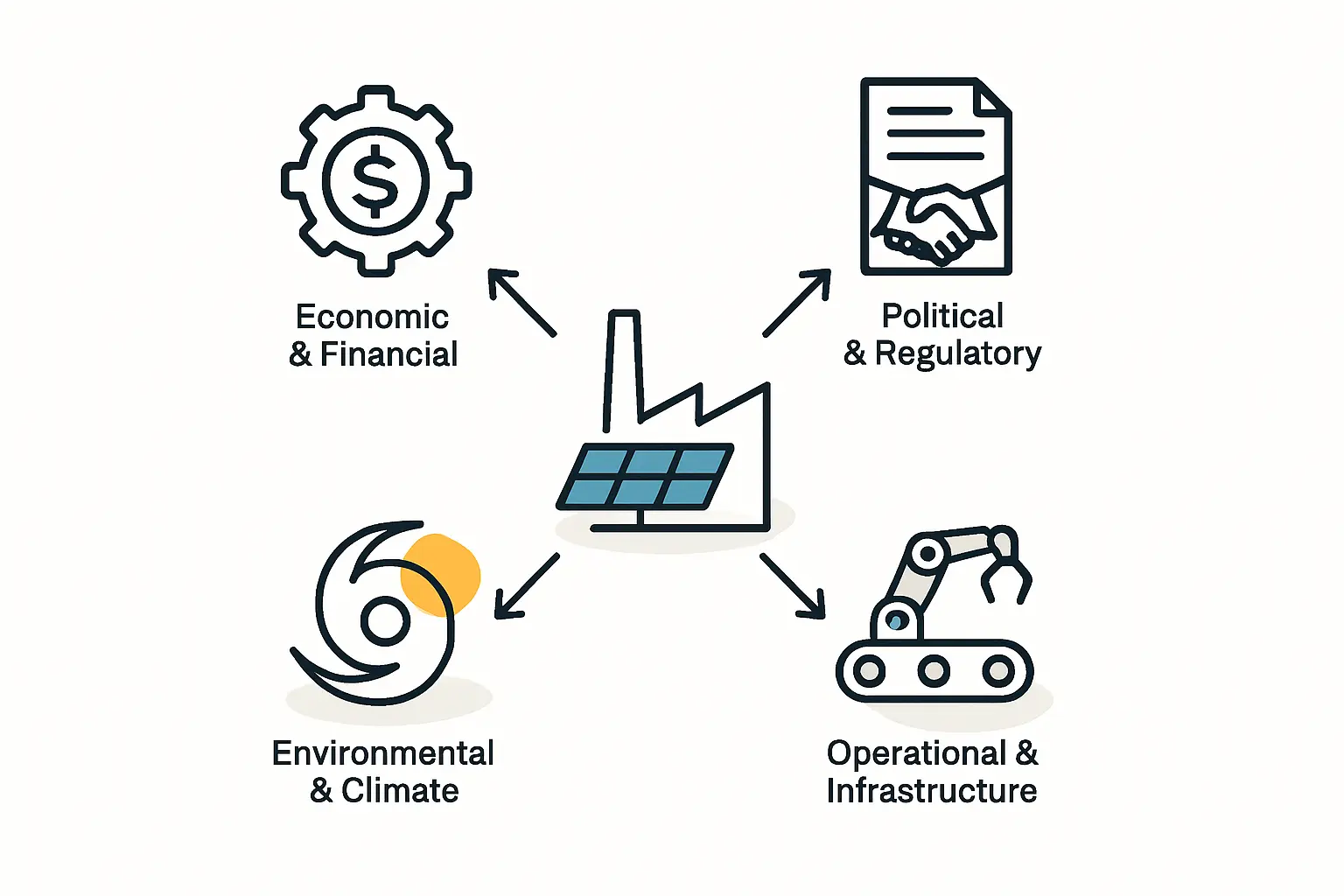
Economic Risks: What’s Going to Hit Your Wallet
Let’s not dance around the obvious: if you want this to be more than a public-spirited side project, you have to pay attention to the money.
Key Risks
- Local demand is limited. While solar is popular, the population and energy consumption aren’t huge. You aren’t going to flood the local market.
- APUA is the gatekeeper. Until they’re on board and you have agreements in hand, your panels might not have a local buyer.
- Factories are expensive to build and finance. You’re competing for capital against other climate adaptation projects that also attract investor attention.
- Raw materials must be imported. Every global hiccup—shipping costs, supply shortages, trade politics—becomes your problem.
- Small economies are vulnerable. Significant currency fluctuations and sudden inflation can have an almost immediate impact.
- You’re up against established global solar manufacturers with deeper pockets and larger economies of scale.
How to Deal With All That
- From day one, plan to export beyond just Antigua and Barbuda. CARICOM and the wider Caribbean are your real market.
- Don’t try to go it alone. Seek solid local or international partners to spread the risk and open doors.
- Diversify your funding sources. Explore green bonds, development bank loans, and climate funds—don’t just rely on a single local bank.
- Avoid relying on a single supplier. Establish backup options and try to source regionally where possible to keep your operation moving.
- Hedge your finances. Use financial instruments to protect your business from damaging currency swings.
- Find a clear niche. Compete on value, not price, with products like modules that survive hurricanes or panels for marine use.
- Start small. Prove your model and build a track record before you try to scale. Don’t attempt to build a mega-factory out of the gate.
Political and Regulatory Risks: What Could Grind You To a Halt
No matter how sharp your business plan is, you’ll hit the brakes hard if policy shifts or regulations flip on you. Here’s what to expect.
The Main Hurdles
- Governments can change quickly, and with them, the energy incentives, regulations, and the entire support system.
- Getting a license or permit can be a long, drawn-out process. Bureaucracy here can be slow and unpredictable.
- Financial incentives rarely last forever. A tax break this year is no guarantee it will be there in five years.
- Rules can be ambiguous, or decisions made without public transparency. This makes long-term planning difficult.
- Changes to tariffs or trade duties, especially on cross-border commerce, can instantly wipe out your profits.
How to Protect Yourself
- Invest in a local legal expert who understands not just the laws, but how things actually get done on the ground.
- Political risk insurance sounds boring until you desperately need it. Look into securing a policy.
- Build genuine, ongoing relationships with government officials, APUA, and community leaders. Don’t just show up to ask for something—be present and known.
- Maintain strict compliance from day one. Don’t cut corners, because it will come back to bite you.
- Partner with respected local entities. They know the landscape and can help you avoid common but costly mistakes.
- Stay informed about what’s coming down the policy pipeline so you can anticipate and adapt to changes.
Operational Risks: The Reality of Making Stuff on an Island
You’ve navigated the regulations? Great. Now the real, day-to-day problems begin.
What to Watch Out For
- Skilled labor is scarce. The specific technical expertise for solar manufacturing may barely exist locally.
- Power, roads, and ports may not be “reliable” by industrial standards. You must plan for that reality.
- Quality is non-negotiable. Poorly made panels will kill your business, and defects in solar modules are a major global issue.
- Equipment downtime is painful. Getting a replacement part or a specialized technician out here isn’t a one-day affair.
- You can’t just connect to the grid as you please. APUA sets strict technical standards, and grid capacity is limited.
- Physical security is a must—otherwise, valuable inventory and machinery can walk off your site.
- Technical and safety standards are constantly evolving, so today’s compliance may be tomorrow’s violation.
How to Tackle These
- Establish local training programs. Get ahead of the skills gap by developing your own talent pipeline.
- Choose your factory site for resilience: prioritize access to reliable power, roads, and ports, and plan for backup generation (ideally solar-plus-storage).
- Implement top-tier quality control standards from the very beginning. Cutting corners now leads to expensive failures later.
- Schedule rigorous preventative maintenance. Line up suppliers and service support before you ever have an emergency.
- Understand APUA’s interconnection requirements in detail from the start, and maintain communication as they evolve.
- Invest in comprehensive physical security for your facility. Do not take shortcuts.
- Maintain open lines of communication with APUA and regulators—don’t wait to be surprised by new rules.
Environmental Risks: What Can Go Wrong With Nature (and Public Opinion)
This is a beautiful place with a fragile environment. If you mess this up, you’re done.
Environmental Red Flags
- Factory space is limited and may conflict with agriculture, tourism, or protected ecosystems.
- Some manufacturing processes use hazardous chemicals. Improper handling will lead to local backlash and legal nightmares.
- Solar panels aren’t disposable. You need a credible end-of-life management plan for your products from the start.
- Water is a scarce resource. Water-intensive manufacturing is a poor fit for a dry island.
- Hurricanes are not rare events. They are an expected and destructive threat that can wreck everything.
- Running a “green” business on dirty, diesel-generated electricity is hypocritical and bad for your brand.
How to Do This Right
- Conduct a thorough Environmental Impact Assessment (EIA) before you commit to anything.
- Don’t just meet the minimum environmental regulations—exceed them. This will protect you when rules inevitably tighten.
- Design your products and facility with recycling and reuse in mind. Don’t wait for a crisis to force your hand.
- Install water-saving and recycling systems from day one as a core part of your operations.
- Build your factory to withstand what nature throws at it. Use Barbuda’s new hurricane-resilient solar plant as a model.
- Power your own factory with solar and storage, not diesel generators.
- Follow the mitigation hierarchy: first, avoid environmental impacts; then, reduce those you can’t; fix what you break; and finally, offset what you can’t fix.
Tying It Together: Questions to Ask Yourself Before Signing Anything
All these risks are interconnected. Economic trouble creates supply chain disruptions, which a hurricane can worsen, all made more tangled by regulatory red tape. One problem can easily spiral. Before you invest any money, honestly answer these questions:
- Is there enough real, steady demand for my panels, both locally and in export markets?
- Do I have a crystal-clear understanding of APUA’s technical standards and interconnection requirements?
- What is the government’s actual, long-term plan for supporting this industry beyond promises?
- Are there enough people with the skills I need, and if not, how will I realistically train them?
- How fragile is my supply chain? What’s my Plan B and Plan C?
- What are the specific environmental regulations, and what is my plan for waste and end-of-life panels?
- How, specifically, am I engineering my facility for disasters like a Category 5 hurricane?
- Have I stress-tested my financial model against every one of these risks?
- Do I have local partners I trust who understand how things actually work here, not just how they’re supposed to?
Conclusion
Yes, there’s a real opportunity in solar manufacturing in Antigua and Barbuda. You could even help shape the country’s energy future. But this is not a “future of energy” fantasy—it’s a serious challenge that demands rigorous preparation, local buy-in, and relentless attention to all the unglamorous details.
Passion isn’t enough. Success here is about steady planning, digging deep to understand what works locally, and refusing to cut corners. If you’re not from here and you try to go it alone, you will hit a wall. Talk to people who have done it, and keep your checkbook closed until you have their on-the-ground insight.
Have you seen or tried similar projects in the Caribbean? What’s tripping you up, or what are you determined to figure out? Leave a comment. Let’s cut through the noise and share what actually works.
Frequently Asked Questions (FAQs)
What’s the biggest risk for a new solar manufacturing business here?
It’s hard to pick just one, since everything’s connected. However, the biggest challenges will likely hit you early: securing sufficient upfront capital, managing an unpredictable supply chain, and finding people with the right technical skills. And don’t forget, building a hurricane-proof facility won’t be cheap.
How can someone find a reliable local partner?
Start with local institutions. Engage with the Chamber of Commerce, investment agencies like the Antigua and Barbuda Investment Authority (ABIA), and reputable law or consulting firms with experience in renewables. Attend local business events. Tap contacts at your embassy or trade groups. Most importantly, conduct thorough due diligence on anyone you consider partnering with.
What government incentives are actually available?
Incentives change, so don’t rely on hearsay—get the latest information directly from the ABIA. You can likely expect a mix of possibilities: potential tax holidays, duty-free importation of equipment, and sometimes assistance with worker training programs. Always ask for official documentation, not just verbal promises.
What power does APUA have in all this?
APUA calls the shots on nearly everything related to the grid. This includes technical specifications, safety standards, the process for connecting projects to the grid, and they are also your biggest potential local customer. If you want your venture to succeed, you must engage with APUA early and often.
Are there any real successes in risk mitigation locally?
Absolutely. Look at Barbuda’s new hybrid solar plant. It was built with resilience as a top priority after Hurricane Irma, specifically designed to withstand another major storm. That’s risk mitigation in action, and it’s the standard you should aim for if you plan to build something that lasts.