Barbados has set a bold objective: to achieve 100% renewable energy generation by 2030. This national commitment is more than an environmental goal; it’s also a significant, sustained economic opportunity.
For entrepreneurs and investors, this commitment creates a predictable, long-term local market for solar components. The question is no longer if a domestic solar industry will grow, but who will build it.
This article explores the market potential for establishing a solar module manufacturing facility in Barbados, analyzing the scale of domestic demand, the strategic advantages of exporting to neighboring Caribbean nations, and the key factors determining a venture’s viability. Grounded in data and practical considerations, our analysis is designed to help business professionals understand the landscape before making an investment decision.
Table of Contents
The Foundation: Barbados’s Domestic Demand
A clear understanding of the home market is the bedrock of any successful manufacturing venture. In Barbados, the demand for solar photovoltaic (PV) modules is driven by national energy policy. A 2022 market assessment by the U.S. National Renewable Energy Laboratory (NREL) provides a clear, quantitative picture of this opportunity.
The study estimates that to meet its 2030 targets, Barbados will require an annual installation of 55 MW to 105 MW of solar capacity. This demand isn’t monolithic; it is distributed across several key sectors:
-
Distributed PV: This segment provides a consistent foundation for demand, covering everything from residential rooftop systems to commercial installations on buildings, hotels, and industrial facilities.
-
Utility-Scale Projects: Larger solar farms, often paired with energy storage solutions to ensure grid stability, will be required to meet the national grid’s needs, creating opportunities for bulk supply contracts.
A local manufacturer would be well-positioned to serve these segments, offering benefits like reduced shipping times, lower transportation costs, and the ability to tailor products to specific local requirements.

Expanding Horizons: The CARICOM Export Opportunity
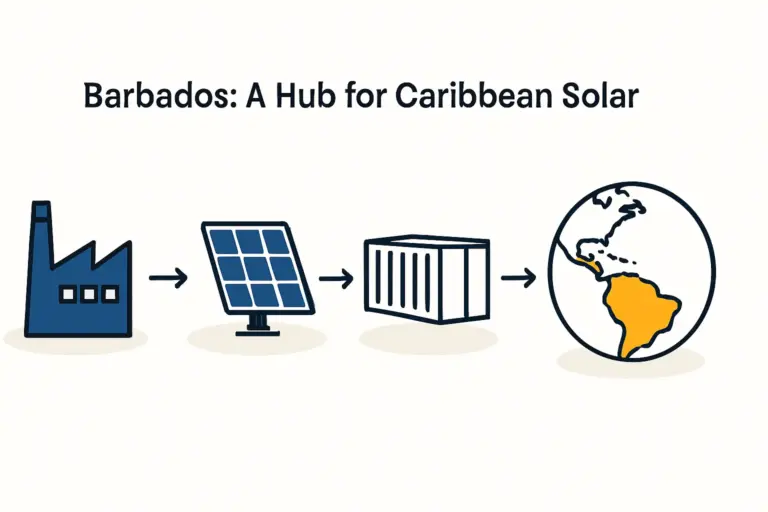
While the Barbadian market provides a strong foundation, an even greater strategic opportunity lies in exporting to the Caribbean Community (CARICOM). As a member of CARICOM, a Barbados-based manufacturer could gain preferential access to a market of 15 member states.
A key advantage here is the CARICOM Common External Tariff (CET). This tariff, levied on goods imported from outside the community, can make modules from a Barbadian factory more cost-competitive than those from Asia or North America.
Barbados’s infrastructure is well-suited to serving this regional market. The deep-water Port of Bridgetown is a modern, capable facility that can handle both the import of raw materials and the export of finished goods. Its strategic location makes it an efficient hub for shipping to nearby islands—a critical advantage for logistics and supply chain management.
Assessing the Practicalities: A Viable Factory Scale
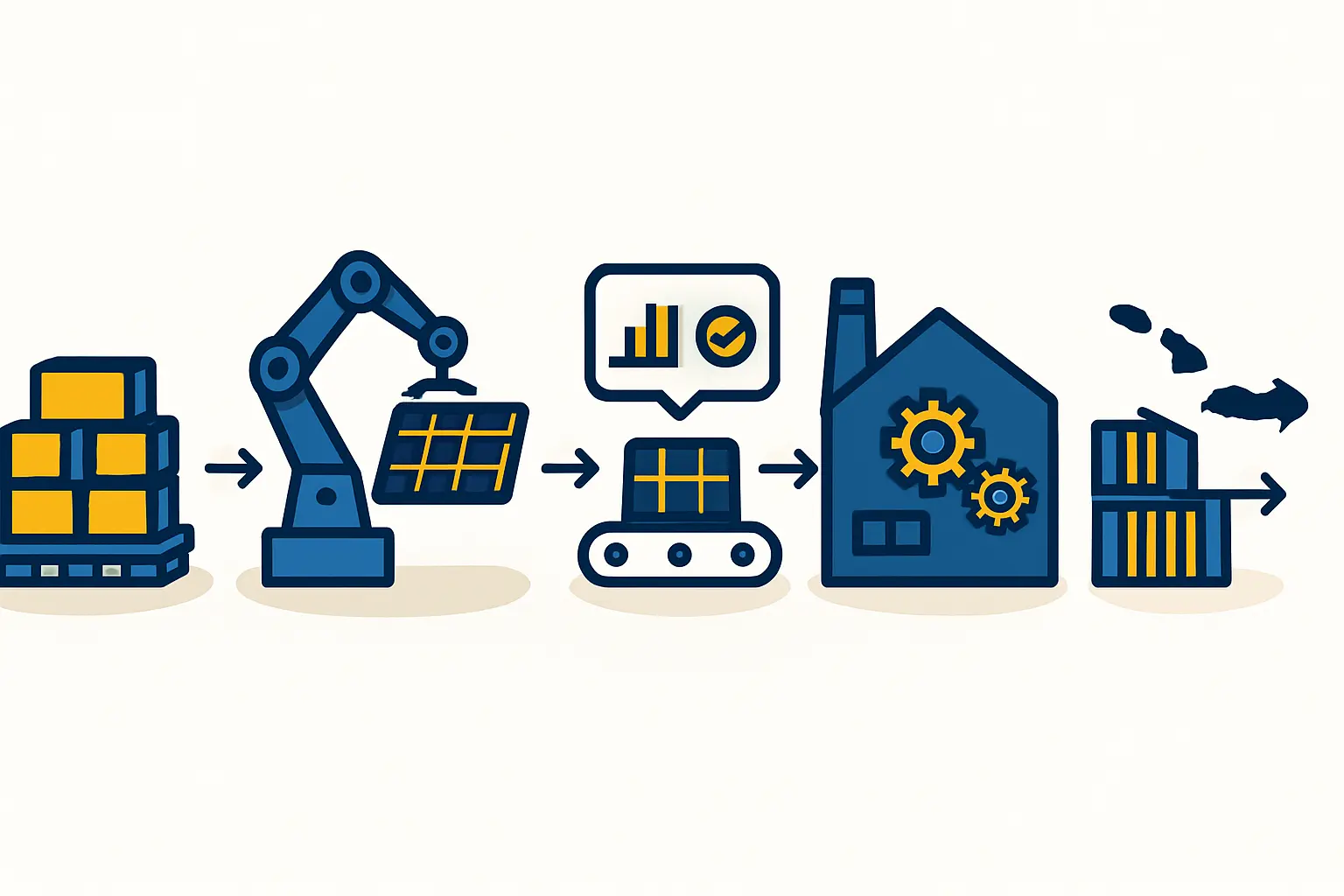
Based on combined domestic and potential export demand, the NREL study concluded that a manufacturing facility with an annual production capacity of 25 MW to 50 MW would be economically viable. This scale is considered a semi-automated or “low-automation” setup, which balances capital investment with the need for skilled labor.
A factory of this size represents a significant but manageable industrial project. It is large enough to achieve economies of scale and compete effectively, yet streamlined enough to be established with a clear project timeline and investment framework. Such an operation typically requires a workforce of 25-40 employees, including technicians, operators, and administrative staff.
Establishing such a facility requires a meticulous business plan. A thorough market analysis for a solar factory is critical for validating assumptions and forecasting revenues. Many investors new to the industry find that structured support, such as a guide on turnkey solar production lines, offers a clear roadmap from initial concept to full operation.
A Note from Experience
J.v.G. Technology GmbH has supported numerous clients in emerging markets, including a project with Mr. Goyal in India. His initial vision was to serve his local market, but with a well-planned facility, he quickly realized the potential for export. His experience demonstrates that a strong local foundation is often the perfect launchpad for regional expansion—a model that fits the Barbadian context well.
Key Considerations for Investors
While the opportunity is clear, any prudent investor will also evaluate the challenges. Success in Barbados will hinge on carefully managing several factors:
-
Raw Material Imports: Most raw materials for module manufacturing (solar cells, glass, aluminum frames) will need to be imported. Establishing reliable, cost-effective supply chains is critical.
-
Energy Costs: Electricity prices in Barbados can be high, impacting operational expenditures. Investing in an on-site solar PV system for the factory itself is a logical step to mitigate this cost and demonstrate the product’s value.
-
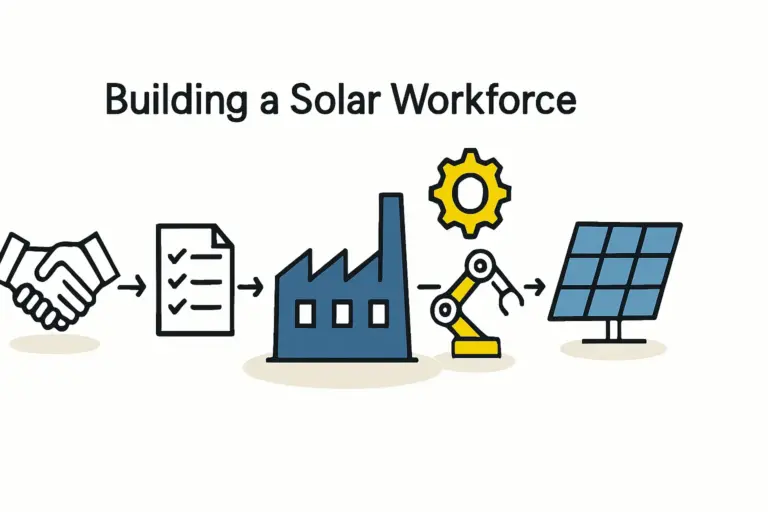
Labor Training: While Barbados has a skilled workforce, specific training in PV manufacturing techniques will be necessary. This must be factored into the initial setup plan and budget.
-
Government Incentives: The Government of Barbados has historically offered fiscal incentives and support for investments in key sectors. Exploring these potential benefits is a crucial part of the financial planning process.
Frequently Asked Questions (FAQ)
What exactly is a solar module?
A solar module, or solar panel, is the end-product that generates electricity from sunlight. It consists of interconnected solar cells protected by glass, an encapsulant, a backsheet, and an aluminum frame.
What is the approximate investment for a 25-50 MW factory?
The capital investment for a semi-automated line of this scale can vary based on the level of automation and choice of equipment. Entrepreneurs can generally anticipate a multi-million dollar investment for machinery, facility setup, and initial working capital. A detailed business plan is necessary to determine a precise figure.
Do I need a technical background in solar energy to start a factory?
No, a technical background is not a prerequisite. Many successful factory owners are business professionals who excel in management, finance, and logistics. The key is to partner with experienced technical consultants or turnkey providers who can manage the engineering and operational setup. Platforms like pvknowhow.com are designed to provide this structured guidance.
What are the primary risks to consider?
The main risks include potential supply chain disruptions for raw materials, competition from large-scale international manufacturers, and shifts in regional trade policies. A robust market analysis and a flexible business strategy are essential for mitigating these risks.
The Path Forward
The convergence of national policy, local demand, and regional export opportunities presents a compelling case for solar module manufacturing in Barbados. The data suggests that a well-planned 25-50 MW facility is not only viable but strategically positioned for long-term growth.
Success will depend less on prior solar experience and more on diligent planning, a strong business case, and execution with the right technical partners. For investors ready to act, the clear next step is a detailed feasibility study and business plan to capitalize on this unique and promising Caribbean opportunity.