Developing a Skilled Workforce for Solar Manufacturing in Dominica
An investor considering Dominica’s ambitious goal of becoming the world’s first climate-resilient nation will see a clear opportunity in local solar module manufacturing—a sector with significant potential for import substitution, job creation, and energy independence. Yet, this insight quickly leads to a critical question: Where will the skilled labor come from? For an island nation without an established industrial manufacturing base, this challenge can seem insurmountable.
The reality, however, is that building a competent local workforce is achievable. It requires not a preexisting pool of solar experts, but rather a strategic blueprint for recruitment, training, and knowledge transfer. This article outlines such a blueprint, drawing on established practices from successful factory startups in emerging markets.
Understanding the Human Capital Requirement in Solar Manufacturing
Understanding the nature of the work is the first step in developing a training plan. A modern, semi-automated solar module factory is more akin to an electronics assembly plant than a heavy industrial facility. The environment is clean, the processes are precise, and success hinges on consistency and attention to detail.
According to reports from the International Renewable Energy Agency (IRENA), the global solar PV sector is a major source of employment, but the types of jobs vary widely. For a manufacturing facility, the primary need is not for research scientists but for diligent operators and technically adept maintenance staff. The initial challenge is not a lack of PhDs, but the need for a methodical plan to build foundational skills. Defining the precise roles required is the first step toward demystifying the labor requirements of the solar module manufacturing process.
Defining Core Roles: Operators vs. Technicians
A common misconception is that every employee in a solar factory needs a deep understanding of photovoltaic science. In practice, the workforce breaks down into two primary groups, each with distinct skill sets and training paths.
The Production Line Operator
The majority of the workforce in a typical 20–50 MW factory will be production line operators. Their role is to manage specific stations along the assembly line, such as cell stringing, layup, lamination, or framing.
Core Responsibilities: Executing standardized tasks repeatedly and consistently, performing visual quality inspections, and adhering strictly to Standard Operating Procedures (SOPs).
Required Aptitude: High attention to detail, good manual dexterity, and a disciplined approach to process. A background in fields like textiles, electronics assembly, or even detailed craftwork can be an excellent indicator of potential.
Training: Effective operators can be fully trained on the job within two to four weeks, focusing on mastering the specific tasks of one or two machine stations.
The Maintenance Technician
A smaller, more specialized group consists of maintenance technicians. These individuals are the problem-solvers responsible for keeping the production line running smoothly, ensuring machine uptime and product quality.
Core Responsibilities: Performing preventive maintenance, diagnosing and resolving mechanical or electrical faults, calibrating equipment, and managing spare parts inventory.
Required Aptitude: A strong foundation in mechanical and electrical systems is crucial. Experience as an industrial electrician, a mechanic in an automated plant, or in HVAC repair often provides the necessary problem-solving mindset.
Training: This role requires a longer and more in-depth training period, often involving several months of direct mentorship from an experienced engineer to understand the nuances of specialized solar manufacturing equipment.
A Phased Approach to Workforce Development
A successful workforce development strategy unfolds in deliberate phases, systematically building local capacity while mitigating initial operational risks.
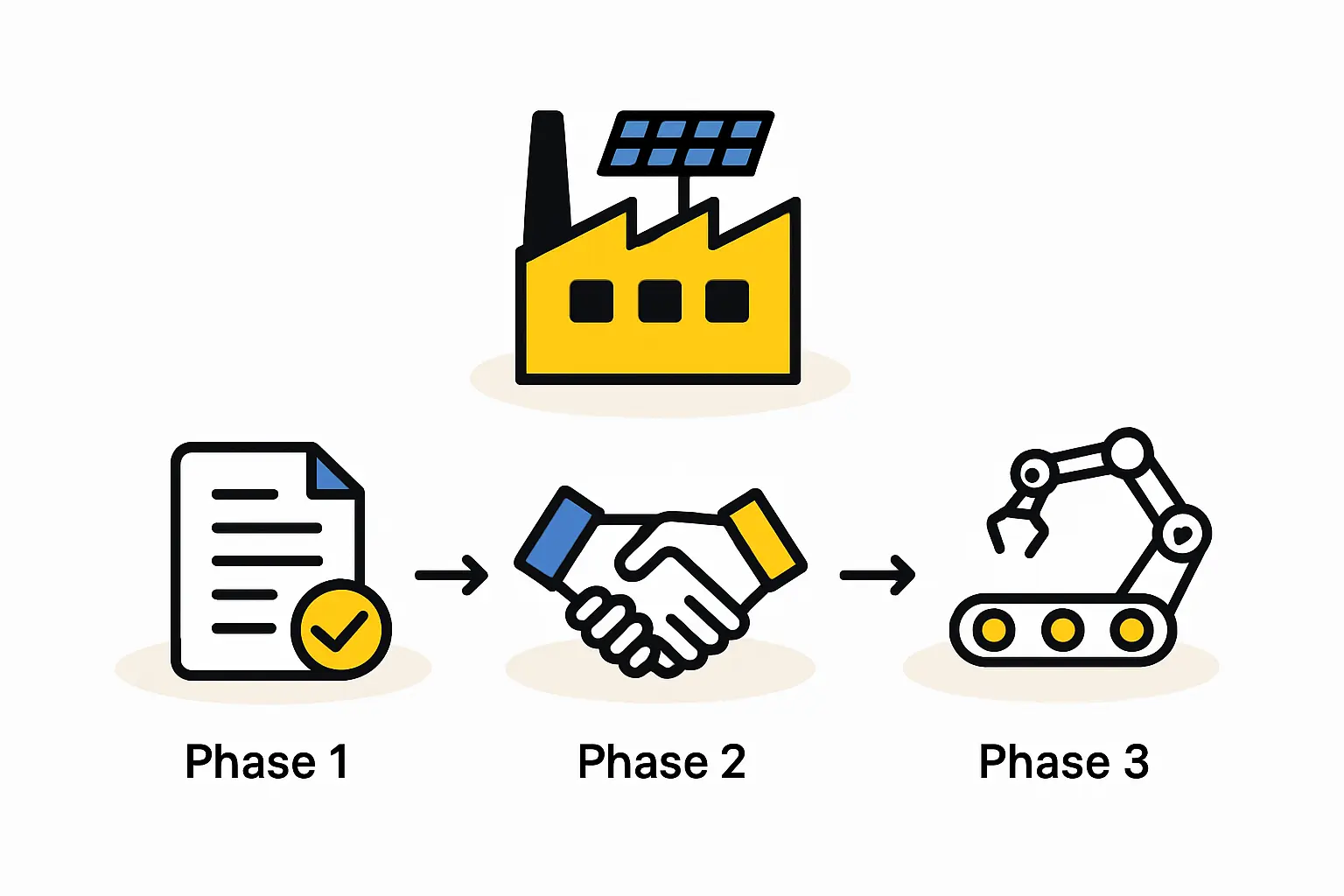
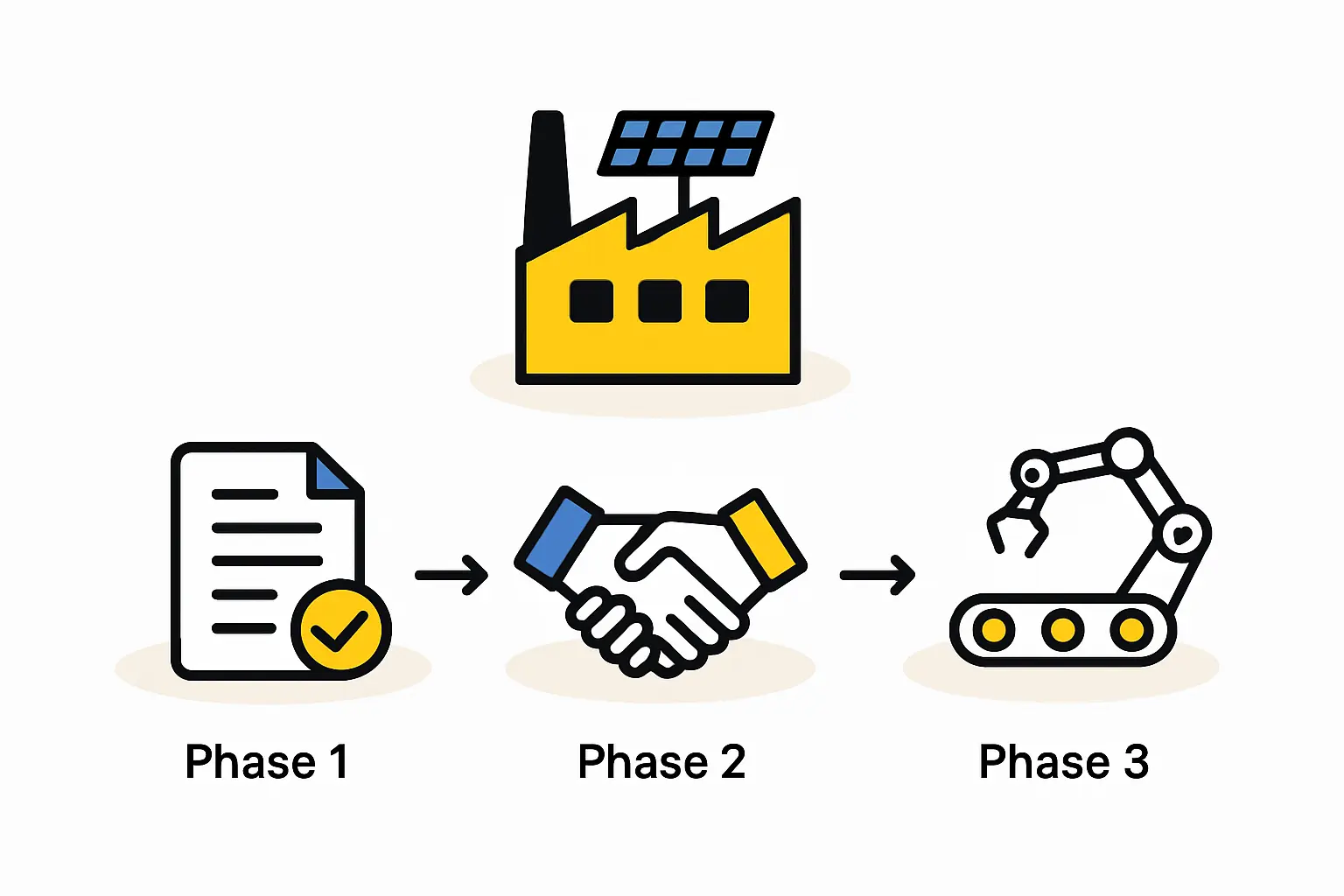
Phase 1: Foundation Building with Expatriate Experts
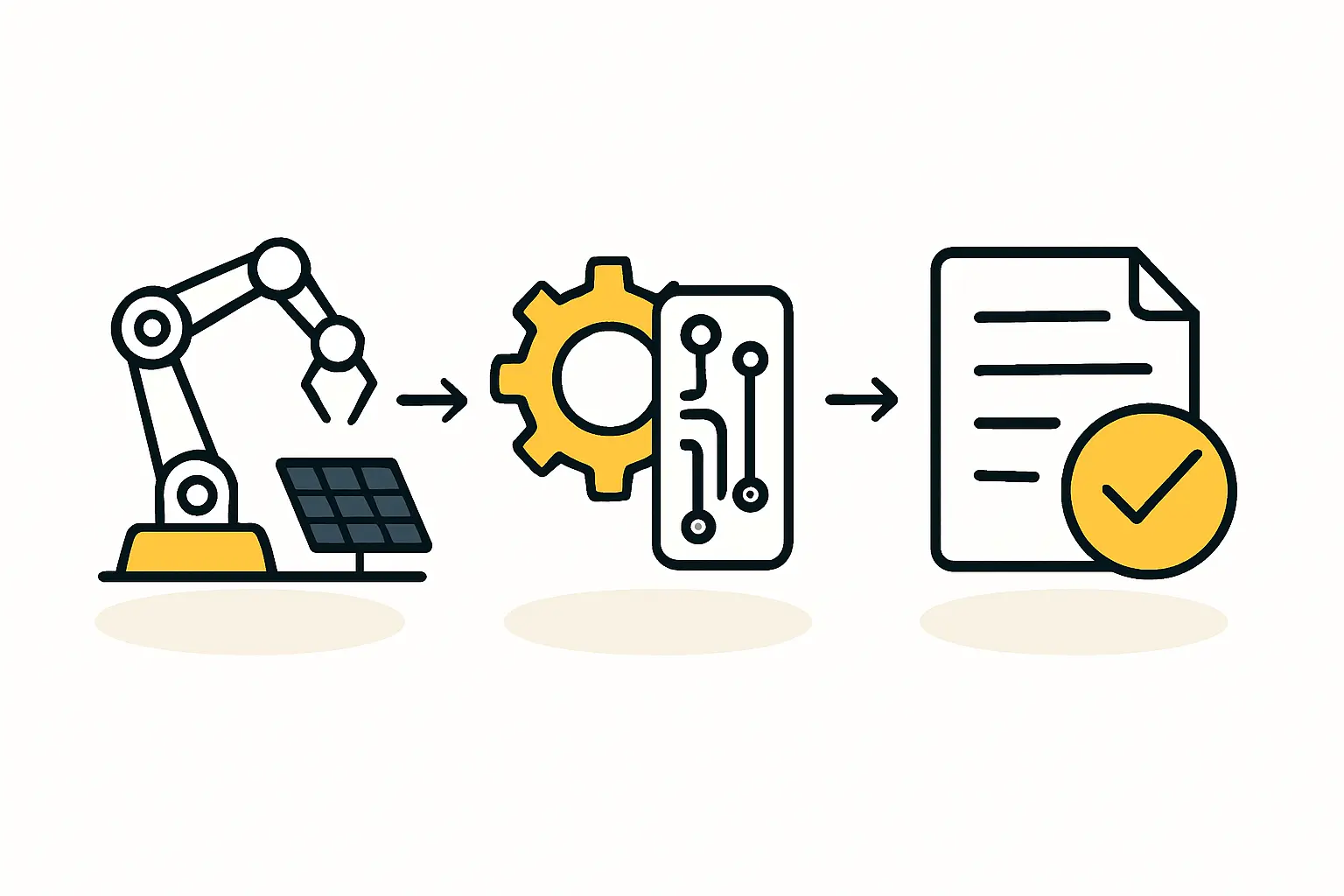
For the first 6 to 12 months, standard practice is to bring in a small team of two or three expatriate experts—typically a lead production engineer and a senior maintenance technician. Their immediate task is to correctly commission the production line, ensuring it quickly reaches target output and quality levels. This initial guidance is a critical part of a turnkey factory setup, preventing costly early mistakes. Beyond this, their primary long-term role is to act as trainers and mentors for the foundational local team. They establish the SOPs, safety protocols, and quality benchmarks that will define the factory’s culture.
Phase 2: The ‘Train-the-Trainer’ Model for Sustainability
A critical function for the expatriate experts is implementing a ‘train-the-trainer’ program. During the initial months, they identify local employees who demonstrate leadership potential, technical aptitude, and a strong understanding of the processes. These individuals, perhaps one or two future shift leaders and a lead technician, receive intensive, one-on-one coaching.
The goal is to empower this core group to become the next generation of internal trainers. This model ensures that operational knowledge becomes deeply embedded within the local organization, creating a self-sustaining system for training new hires and reducing long-term dependence on foreign specialists.
Phase 3: Collaboration with Local Technical Institutions
Once the factory is operational and the internal training system is established, the next phase involves building a sustainable talent pipeline. This means collaborating with local institutions such as Dominica State College or other Technical and Vocational Education and Training (TVET) centers.
A partnership could develop a short-term certificate program focused on the fundamentals of manufacturing quality control and basic electrical and mechanical principles. The company can provide input on the curriculum, offer factory tours, and sponsor internship opportunities. This creates a direct channel for recruiting pre-screened, motivated candidates, significantly lowering future recruitment costs and strengthening the company’s ties to the community.
Financial and Operational Considerations
Engaging expatriate experts represents a significant initial expense. However, this expenditure should be viewed as an investment, not merely a cost. The financial impact of a poorly trained team—resulting in high material waste, low product yield, equipment damage, and production delays—can far exceed the cost of professional initial training.
As a general benchmark, a typical startup team for a 20 MW line consists of 15-20 operators and 3-4 technicians, all trained under the supervision of 2-3 expatriate experts over a 9-month period. This structure provides a robust foundation for independent operation. This investment in human capital is a fundamental part of the overall solar factory investment and is essential for long-term profitability.
Frequently Asked Questions (FAQ)
What educational background is required for operators?
A secondary school education is generally sufficient. More important are soft skills: a strong work ethic, the ability to focus on detailed tasks, and a positive attitude toward learning and teamwork.
How long until a local team can operate the factory independently?
With the phased approach described, a core local team can typically manage day-to-day operations with minimal external supervision within 9 to 12 months. The identified local leaders will be capable of training new staff by the end of the first year.
Can remote video training be used to reduce costs?
Remote learning can be effective for conveying theoretical concepts or for ongoing support. However, for the initial setup and skill-building phase, there is no substitute for hands-on, in-person training on the actual machinery.
Where can a new venture find qualified expatriate experts?
Specialized engineering and consultancy firms that manage turnkey projects, such as J.v.G. Technology GmbH, typically provide experienced personnel as part of their project execution package. They select engineers and technicians with specific experience in launching new factories in international settings.
Conclusion: Building a Workforce as a Strategic Asset
The absence of a ready-made solar manufacturing workforce in Dominica is not a barrier to entry but a strategic challenge to be managed. By implementing a deliberate, phased approach—starting with expert-led training, fostering internal trainers, and building long-term partnerships with local educational institutions—an investor can build a skilled and motivated local team from the ground up.
This investment in human capital does more than just enable production. It creates a powerful and sustainable competitive advantage, builds significant goodwill within the community, and contributes directly to the nation’s broader goals of economic development and climate resilience. The result is not just a factory, but a lasting local asset.