Disclaimer: This case study represents a composite example derived from real-world
consulting work by J.v.G. Technology GmbH in solar module production and factory optimization. All data points are realistic but simplified for clarity and educational purposes.
For a nation blessed with over 330 days of sunshine annually, energy independence is less a distant dream than a tangible economic objective. Jordan’s strategic location and high solar irradiance present a unique opportunity to transition from an energy importer to a regional leader in renewable technology manufacturing.

This transformation requires more than just sunlight; it demands a robust industrial strategy, significant investment, and deep technical expertise. The most effective pathway is a large-scale, domestically-owned solar module factory—a ‘National Champion’ project.
This article outlines a strategic blueprint for establishing a 200 MW solar module manufacturing facility in Jordan, structured as a Public-Private Partnership (PPP). Engineered by an EU PV factory turnkey supplier expert, the phased implementation plan is designed to attract international financing and build sustainable, in-country value.
The Strategic Imperative for Domestic Solar Manufacturing
Many nations with high solar potential rely on importing solar modules, creating several strategic vulnerabilities:
- Supply Chain Risk: Global disruptions can halt national energy projects and cause price volatility.
- Capital Outflow: Billions of dollars are spent on foreign-made panels—money that could be invested domestically.
- Lack of Technical Sovereignty: A nation remains dependent on external technology and expertise, limiting innovation and the creation of high-skilled jobs.
Establishing a domestic manufacturing plant directly addresses these issues. It secures a supply of modules for national projects, keeps capital within the economy, and fosters a new generation of engineers and technicians. A 200 MW facility can produce approximately 500,000 panels per year, enough to power tens of thousands of homes and businesses while creating over 200 direct, skilled jobs.
The Public-Private Partnership (PPP) Framework: A Model for Success
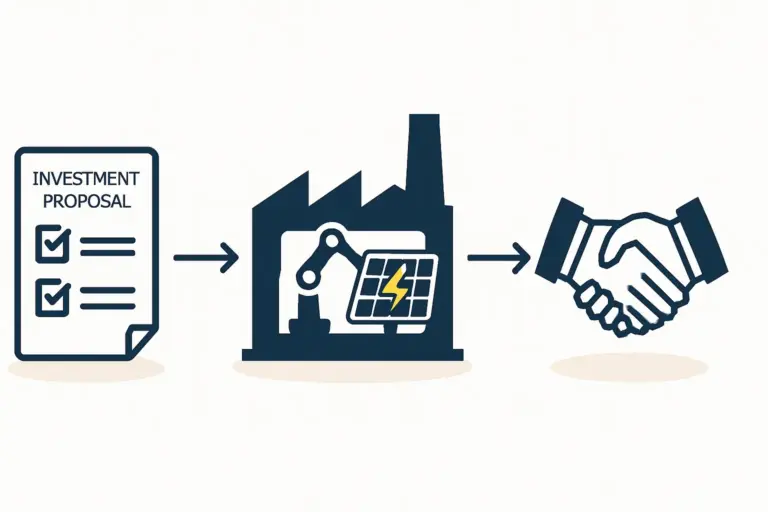
A project of this scale and national importance is best realized as a Public-Private Partnership. This model leverages the strengths of both sectors to de-risk the investment and ensure long-term viability.
The Role of the Public Sector (Government)
The government’s role is to act as a facilitator and strategic partner, creating an environment conducive to investment. Key responsibilities include:
- Guarantees and Offtake Agreements: Committing to purchase a percentage of the factory’s output for national energy projects provides the revenue certainty critical for securing financing.
- Land and Infrastructure: Providing a suitable site with access to utilities like power and water, as well as transport links.
- Regulatory Support: Streamlining permits and creating favorable investment policies, such as tax incentives or establishing a free-trade zone.
The Role of the Private Sector (Investors & Operators)
Private investors and the operational management team bring capital, commercial discipline, and efficiency. Their responsibilities include:
- Capital Investment: Securing a significant portion of the solar manufacturing investment costs alongside international financial institutions.
- Operational Excellence: Managing day-to-day operations, supply chain logistics, and quality control to international standards.
- Market Development: Driving sales to private domestic projects and developing export markets in the region.
The Role of the Technology Partner (An EU-Based Photovoltaic Manufacturing Solutions Partner)
The engineering partner provides the cornerstone of the project: the technical expertise to design, build, and commission the factory. This includes:
- Turnkey Implementation: Delivering the complete solar panel production line machinery and process know-how.
- Knowledge Transfer: Training local engineers and technicians to operate and maintain the facility independently.
- Technology Roadmap: Ensuring the factory is equipped with future-proof technology to remain competitive.
A Phased Implementation Plan for a 200 MW Facility
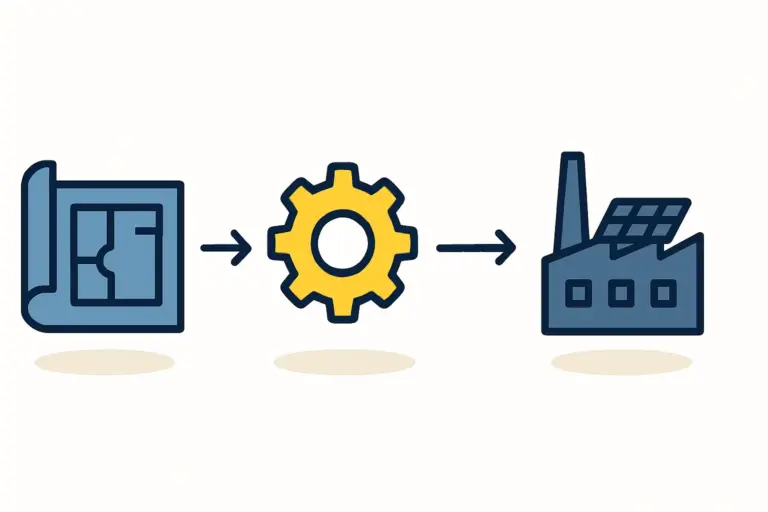
A project of this magnitude should be executed in phases to manage risk, build local capabilities systematically, and align with market demand. Drawing on established engineering principles developed in the 1990s, a specialized EU engineering partner proposes a three-phase approach.
Phase 1: The Foundation (Years 1-2) – 50 MW Pilot Line
The initial phase focuses on establishing a solid operational foundation and achieving international credibility.
- Objective: Build and commission a 50 MW semi-automated production line.
- Key Activities: Recruit and train a core team of 60-80 local engineers and operators, establish robust quality management systems, and achieve IEC certification for solar modules, a prerequisite for bankability and international sales.
- Outcome: A fully operational, certified factory producing high-quality modules, proving the project’s viability to all stakeholders.
Phase 2: Scaling Production (Years 3-4) – Expansion to 150 MW
With the foundation in place, the second phase focuses on scaling capacity and increasing automation to improve efficiency and reduce production costs.
- Objective: Add 100 MW of production capacity.
- Key Activities: Integrate higher levels of automation, such as automated bussing and framing stations, expand the workforce and implement advanced training programs, and begin developing a local supply chain for components like aluminum frames and junction boxes.
- Outcome: A highly efficient 150 MW facility capable of meeting a significant portion of Jordan’s domestic demand and initiating exports.
Phase 3: Technology Leadership (Years 5+) – Reaching 200 MW and Beyond
The final phase positions the factory as a regional technology leader capable of producing next-generation solar modules.
- Objective: Upgrade and expand the line to 200 MW, incorporating advanced cell technology.
- Key Activities: Introduce production capabilities for high-efficiency modules (e.g., TOPCon or HJT), establish a small R&D unit to collaborate with local universities on material science and process optimization, and solidify the factory’s brand as a premium supplier in the MENA region.
- Outcome: A flagship national asset that drives innovation, generates significant export revenue, and anchors Jordan’s position as a renewable energy powerhouse.
Attracting International Finance and Ensuring Bankability
International development banks (such as the World Bank, EIB, or KfW) and private equity funds are actively seeking to finance well-structured renewable energy projects in emerging markets. The PPP model, combined with a credible technology partner, makes this project highly attractive.
A German engineering partner, such as an established European industrial solutions provider lends immense credibility. With over three decades of experience delivering turnkey solar factory solutions across the globe, the company’s involvement assures financial institutions that:
- The project plan is technically sound and based on proven experience.
- The budget and timelines are realistic.
- The technology is state-of-the-art and reliable.
- A robust knowledge transfer plan is in place to ensure long-term operational success.
This combination of government backing, private sector investment, and proven German engineering creates a low-risk, high-impact proposition that meets the stringent requirements of international financiers.
Frequently Asked Questions (FAQ)
1. Why is 200 MW the target capacity?
A 200 MW scale is large enough to achieve economies of scale, making production costs competitive with imports. It also represents a significant capacity to meet national targets and establish a strong export base without oversaturating the initial domestic market.
2. What is the typical timeline from agreement to first production?
For Phase 1 (50 MW), a realistic timeline is 12–15 months from the final investment decision to the production of the first certified module. This period includes factory layout design, machine procurement, installation, and commissioning.
3. How does this project contribute to local job creation?
A 200 MW facility directly employs over 200 people, including engineers, technicians, quality control specialists, and administrative staff. It also creates hundreds of indirect jobs in logistics, raw material supply, and maintenance services, fostering a new industrial ecosystem.
4. What makes German engineering a critical component for success?
German engineering holds a global reputation for precision, reliability, quality, and efficiency. In a complex industrial project like a solar factory, this ensures production lines are designed for maximum uptime, low material waste, and consistent output of high-quality products—factors essential for long-term profitability and bankability.
5. Can the factory produce different types of solar panels?
Yes. The production line is designed with flexibility in mind. While it may start with standard monofacial PERC modules, the technology roadmap includes upgrades to produce more advanced products like bifacial modules, which capture sunlight from both sides, and higher-efficiency TOPCon modules as the market evolves.

Conclusion: Building a Legacy of Energy Sovereignty
Establishing a 200 MW solar manufacturing facility is more than an industrial project; it is a declaration of national ambition. It is a strategic investment in Jordan’s economic future, energy security, and technological capacity.
Through a well-structured Public-Private Partnership and guided by an experienced engineering partner, this vision is entirely achievable. The phased approach mitigates risk, builds local expertise, and creates a sustainable industrial asset that will serve the nation for decades. By transforming its abundant sunshine into a high-value manufactured product, Jordan can build a true National Champion and a lasting legacy of innovation and sovereignty.
Download: Jordan 200 MW Public-Private Partnership Case Study (PDF)
Author: This case study was prepared by the
turnkey solar module production specialists at J.V.G. Technology GmbH
It is based on real data and consulting experience from J.v.G. projects
worldwide, including installations ranging from 20 MW to 500 MW capacity.