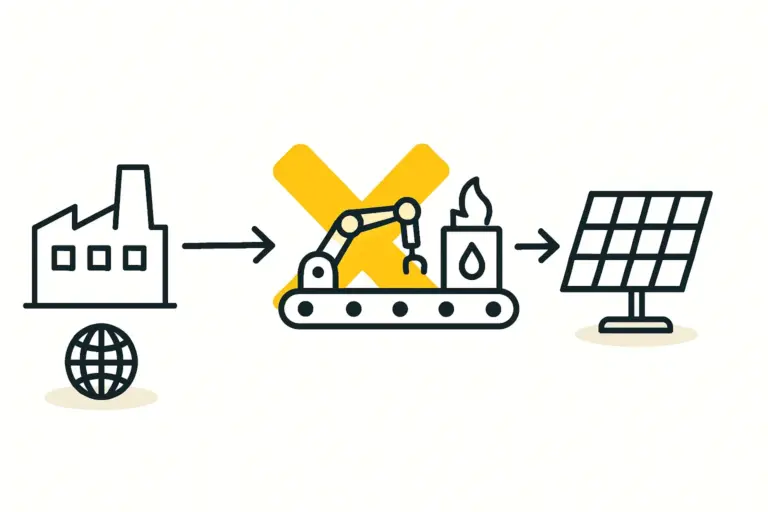
Imagine establishing a modern solar module factory in one of the world’s most economically isolated environments. The technical and logistical challenges would be immense, requiring careful planning for machinery procurement, supply chain management, and workforce training.
But beneath these operational hurdles lies a far more complex and critical challenge: navigating the financial system. For any entrepreneur considering such a venture, understanding the flow of money—from initial investment to eventual profit—is fundamental to building a viable business case.
This article offers a high-level overview of the theoretical financial protocols for capital-intensive projects, such as a solar panel manufacturing line, within the Democratic People’s Republic of Korea (DPRK). It explores the mechanisms for capital investment, the impact of currency controls, and the pathways for profit repatriation, all framed by the country’s unique legal and economic structure.
The Core Challenge: A Dual-Currency System and Capital Controls
The primary financial complexity in the DPRK stems from its rigidly controlled, dual-currency system. Officially, the domestic currency is the North Korean Won (KPW). In practice, foreign hard currencies—primarily the Euro, U.S. Dollar, and Chinese Yuan—are used for international trade and are highly sought after by the state.
For a foreign investor, this system presents an immediate operational challenge. Capital for a project, such as a 50 MW solar module assembly line, would arrive in a hard currency. Yet many local expenses, including labor, land leases, and construction materials, might be denominated or paid in KPW.
This discrepancy forces investors to navigate an official exchange rate that often differs significantly from informal market rates, creating inherent financial risk and accounting complexities. All foreign exchange transactions are supervised by state-controlled entities, most notably the Foreign Trade Bank of the DPRK, making financial autonomy virtually nonexistent.
Pathways for Capital Investment
Historically, foreign investment in the DPRK has been channeled through specific, state-approved structures. For a project like a solar factory, the following models are the most relevant.
Joint Ventures (JVs)
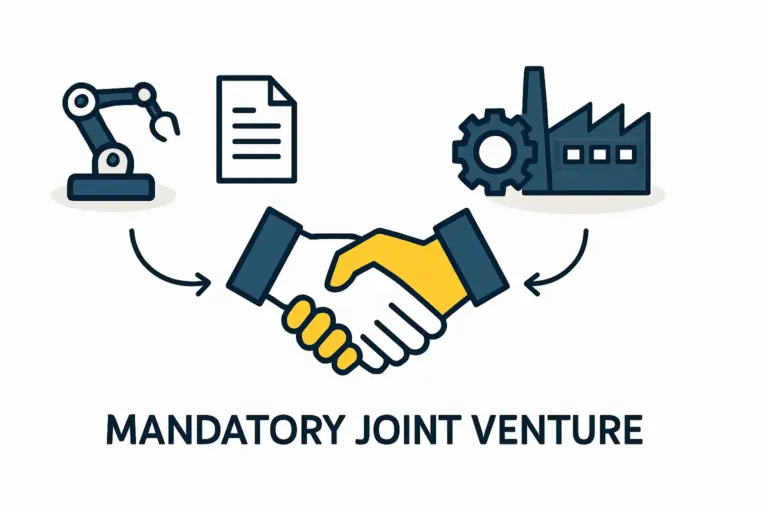
The most traditional method for foreign investment has been the joint venture. In this model, a foreign partner typically provides capital, technology, machinery, and international management expertise. The local DPRK partner contributes land, buildings, labor, and crucial access to government permits and utilities. Profits and control are shared according to a negotiated equity split. This structure is designed to give the state significant oversight while leveraging foreign capital and knowledge.
Wholly Foreign-Owned Enterprises (WFOEs)
In certain designated areas, DPRK law permits the establishment of wholly foreign-owned enterprises. This model theoretically offers the investor 100% control over business operations and profits. However, these enterprises are almost exclusively limited to Special Economic Zones (SEZs), where different laws and regulations apply.
Special Economic Zones (SEZs)
SEZs are the most realistic entry points for significant foreign investment. Zones like the Rason Special Economic and Trade Zone were established to attract foreign capital by offering more liberal business regulations, tax incentives, and legal frameworks distinct from the rest of the country. For a solar manufacturing project, establishing a facility within an SEZ would be the standard approach, as it provides a clearer, albeit still complex, legal and financial environment.
The process of establishing a turnkey factory setup in such a jurisdiction requires a profound adaptation of standard international practices to meet local legal and banking requirements.
Navigating Currency Controls and Operational Finance
Once capital is invested, managing day-to-day finances becomes the next major hurdle. The DPRK’s Foreign Exchange Control Law mandates that all foreign currency entering the country must be registered and managed through designated state banks.
A solar factory, for instance, would constantly need foreign currency to import critical raw materials like photovoltaic cells, EVA encapsulant, and specialized glass. At the same time, it would incur local costs in KPW. This dynamic requires a meticulously managed dual-currency accounting system, where every transaction between foreign and local currency accounts is subject to state approval.
Based on experience from J.v.G. turnkey projects in other highly regulated emerging markets, a robust financial plan must anticipate potential delays in currency conversion and a lack of conventional banking tools. Such detailed planning is a critical component of the initial investment requirements analysis.
The Critical Question: Profit Repatriation
For any investor, the ultimate goal is to generate a return. Profit repatriation—the process of sending profits from a foreign enterprise back to the investor’s home country—is a litmus test for the viability of any project.
Theoretically, the DPRK’s foreign investment laws allow for the repatriation of legal profits after the payment of income taxes and contributions to any required reserve funds. The process typically requires submitting audited financial statements and an application to the relevant state financial authority, which must then approve the transfer of foreign currency out of the country.
In practice, the reality can be exceptionally challenging. The chronic shortage of hard currency within the country means the state may be unable or unwilling to facilitate large outflows. In similar high-risk jurisdictions, investors often structure agreements where a portion of the manufactured goods (e.g., solar modules) is exported directly by the foreign partner, with sales proceeds collected offshore. While this can mitigate direct repatriation risk, it requires complex legal structuring and state approval.
The Overarching Factor: International Sanctions
It is impossible to discuss investment in the DPRK without addressing the comprehensive international sanctions regime. The United Nations, along with individual nations like the United States and the European Union, has imposed extensive sanctions that severely restrict or prohibit trade, financial transactions, and investment.
These sanctions target specific industries, including metals, machinery, and electronics, and block transactions with designated North Korean entities. Any transfer of funds, procurement of manufacturing equipment, or export of finished goods would face intense legal scrutiny. For a prospective investor, this means that even if a project appears viable on paper, executing it without violating international law is a monumental, and often impossible, task. This risk factor is paramount and overrides nearly all other business considerations.
Frequently Asked Questions (FAQ)
What is the role of a foreign-invested bank in the DPRK?
Foreign-invested banks or branches have been permitted, primarily within SEZs. Their role is generally limited to facilitating approved transactions for other foreign investors within the zone, acting as intermediaries rather than full-service commercial banks.
Can contracts be arbitrated internationally?
DPRK law allows for disputes to be settled via international arbitration, and investment contracts often specify neutral locations like Singapore or Stockholm. However, the practical enforceability of an international arbitration award within the DPRK’s legal system remains a significant point of uncertainty.
How are taxes calculated on foreign investments?
The tax framework, particularly within SEZs, is designed to be competitive, often including a corporate income tax rate lower than in many other countries, along with tax holidays for priority industries. However, the tax code can be opaque and subject to sudden changes by the state.
Is it possible to secure project financing for a DPRK venture?
Securing financing from conventional international banks is not feasible due to the combination of sovereign risk, a lack of transparency, and, most importantly, sanctions. Funding for such projects almost exclusively originates from specialized private investors with a high-risk tolerance or state-backed entities pursuing specific geopolitical objectives.
Conclusion: A Framework for Assessment, Not a Roadmap
While a formal legal framework defines the financial protocols for investing in a capital-intensive project like a solar factory in the DPRK, the practical application of these laws is immensely challenged by a state-controlled economy, a rigid dual-currency system, and an overarching international sanctions regime.
Understanding these complex financial layers is a prerequisite for any serious project feasibility study. Success in the solar manufacturing industry requires more than technical knowledge; it demands a comprehensive grasp of the unique business environment. Guidance from experienced engineering and consultancy partners can help structure this assessment, ensuring that all risks—financial, operational, and geopolitical—are thoroughly evaluated.