Many successful entrepreneurs assume that with sufficient capital, a factory can be built anywhere. But while financial readiness is crucial, a project’s viability often hinges on something more fundamental yet frequently overlooked: the quality of the local industrial infrastructure.
The availability, reliability, and cost of electricity, water, and suitable land can determine the success or failure of a manufacturing venture long before the first machine is purchased.
This article uses the Republic of San Marino as a micro-case study to illustrate the process of a thorough infrastructure assessment. While the data is specific to this European microstate, the analytical framework offers a universal blueprint for investors evaluating locations worldwide, from Africa to the Middle East.
The Foundation: Why Power, Water, and Land Dictate Feasibility
A solar module factory is a sophisticated operation with specific, demanding utility requirements. A preliminary assessment must therefore go beyond simple availability to examine three core pillars:
Electricity
Solar panel manufacturing is energy-intensive. The question is not merely whether power is available, but whether the grid is stable enough for sensitive machinery and the cost per kilowatt-hour is sustainable for a profitable operation. An unstable grid can lead to production stoppages and damaged equipment, while high energy tariffs can erode margins.
Water
A consistent supply of clean water is essential, primarily for washing glass during production. Impurities in the water can cause defects in the final product. An investor must assess both volume availability and the cost per cubic meter.
Land and Buildings
An ideal site is more than just an empty plot. It must be in a designated industrial zone to simplify permitting, offer excellent road access for heavy logistics, and be on land suitable for constructing a factory building that meets the specific requirements of solar panel manufacturing.
Electricity Supply in San Marino: A Deep Dive
An investigation into San Marino’s energy landscape reveals a critical structural dependency: the republic imports 100% of its electricity from Italy. The national grid is managed by the Azienda Autonoma di Stato per i Servizi Pubblici (AASS), which receives power from Italy via a 132 kV high-voltage line.

Key Data Points:
- Source: 100% imported from Italy.
- Local Distributor: AASS (Azienda Autonoma di Stato per i Servizi Pubblici).
- Industrial Tariff: Approximately €0.20 – €0.30 per kilowatt-hour (kWh).
For a potential investor, this single-source dependency is both a simplification and a risk. On one hand, dealing with a single, state-owned utility (AASS) streamlines negotiations. On the other, the country’s entire power supply is vulnerable to technical or commercial issues originating from the Italian grid.
The industrial tariff, though stable, is a significant operational expense that must be factored into any business model. This dependence underscores the importance of understanding the complete energy value chain when planning how to start a solar panel manufacturing plant.
Water Resources: Availability and Cost Considerations
In contrast to its electricity, San Marino’s water is sourced locally from springs and wells and is also managed by the AASS. This local control offers greater stability than the imported power supply.
Key Data Points:
- Source: Local springs and wells.
- Management: AASS.
- Industrial Tariff: Approximately €2.50 per cubic meter (m³).
Although the supply is generally considered reliable, due diligence should include confirming supply guarantees with AASS, especially during drier seasons. The €2.50/m³ tariff is a direct input into the cost of goods sold and must be weighed against the factory’s projected water consumption for glass washing and other processes.
Identifying Suitable Industrial Land in San Marino
San Marino has several well-defined industrial zones—a significant advantage for any new enterprise. Operating within these zones simplifies zoning compliance and ensures access to basic infrastructure.
Key Industrial Zones:
- Faetano
- Gualdicciolo
- Rovereta
Key Data Points:
- Purchase Price for Industrial Land: €250 – €400 per square meter (m²).
- Annual Rent for Industrial Buildings: €35 – €50 per square meter (m²).
The availability of designated zones is a positive indicator, but an investor must conduct a site-specific survey. This survey should answer critical questions: Does the plot have a high-capacity electrical connection at its boundary? Can the road access handle 40-foot containers for materials and shipments? Is it more financially prudent to acquire land and build a new facility, or to lease and retrofit an existing building? The latter often allows for a faster start to production but may involve compromises in layout and efficiency.

Synthesizing the Data: A SWOT Analysis for San Marino
This infrastructure assessment provides the basis for a Strengths, Weaknesses, Opportunities, and Threats (SWOT) analysis. This framework helps transform raw data into strategic insights.
Strengths:
- Well-defined industrial zones with clear regulations.
- A single, state-owned utility simplifies negotiations for power and water.
- Location within Europe, providing access to a mature market.
Weaknesses:
- 100% dependency on imported electricity, creating price and supply risks.
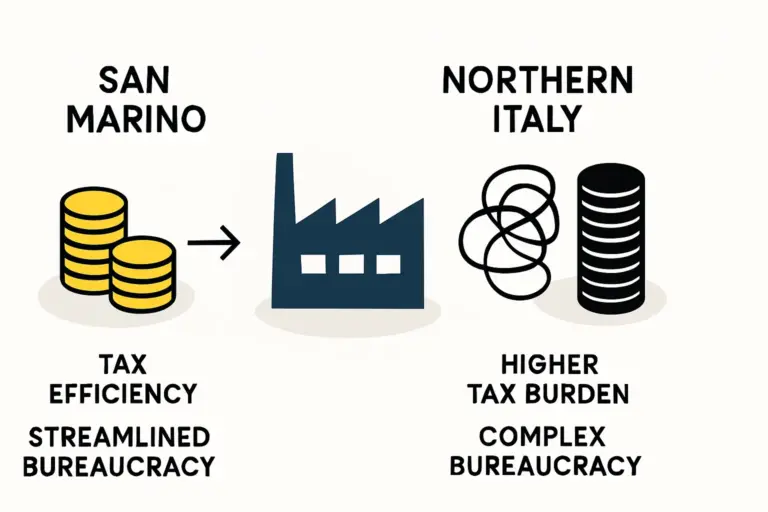
- Relatively high utility costs compared to some other manufacturing regions.
- Limited land availability due to the country’s small size.
Opportunities:
- Potential for government incentives to attract foreign investment in renewable energy manufacturing.
- ‘Made in San Marino’ branding could appeal to customers valuing European quality standards.
- Opportunity to install a large rooftop solar system on the factory to offset high electricity costs.
Threats:
- Energy price volatility in the Italian market directly impacts production costs.
- Logistical complexities associated with being a landlocked microstate.
- Potential for water scarcity during prolonged droughts, impacting production.
This type of analysis, often part of a comprehensive feasibility study, is critical to making an informed investment decision. J.v.G. Technology GmbH’s experience with turnkey projects shows that overlooking these foundational factors is a common and costly mistake.
Frequently Asked Questions (FAQ)
How much power does a typical small-scale solar factory need?
A semi-automated solar module production line with an annual capacity of around 50 MW typically has a peak power demand of 250–500 kW. This requires a dedicated industrial-grade connection and transformer, which must be verified during the site assessment.
Is it feasible to power the factory with its own solar panels?
A factory can significantly reduce its electricity costs by installing a large solar PV system on its roof. However, it cannot operate entirely off-grid. The sensitive machinery involved in the solar panel manufacturing process requires the stable frequency and voltage provided by a national grid connection to function reliably 24/7. The rooftop system serves to offset operational costs, not replace the grid connection.
How does this assessment in San Marino apply to my country?
The principles are universal. Whether you are in Nigeria, Saudi Arabia, or Brazil, the methodology is the same. You must investigate:
- Power: Who is the provider? What is the cost? How reliable is the grid?
- Water: Where does it come from? Is the supply consistent? What is the industrial tariff?
- Land: Are there designated industrial zones? What is the quality of road access? What are the costs to buy or lease?
The answers will change, but the critical questions remain the same.
From Assessment to Action Plan
This case study of San Marino illustrates that a successful solar manufacturing project begins long before any equipment is ordered. It starts with a meticulous, on-the-ground assessment of three fundamental resources: power, water, and land.
By systematically analyzing their availability, reliability, and cost, an entrepreneur can build a business plan grounded in reality, mitigating risks and paving the way for long-term success.
Undertaking a detailed feasibility study is a core part of the initial planning phase. For business professionals seeking a structured approach to this process, the resources and courses at pvknowhow.com provide a comprehensive roadmap for navigating these critical early stages.