An investor evaluating the potential of solar module manufacturing in an emerging market often focuses first on technology, financing, and logistics. However, the most critical component for long-term success is often the most overlooked: building a competent and reliable local workforce.
In a nation like Sao Tome and Principe, with a limited industrial base, the question is not if a skilled team can be developed, but how. This article lays out a practical framework for recruiting, training, and managing a local production team for a new solar factory. Using Sao Tome as a case study, it provides a replicable strategy for transforming high-potential individuals into skilled technical operators. The approach demonstrates that a lack of prior industrial experience is no barrier to establishing a world-class manufacturing operation.
Understanding the Local Labor Landscape in Sao Tome and Principe
An effective workforce strategy begins with understanding the specific context of the local labor market. Sao Tome and Principe, a small island nation in the Gulf of Guinea, presents a unique landscape of challenges and opportunities.
The nation’s economy has historically relied on agriculture—primarily cocoa, coffee, and palm oil. While tourism is a growing sector, formal industrial activity remains limited. Key labor market statistics offer essential context for any investor:
- Workforce Size: The total labor force is approximately 68,000 individuals.
- Unemployment: Youth unemployment stands at a significant 18.6%, indicating a large pool of available, younger candidates.
- Informal Sector: An estimated 89.5% of the workforce operates in the informal economy. This represents an opportunity to offer stable, formal employment that is highly valued.
- Education Levels: The average citizen has 6.4 years of formal schooling. This suggests that training programs must be practical, hands-on, and not reliant on high levels of academic knowledge.
The primary challenge identified by businesses in the region is a skills gap, particularly in technical and vocational fields. For a solar manufacturing venture, this is not an insurmountable obstacle. Instead, it defines the starting point: the strategy must be built around skill creation, not just skill acquisition.
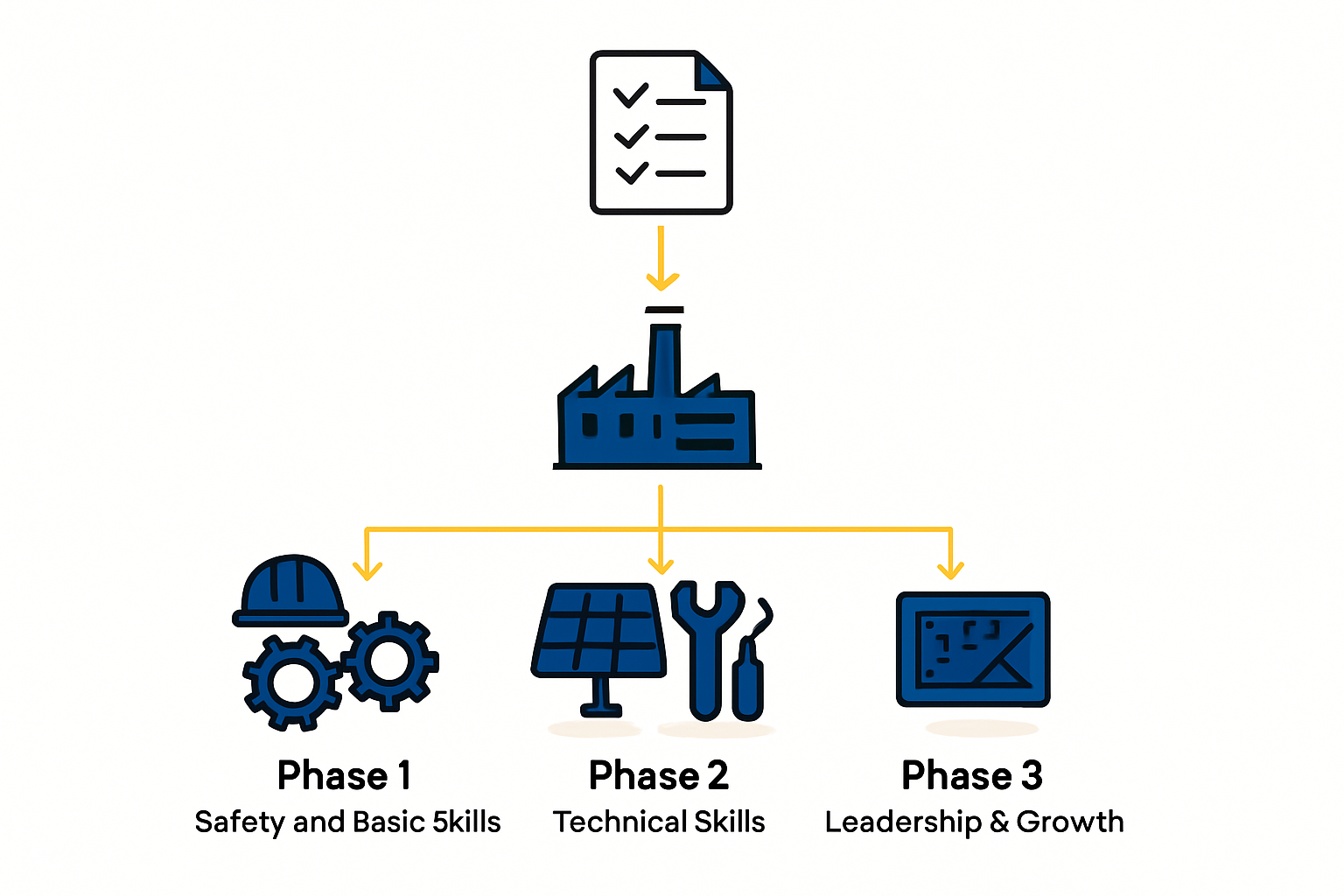
A Phased Approach to Building Your Production Team
A structured, phased approach is essential for assembling a team from the ground up. This method builds a strong foundation of leadership and technical knowledge before scaling up the full production crew.
Phase 1: Identifying Core Leadership and Technical Supervisors
The initial hires are the most critical. This core team, typically consisting of a Production Manager and a Quality Control Supervisor, will become the foundation of your factory’s operational excellence. In a market like Sao Tome, these individuals may not come from a solar background. The search should focus on candidates with experience in any form of process management, quality assurance, or team leadership.
Their most important attributes are problem-solving skills, leadership potential, and the ability to absorb and transfer technical knowledge. This small group will often receive intensive, direct training from equipment suppliers and technical partners.
Phase 2: Recruiting High-Potential Operators
With the leadership team in place, the focus shifts to recruiting machine operators and assembly line workers. For these roles, aptitude must be prioritized over existing experience. An ideal candidate profile for an entry-level operator role includes:
- Attention to Detail: Crucial for tasks like cell stringing and quality inspection.
- Manual Dexterity: Important for handling delicate components like solar cells and glass.
- Reliability and Discipline: Essential for maintaining consistent production schedules.
- Willingness to Learn: A positive attitude toward acquiring new technical skills is non-negotiable.
Recruitment efforts should be localized, working with community centers, vocational institutions, and public announcements. Given the high youth unemployment, there is a substantial pool of motivated individuals seeking formal, long-term employment opportunities.
Ready to make big Profits?
The solar Industry is Booming
WE HELP NEWCOMERS to the solar industry start their own solar module production line. Customers can make BIG PROFITS by selling modules and finding investors, without wasting money and time on things they don't need!
Designing an Effective Training Program: From Theory to Practice
A well-designed training program is what transforms raw potential into technical proficiency. The program should be divided into distinct, complementary stages.
Foundational Classroom Training
Before any employee touches a machine, they must understand the ‘why’ behind their work. This initial phase, typically lasting one to two weeks, covers essential theoretical knowledge in an accessible format:
- Basics of Photovoltaics: How a solar cell works and how modules generate electricity.
- Production Workflow: A high-level overview of the entire solar panel production process, from raw materials to the final product.
- Safety Protocols: Comprehensive training on workplace safety, electrical hazards, and proper handling of materials.
- Quality Standards: Introducing the concept of quality control and why precision at every step is vital.
This classroom instruction ensures that the entire team shares a common language and understands the importance of their role in creating a high-quality product.
Hands-On Machine-Specific Training
This is the most critical phase, where theoretical knowledge becomes a practical skill. The most effective method is a ‘Train the Trainer’ model. The core supervisors—who have already received expert instruction—then lead the training for new operators on the actual production equipment.
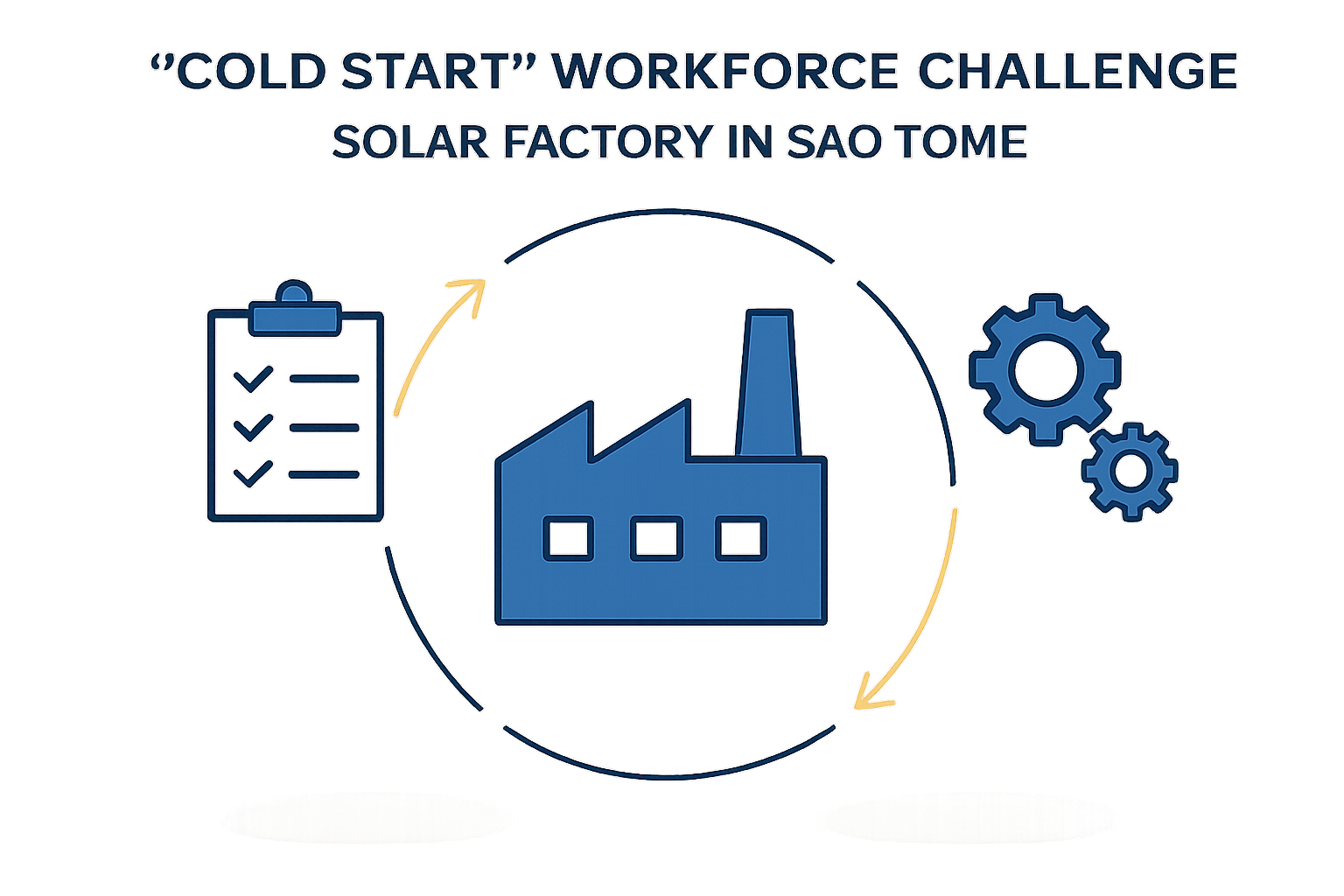
The process is methodical:
- Demonstration: The supervisor demonstrates the correct operation of a machine (e.g., a solar cell stringer or laminator).
- Shadowing: The trainee observes the supervisor, asking questions and learning the workflow.
- Supervised Operation: The trainee operates the machine under the direct supervision of the trainer, who provides real-time feedback and correction.
- Independent Operation: The trainee gradually assumes full responsibility for the machine, with quality checks and ongoing support from the supervisor.
This hands-on approach builds muscle memory and confidence, ensuring operators are not just following steps but understanding the machinery they command. Understanding the main components of a solar module becomes second nature through this tactile learning process.
Ongoing Quality Control and Skill Refinement
Training is a continuous process, not a one-time event. Maintaining high standards requires a system of ongoing skill development. This includes regular quality control reviews, performance feedback, and cross-training employees on different machines. Cross-training creates a more flexible and resilient workforce, capable of adapting to changing production demands.
Business-Relevant Metrics: Staffing a 20 MW Solar Factory
For investors, understanding the practical staffing requirements is key. A typical 20 MW semi-automated solar module factory operating on a single shift requires a surprisingly lean team.
- Total Staff: Approximately 25–30 employees.
- Management & Administration: 2-3 (General Manager, Office Support).
- Supervisors: 2 (Production Supervisor, Quality Control Supervisor).
- Machine Operators & Line Workers: 15-20 (Covering all stations from stringing to framing).
- Logistics & Maintenance: 3-4 (Warehouse management, equipment maintenance).
Based on experience from J.v.G. turnkey projects, this staffing level is a solid foundation for efficient operation, with the potential to add a second shift to double capacity as the team’s proficiency grows.
The Strategic Advantage of Local Investment
Investing in a local workforce in a market like Sao Tome offers benefits that extend beyond the factory floor. It aligns the business with national development goals, such as reducing unemployment and transitioning workers from the informal to the formal economy. This creates significant goodwill with local authorities and communities.
A factory that provides stable, well-paying jobs and invests in professional development becomes a cornerstone of the local economy. This approach builds a loyal, motivated workforce and establishes the company as a respected long-term partner, creating a far more sustainable model than one that relies on expatriate labor. The overall venture becomes part of the local solution, addressing energy needs while creating economic opportunity. For a complete picture, it is useful to understand the full investment requirements for starting a solar module production business, as labor is a key component of the operational budget.

Frequently Asked Questions (FAQ)
What level of formal education is required for machine operators?
For most operator roles, a primary or secondary school education is sufficient. The focus should be on assessing an individual’s aptitude, attention to detail, and ability to follow procedures. Practical skills and trainability are more important than academic qualifications.
How long does it take to fully train a new production team?
A structured program can get a new team operational in 4 to 6 weeks. Achieving high efficiency and proficiency typically takes 3 to 6 months of continuous operation, coaching, and on-the-job refinement.
Is it necessary to hire foreign experts for a new factory?
It is highly recommended to engage foreign experts or technical partners for the initial setup, machine commissioning, and the ‘Train the Trainer’ phase. However, the primary goal should be to create a self-sufficient local team. The initial experts are there to transfer knowledge, not to run the factory long-term.
What are the primary challenges in retaining trained staff?
In a market with few formal industrial employers, a company that invests in its people and offers competitive wages and a positive work environment typically experiences high retention rates. The key is to become the employer of choice by fostering a culture of respect, safety, and professional growth.
Conclusion: Building a Foundation for Long-Term Success
Establishing a solar module factory in an emerging market like Sao Tome and Principe is an ambitious but achievable goal. The key to unlocking its potential lies not in the hardware, but in the people who operate it.
By implementing a strategic, phased approach to recruitment and a robust, hands-on training program, an investor can build a highly skilled and motivated local workforce from the ground up. This investment in human capital is the true foundation for sustainable manufacturing. It creates a competitive advantage that ensures the long-term profitability and positive local impact of the venture. With structured guidance, like that provided in the pvknowhow.com e-course, the path to developing this critical asset becomes clear and manageable.