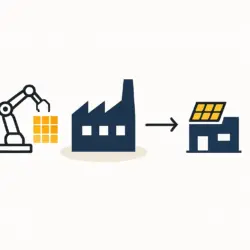
Rajasthan Electronics & Instruments Limited (REIL) has launched a significant initiative to expand solar power generation across India, issuing a Notice Inviting Tender (NIT) for a 17.55 MW rooftop solar project. Announced around January 20-21, 2025, the tender seeks partners for a comprehensive rate contract to install grid-connected systems on government buildings spanning 22 states and union territories.
The scope of the contract is extensive, covering the entire project lifecycle from initial surveys and design to the supply, installation, testing, and commissioning of the solar assets. Critically, the tender also includes a 10-year comprehensive operation and maintenance (O&M) period, ensuring the long-term performance and viability of the installations.
REIL Issues Tenders for 17.55 MW Rooftop Solar Projects: Procurement and Eligibility Details
The tender process is structured to select technically and commercially qualified firms registered in India. Prospective bidders must have a proven track record in designing and installing grid-connected solar power plants. A key financial requirement is the submission of an Earnest Money Deposit (EMD) equivalent to 2% of the estimated cost for each region a bidder applies for.
To ensure competitive pricing and project distribution, the work will be allocated between the two lowest bidders. The L-1 bidder will be awarded 70% of the tendered capacity, with the remaining 30% offered to the L-2 bidder at the same rate established by L-1. However, REIL reserves the right to modify these allocations based on specific customer requirements.
Technical Mandates and Quality Assurance
The tender places a strong emphasis on high-quality components and adherence to national manufacturing goals. All projects must utilize Mono-Perc solar panels with a minimum power output of 540Wp, in line with Ministry of New and Renewable Energy (MNRE) guidelines. In a significant push for the “Make in India” initiative, both solar PV modules and inverters must be sourced from Class-I local suppliers.
Durability and performance are central to the requirements. Solar modules must comply with IEC 61215, IS 14286, and IEC 61730 standards and feature RFID tags for traceability. Manufacturers must provide a warranty guaranteeing at least 90% of the rated power output for the first ten years and 80% for the subsequent fifteen years. Mounting structures must be robust, made from materials like hot-dip galvanised iron or aluminium, and certified to withstand local wind loads. Furthermore, installations must include DISCOM-compliant energy meters with a minimum ten-year warranty, with bidders responsible for replacements during this period.
This large-scale tender represents a major opportunity for domestic renewable energy firms to contribute to India’s clean energy targets while promoting indigenous manufacturing and sustainable infrastructure on government properties nationwide.
Sources
- REIL Issues Rate Contract Tender for 2 MW Rooftop Solar …
- REIL’s Comprehensive 17.55 MW Tender For Rooftop …
- REIL Issues Tender for 17.55 MW Rooftop Solar Rate …
- Tag: REIL tender
- REIL Floats Rate Contract Tender for 17.55 MW Rooftop …
- Government Solar Tenders