
Securing capital for a solar panel recycling facility presents challenges distinct from those of traditional renewable energy generation projects. While a solar farm’s bankability is anchored in predictable energy generation and long-term power purchase agreements (PPAs), a recycling plant’s financial viability depends on a more complex interplay of feedstock availability, technological efficiency, and volatile commodity markets for recovered materials.
For investors, waste management operators, and public sector partners evaluating this emerging industry, understanding the appropriate project finance structures is the critical step in transforming a business plan into a bankable, operational asset. This guide outlines the primary financing models for capital-intensive recycling infrastructure and details how each structure addresses the sector’s specific risk profile.
The Unique Financial Profile of Solar Recycling
A solar recycling project is fundamentally different from a solar farm in the eyes of a lender, a distinction that shapes its financing.
- Input Risk vs. Resource Risk: A solar farm has predictable “sunshine” risk, which is easily modeled and mitigated. A recycling facility, however, faces feedstock risk—the uncertainty of securing a consistent, long-term supply of end-of-life solar panels at a predictable cost.
- Revenue Volatility: Solar farm revenue is often stabilized by fixed-price, 20- to 25-year PPAs. In contrast, a recycling plant’s revenue is tied to the sale of recovered materials like aluminum, glass, silicon, and silver, whose prices are subject to global commodity market fluctuations.
- Technology & Operational Risk: While solar farm technology is mature and standardized, recycling technologies are still evolving. Lenders will apply greater scrutiny to the operational track record and efficiency guarantees of a given recycling process.
These distinctions demand financial structures that can effectively allocate and mitigate these specific risks, providing confidence for debt providers and equity investors alike.
Core Project Finance Structures for Solar Recycling
Project finance is a method of funding large-scale infrastructure projects where the financing is “ring-fenced” from the sponsors’ other assets. The debt and equity are repaid from the project’s own cash flow. For solar recycling, several structures are common.
Non-Recourse Debt Financing
In a non-recourse structure, lenders’ claims in the event of default are limited to the project’s assets and cash flows, with no recourse to the sponsor’s corporate balance sheet.
This is the “purest” form of project finance but requires an exceptionally robust project with highly predictable cash flows, strong long-term contracts for both feedstock and offtake, and proven technology. Given the emerging nature of the solar recycling industry, pure non-recourse financing is challenging to secure without significant credit enhancements or government guarantees.
Limited-Recourse Debt Financing
This is the most common structure for new infrastructure projects. Lenders have recourse to the project’s assets and, for specific, predefined risks or time periods, to the sponsor’s assets as well.
Examples of sponsor guarantees in a limited-recourse deal for a recycling plant might include:
- A completion guarantee, which remains in effect until the facility meets specified performance tests.
- A debt service reserve account (DSRA) guarantee.
- Guarantees against cost overruns during the construction phase.
This structure provides lenders with additional security during the high-risk construction and commissioning phases, making them more willing to finance projects with inherent uncertainties.
Equity Partnerships & The Role of the Sponsor
The project sponsor is the entity that organizes the project and provides the initial equity. For a solar recycling facility, sponsors are often large industrial groups, established waste management companies, or consortiums of solar manufacturers. Strong sponsorship is critical, as it signals to lenders that the project is backed by an entity with the technical and financial capacity to manage it successfully. These equity partners share in the project’s risks and potential rewards; their capital is typically the first to be lost in a downside scenario.
Blended Finance (Public-Private Partnerships)
Given the strategic importance of building a circular economy, public entities often play a crucial role in launching first-of-their-kind recycling projects. Blended finance combines public or philanthropic capital with private sector investment.
Public funds can be used to “de-risk” the project for private lenders through:
- Concessional Loans: Loans with lower interest rates or longer tenors than the market can offer.
- First-Loss Guarantees: The public entity agrees to absorb the first portion of any losses, protecting senior debt providers.
- Direct Grants: Funding for initial capital expenditures, reducing the overall debt burden required.
This model is particularly relevant in regions where regulatory frameworks are mandating recycling but the commercial case is not yet fully mature.
Building the Capital Stack
The “capital stack” refers to the different layers of financing used to fund a project, arranged by seniority, which dictates the order of repayment. A typical structure involves a significant portion of debt—often 70-80%—as it generally has a lower cost than equity.
- Senior Debt: This is the largest layer and the first to be repaid from project cash flows. As the least risky layer, it carries the lowest interest rate and is typically provided by commercial banks, development finance institutions, or institutional investors.
- Subordinated (or Mezzanine) Debt: This sits below senior debt and is only repaid after senior debt obligations are met. It is riskier and thus commands a higher interest rate.
- Equity: This is the riskiest layer, representing ownership in the project. Equity investors are paid last but stand to gain the highest returns if the project is successful.
A well-structured business case will clearly articulate the proposed capital stack. It must also demonstrate that projected cash flows can comfortably cover senior and subordinated debt service under various stress scenarios.
Lender Due Diligence: A Checklist for Solar Recycling Projects
Before committing capital, lenders conduct exhaustive due diligence. Project sponsors must be prepared to provide robust documentation and analysis across several key areas.
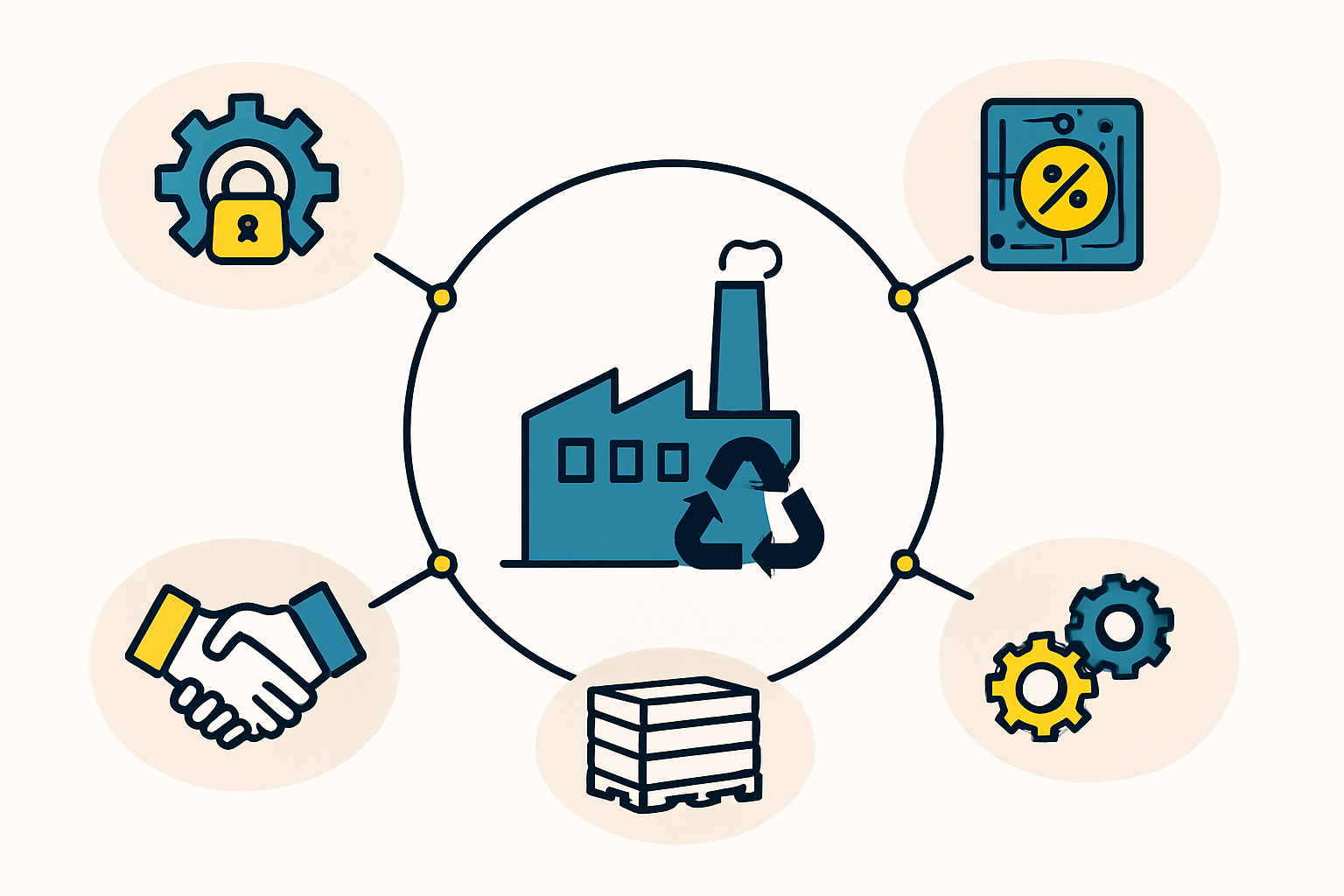
- Feedstock Supply Analysis: Lenders will scrutinize the security of the panel supply, requiring long-term, binding agreements with solar farm operators, manufacturers, or waste collection aggregators. The analysis must demonstrate sufficient volume and a clear pricing structure.
- Offtake Contracts & Commodity Risk: To mitigate revenue volatility, lenders prefer to see long-term, fixed-price or formula-based offtake agreements for a significant portion of the recovered materials. Where this is not possible, the financial model must be stress-tested against severe downturns in commodity prices. The material recovery economics are a central point of this analysis.
- Technology & Operational Plan: The chosen recycling technology must be proven, with performance guarantees from the technology provider. The lender will require a detailed operational plan, including staffing, maintenance schedules, and management expertise.
- Regulatory & Permitting: A complete package of all necessary environmental permits, zoning approvals, and operating licenses must be in place. Any legal or regulatory risks must be identified and mitigated.
- Financial Model Integrity: The financial model is the core of the financing proposal. It must be detailed, flexible, and transparent. Lenders will run numerous sensitivity and scenario analyses to test its resilience to adverse conditions like lower feedstock volumes, higher operating costs, or lower commodity prices.
Key Terms in a Project Finance Term Sheet
The term sheet is a non-binding document outlining the basic terms and conditions of the financing agreement, which forms the basis for the final legal documentation. Sponsors should pay close attention to the following sections.
- Conditions Precedent (CPs): These are the conditions that must be met before any funds are disbursed. This typically includes executing all project contracts, securing all permits, and providing legal opinions.
- Covenants: These are promises made by the project company to the lenders. They can be positive (e.g., maintain a certain level of insurance) or negative (e.g., not take on additional debt without lender consent).
- Debt Service Coverage Ratio (DSCR): This is a key financial covenant, defined as the ratio of cash flow available for debt service to the required debt service payment. Lenders will require the project to maintain a minimum DSCR (e.g., 1.25x), and a breach of this covenant can trigger a default.
- Security Package: This section details the assets over which the lenders will take security. For a recycling plant, this includes the physical plant and equipment, land, bank accounts, project contracts, and permits.
Conclusion: Positioning Your Project for Bankability
Financing a solar recycling facility requires a sophisticated approach that addresses the industry’s unique risk profile. While the renewable energy finance market is mature, lenders and investors require a higher level of assurance for recycling projects compared to standard solar or wind farms.
Success hinges on de-risking the project from a lender’s perspective. This is achieved by securing long-term contracts for both feedstock and recovered materials, utilizing proven technology with performance wraps, engaging strong and experienced sponsors, and developing a meticulously detailed and stress-tested financial model.
As regulatory pressure for solar panel recycling mounts globally, projects structured for bankability from the outset will be best positioned to attract the necessary capital and secure a strategic early-mover advantage.
Frequently Asked Questions (FAQ)
Q1: Is project finance suitable for smaller or pilot-scale solar recycling plants?
Project finance is typically used for large-scale, capital-intensive projects due to the high transaction costs associated with legal and financial advisory fees. For smaller or pilot-scale facilities, corporate finance (funding from the sponsor’s balance sheet), venture capital, or government grants are often more appropriate financing mechanisms.
Q2: How do lenders assess the risk of new or less-proven recycling technologies?
Lenders are inherently conservative and prefer technologies with a significant operational track record. For newer technologies, they will look for strong performance guarantees from the technology supplier, often backed by the supplier’s corporate balance sheet. They may also require higher equity contributions from the sponsor or a larger contingency budget to mitigate the perceived risk.
Q3: Can a recycling facility be financed without long-term offtake agreements for recovered materials?
It is extremely difficult. Financing a project on a purely “merchant” basis (selling materials on the spot market) is highly challenging because it exposes the project to full commodity price volatility. Lenders require a degree of revenue certainty. At a minimum, they will want to see offtake agreements covering a substantial portion of the output for a period long enough to provide confidence in debt repayment.
Q4: What is the typical timeline for securing project finance for a recycling facility?
The timeline can be lengthy, often ranging from 12 to 24 months from initial discussions to financial close. The process involves multiple stages: preliminary due diligence, term sheet negotiations, exhaustive final due diligence by lenders and their consultants, and negotiation of the final financing and project documents.
Q5: How do government incentives, like the U.S. Inflation Reduction Act (IRA), impact the bankability of a project?
Government incentives can significantly improve a project’s financial viability and bankability. Tax credits, production credits, or investment grants directly improve the project’s return on equity and cash flow, increasing the DSCR and making the project more attractive to lenders. For example, legislation like the IRA has been transformative in lowering the cost of capital for green technology projects in the United States.