
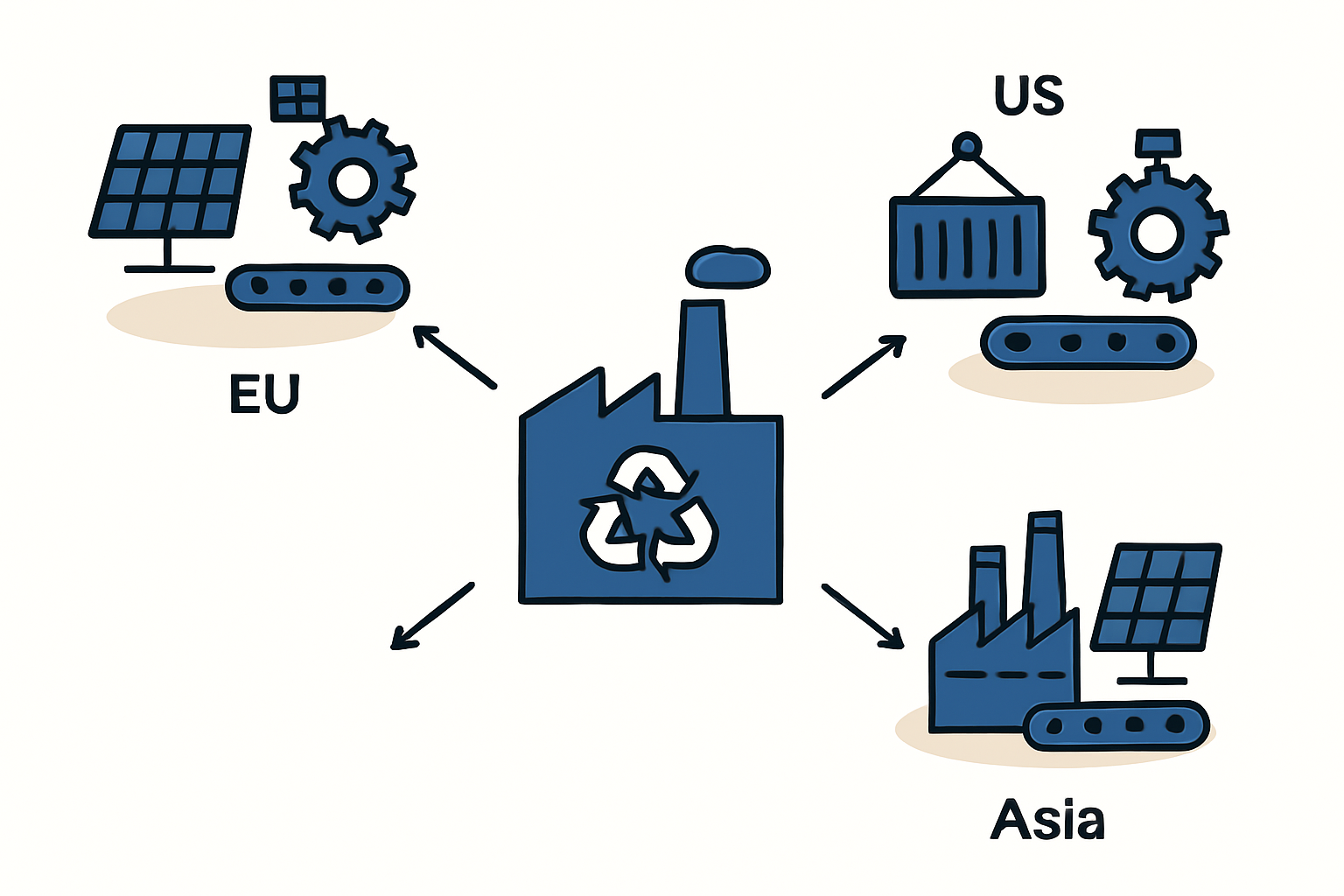
Investors and policymakers evaluating the solar panel recycling sector often look for a universal blueprint for success. Yet a flagship facility in Germany and a high-volume plant in India are fundamentally different operations, shaped by distinct economic and regulatory forces.
A plant design that is profitable in one market can easily fail in another. This analysis explores the core drivers shaping PV recycling plant architectures across Europe, the United States, and Asia.
It outlines why a one-size-fits-all approach is unworkable and provides a framework for designing facilities tailored to specific regional market conditions. The insights here, drawn from extensive analysis of existing operations and emerging market trends, offer a clear guide for strategic decision-making.
Regional Differences in Regulatory and Market Drivers
The architecture of a PV recycling facility—its scale, technology, and economic focus—is a direct response to its operating environment. A plant’s design is shaped by three primary factors: regulatory mandates, the economic value of recovered materials versus disposal costs, and the maturity of the local waste management ecosystem.
The European Union: Compliance-Driven Precision
In the EU, plant design is overwhelmingly driven by the Waste Electrical and Electronic Equipment (WEEE) Directive. This regulation imposes stringent, legally binding targets, including a mandate to recover 85% of PV panel materials and reuse or recycle 80%.
Primary Driver: Regulatory Compliance. The high cost of non-compliance, combined with landfill restrictions for e-waste, creates a powerful incentive for sophisticated recycling.
Architectural Implication: EU plants are engineered for high-purity material separation. They often employ multi-stage processes that combine mechanical delamination, thermal processing for plastics, and advanced chemical leaching to recover elements like silver and high-purity silicon. The goal is to maximize recovery to meet legal targets, even for materials with modest commodity value. Consequently, the business case is built as much on compliance and gate fees as it is on material sales.
The United States: An Economics-First Approach
The US market operates under a patchwork of state-level regulations rather than a single federal mandate. With lower regulatory pressure and variable landfill costs, the primary driver for recycling is economic viability.
Primary Driver: Profitability. A plant’s success depends on whether the revenue from recovered materials (primarily aluminum, copper, silver, and glass) exceeds operational costs, balanced against the alternative expense of landfilling.
Architectural Implication: US facilities are designed to efficiently recover the most valuable materials. Their architecture prioritizes high-throughput mechanical shredding and sorting to quickly liberate aluminum frames and copper from junction boxes. The remaining glass-laminate sandwich, which is more costly to process, is often sent to specialized secondary processors or used in lower-value applications like construction aggregate. This lean design focuses on achieving ROI from a few key material streams.
Asia: Scaling for Volume and Material Security
In markets like India and Southeast Asia, the recycling landscape is shaped by two converging forces: a projected tsunami of end-of-life panels from massive solar installations and a strategic government interest in raw material security.
Primary Driver: Waste Volume Management and Resource Scarcity. With regulations still emerging, the immediate challenge is managing enormous quantities of panels. Concurrently, governments recognize recycling as a way to secure a domestic supply of critical materials like silicon and silver.
Architectural Implication: Plant designs in Asia prioritize scale and throughput. The initial focus is on robust, high-capacity mechanical pre-processing to handle large volumes efficiently, separating aluminum and glass at scale. More complex, capital-intensive processes like hydrometallurgy are often planned as a second phase, to be implemented once the regulatory environment matures and the economics of full material recovery become more favorable. Modularity is a key design principle.
Exemplary Plant Architectures: A Continental Deep Dive
To illustrate these differences, we can examine the typical design and operational focus of a flagship plant in each region.
Case Study: A Flagship EU Facility
A leading German or French plant serves as a showcase of advanced recycling technology. The process might begin with a delamination unit using heated blades or thermal shock to separate glass from the encapsulant, followed by a pyrolysis chamber to cleanly burn off EVA plastic. A final hydrometallurgical circuit uses chemical baths to selectively leach and recover high-purity silicon, silver, and copper. While throughput might be lower, the focus is on producing high-grade materials that meet both regulatory targets and specifications for reuse.
Case Study: A Representative US Operation
A typical facility in Texas or Arizona is built for industrial efficiency. The process often starts with a high-torque shredder that handles dozens of panels per hour, after which a series of eddy current separators, magnets, and density sorters isolates the aluminum, ferrous metals, and copper wiring. The remaining crushed laminate is sold as cullet. The business model is straightforward: maximize throughput, minimize labor through automation, and generate revenue from the most accessible high-value commodities. The in-depth analysis of the economic viability of PV recycling shows how sensitive this model is to commodity prices.

Case Study: An Emerging Asian Plant
A new facility outside a major Indian city is likely designed for phased growth. Phase one might consist of a large, covered area for manual dismantling of frames and junction boxes, followed by a robust crushing and screening line to separate glass from laminate. This initial setup addresses the immediate volume problem while generating revenue from aluminum and glass sales. The plant layout anticipates future expansion, including dedicated space for a chemical processing module to be installed once feedstock volumes are secured and government incentives are in place.
Building Expertise: Design and Technology Frameworks
The choice between different solar panel recycling technologies—be it purely mechanical, thermal, or chemical—is not an academic exercise but a strategic business decision shaped by regional drivers. A compliance-driven EU market justifies the higher CAPEX of a hydrometallurgical line, while an economics-driven US market may favor a less expensive, purely mechanical setup.
A successful plant architecture integrates these technologies into a seamless workflow. This requires deep engineering expertise that extends beyond individual machines to the design of the entire material flow, from panel reception and sorting to final material refinement and logistics.
The operational intelligence documented on pvknowhow.com reflects decades of experience in manufacturing and lifecycle management, providing a structured basis for designing plants that are both technologically sound and commercially viable within their specific market context.
Decision Framework and Strategic Recommendations
For investors, industrial groups, and government bodies, selecting the right plant architecture requires a clear-eyed assessment of the local market. The following framework can guide this evaluation:
-
Identify the Primary Driver: Is the opportunity driven by legal mandate (EU), landfill cost avoidance and commodity prices (US), or future waste volumes and resource security (Asia)? The answer will define the core business model.
-
Quantify Feedstock Availability: What are the projected end-of-life panel volumes in your target region for the next 5, 10, and 15 years? This will determine the necessary scale of the plant.
-
Analyze the Regulatory Roadmap: Understand the current and anticipated regulatory frameworks for solar waste. A clear trend toward stricter regulations can justify a larger upfront investment in more advanced technology.
-
Model the Economic Scenarios: Evaluate the project’s sensitivity to commodity prices, gate fees, labor costs, and energy prices. A robust design is one that remains viable across a range of market conditions.
Ultimately, the most resilient plant architectures are often modular, allowing an operator to start with a core process and add capabilities as the market matures.
Frequently Asked Questions (FAQ)
What is the minimum viable scale for a PV recycling plant?
This depends heavily on the region and business model. A US plant focused on high-value materials might require 10,000-20,000 tons per year to be profitable. In a regulation-driven EU market with guaranteed gate fees, a smaller, more specialized plant of 4,000-8,000 tons focusing on high-purity recovery could be viable.
How does the economic viability of PV recycling change based on region?
In the EU, viability is bolstered by regulatory credits and gate fees, making operations less dependent on fluctuating commodity prices. US viability, by contrast, is directly tied to the market price of recovered aluminum, copper, and silver, as well as local landfill fees. In Asia, the initial business case is often built around volume management for large asset owners, with long-term profitability linked to government incentives for a circular economy.
Which technology offers the best return on investment?
No single technology is best—the optimal choice depends on the strategic goal. For rapid ROI in a market without strict mandates, an efficient mechanical separation line offers the fastest payback. For long-term value creation where regulations are strong and demand for high-purity material exists, a combination of thermal and hydrometallurgical processing will yield a higher return over the plant’s life, despite the higher initial CAPEX.
How do evolving regulatory frameworks impact long-term plant design?
Regulatory evolution is the single biggest factor to consider. A plant designed today must be adaptable for tomorrow’s rules. A modular design is critical. For example, a plant that starts with mechanical processing should be designed with the physical footprint and utility connections needed to add a chemical leaching circuit later. This foresight prevents the facility from becoming obsolete as regulations tighten.