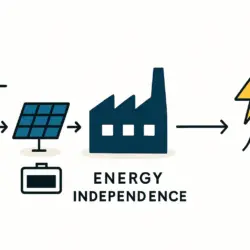
The Nyabira Solar Plant is now in commercial production after completing its expansion from 2.5MW to 25MW. This ten-fold increase in capacity will significantly contribute to Zimbabwe’s national grid and help address the country’s ongoing energy challenges.
Nyabira Solar Plant Completes Expansion
The Nyabira Solar Plant, owned by Centragrid, has completed its expansion and entered commercial production. Located in Nyabira, Zimbabwe, the facility has grown from an initial 2.5MW to an impressive 25MW capacity.
This expansion is a crucial step for Zimbabwe in its efforts to overcome persistent energy shortages. By providing much-needed power to the national grid, the Nyabira project is set to play a significant role in alleviating these long-standing issues.
First operational in 2019, the Nyabira Solar Plant has become one of the largest solar projects in the country. Centragrid, the independent power producer behind the facility, has been a key player in Zimbabwe’s transition to renewable energy, with this latest expansion bringing the plant’s capacity to a significant 25MW.
Key Investors and Local Funding
The success of the Nyabira Solar Plant is made possible by local funding, with the project fully backed by domestic capital. Key investors include Old Mutual Zimbabwe, the National Social Security Authority (NSSA), and various pension funds.
Relying on local capital is a significant achievement, demonstrating that Zimbabwe can fund and manage its own renewable energy projects without external financing. Victor Utedzi, founder of Centragrid, highlighted the importance of such investments in driving Africa’s energy future.
He emphasized that the solar plant is a flagship project, showcasing what local investors can accomplish to solve energy shortages. His comments reflect Zimbabwe’s pride and commitment to growing its renewable energy sector with home-grown solutions.
A Model for Future Renewable Projects
The Nyabira Solar Plant’s success serves as a model for other renewable energy initiatives across Zimbabwe. As one of the first independent power producers to connect to the national grid, its expansion further cements its role as a key player in the country’s renewable energy strategy.
Spanning approximately 50 hectares, the plant is comprised of around 70,000 solar modules arranged into 10 power blocks. Each block contributes 2.5MWdc, enabling the facility to generate a total of 25MW. This design maximizes energy output and helps Zimbabwe reduce its dependence on fossil fuels.
The plant uses advanced technology to optimize electricity production, with polycrystalline panels arranged in series on racking structures fitted with horizontal single-axis trackers. By following the sun’s movement from east to west, these trackers ensure the panels capture maximum sunlight throughout the day.
This tracking system boosts electrical output by 25% compared to fixed-racking alternatives. The facility also includes 44 Huawei inverters and a 2.5MW transformer. From a central breaker room that manages power conditioning, protection, and monitoring, energy is fed into the national grid through a 6.6km transmission line.
Future Plans for Nyabira Solar Plant
Centragrid’s ambitions for the Nyabira Solar Plant don’t end with this expansion. The company has already announced plans to increase the plant’s capacity to 100MW, with the next phase scheduled to begin in 2025. This move reinforces Centragrid’s commitment to becoming a leader in Zimbabwe’s renewable energy production.
The company is confident about the future of solar energy in the region and views the plant as a springboard for more renewable projects across the country. Amid growing interest from local investors, Centragrid is optimistic that solar power can play a crucial role in solving Zimbabwe’s energy challenges.
As Zimbabwe continues to explore renewable options, the Nyabira Solar Plant stands as a powerful model for future projects. With further expansions planned and growing interest in solar energy, the nation’s renewable energy landscape looks promising.