
A new solar module factory is a complex system of interconnected machinery. In the initial months of operation, as production ramps up and targets are met, it is easy to overlook a critical detail: the small, often inexpensive components inside each machine that keep the entire line running. Imagine a single sensor, valued at less than €200, failing on the main laminator. Without a replacement on hand, the entire production line can grind to a halt. The cost is no longer €200; it is the value of every module that is not produced each day the line remains idle.
This situation highlights a fundamental principle of industrial operations: a proactive spare parts strategy is not an optional expense but a core component of operational resilience—an investment in uptime and a safeguard against the significant financial impact of unplanned delays.
The Financial Impact of Unplanned Downtime
For any industrial manufacturer, unplanned downtime is one of the most significant threats to profitability. Research shows that unexpected production halts cost industrial manufacturers an estimated $50 billion annually. In the context of a solar module factory, the numbers are just as stark.
A medium-sized facility with a 50 MW annual capacity produces approximately 600–700 modules per day. If each module has a market value of $100, a single day of downtime means a potential revenue loss of $60,000 to $70,000. This figure excludes idle labor costs, potential penalties for delayed shipments, or damage to the company’s reputation. When viewed through this lens, the cost of maintaining an inventory of critical components is insignificant compared to the cost of a single major stoppage.
Why a “Wait and See” Approach Fails
For entrepreneurs new to manufacturing, the intuitive approach might be to order parts only when they are needed. This reactive strategy, however, is fraught with risk, particularly in a globalized supply chain. Recent years have shown that supply chain disruptions are more frequent and severe, making this approach untenable.
Specialized components for solar manufacturing equipment, especially from European or Asian OEMs (Original Equipment Manufacturers), often have lead times of 6 to 12 weeks. This timeframe can be extended further by shipping complexities and customs clearance procedures—a common challenge for businesses in Africa, the Middle East, and Latin America. Relying on “just-in-time” ordering for critical parts effectively guarantees extended periods of costly downtime.
Building a Framework for Your Spare Parts Inventory
A strategic inventory is not about stocking every possible component; it is about a risk-based approach that prioritizes parts based on their importance and scarcity. The Pareto principle often applies here, as studies show that as many as 80% of failures are caused by only 20% of the components. The goal is to identify and stock that critical 20%.
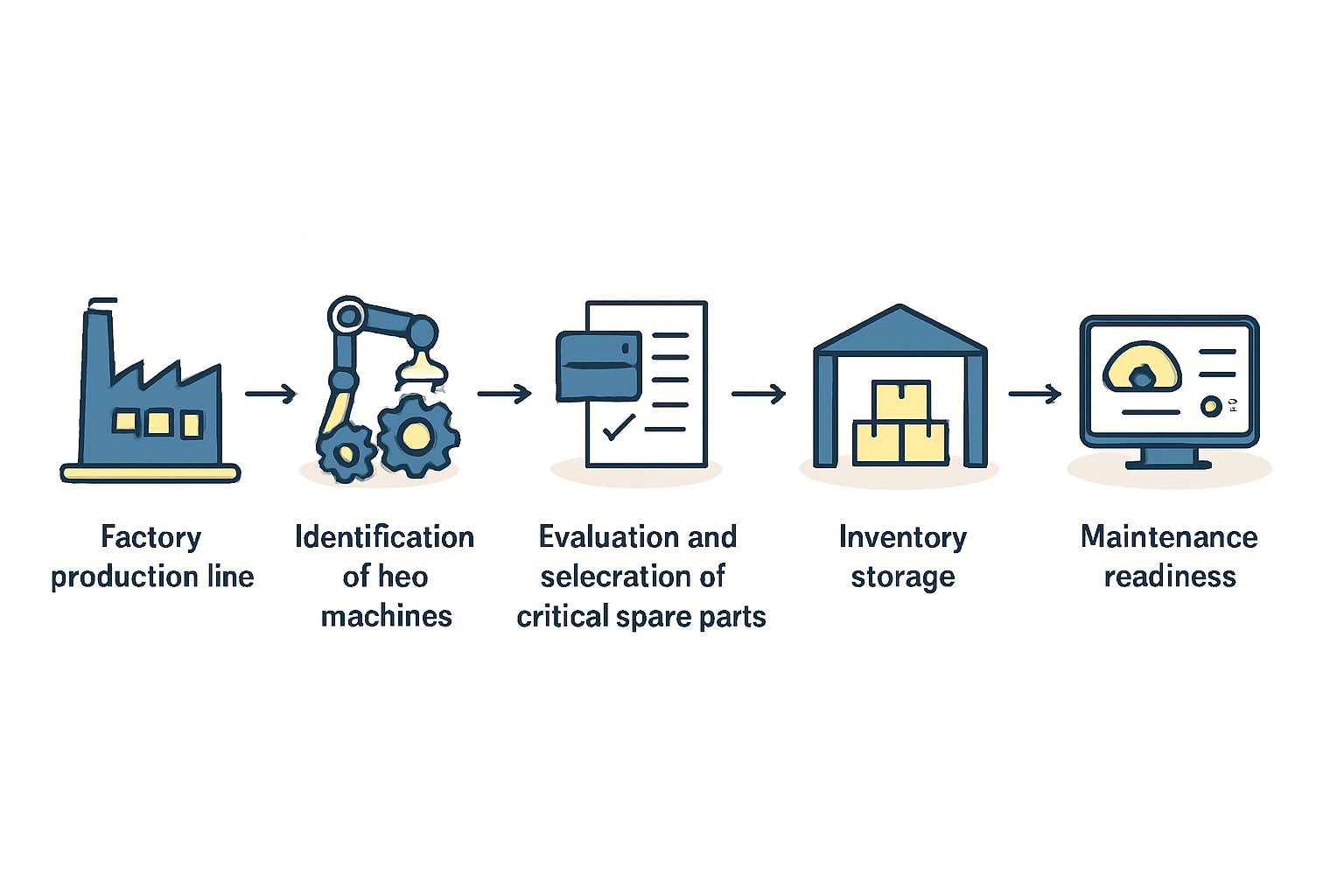
Step 1: Criticality Analysis – Identifying Your Most Important Machines
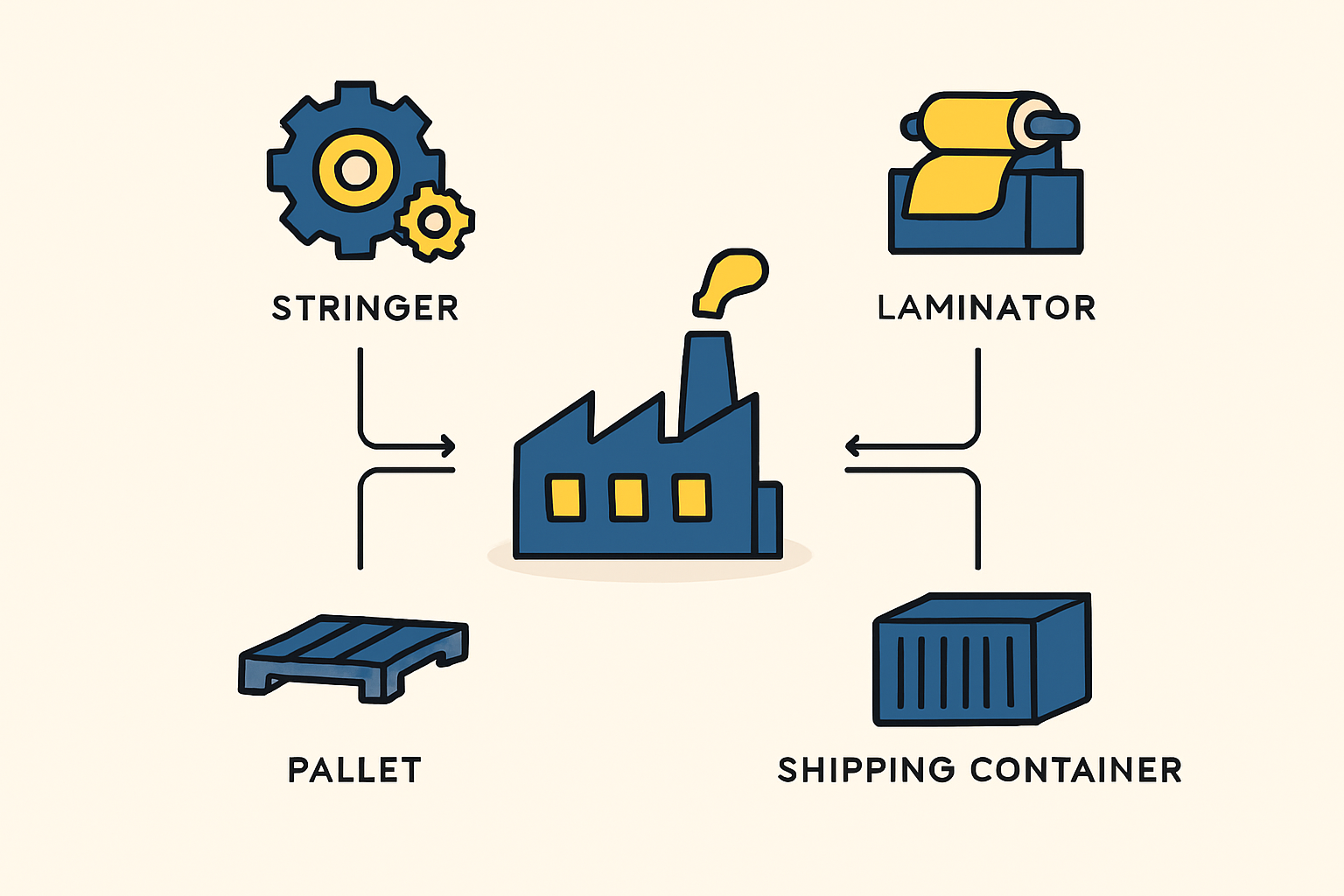
The first step is to analyze the production line to identify single points of failure. These are machines where a breakdown would bring the entire process to a halt. In a typical solar module assembly line, the solar panel stringer machine and the laminator are primary bottlenecks. If the stringer cannot connect the cells or the laminator cannot encapsulate the modules, no finished product can be made.
Mapping the workflow and identifying these critical assets is the foundation of an effective spare parts strategy.
Step 2: Categorizing Spare Parts by Risk and Lead Time
Once the critical machines are identified, their components can be classified to guide stocking decisions. A simple three-tier system is effective:
- Category A (High-Criticality, Long Lead Time): These parts are essential for the machine’s operation and are difficult to source quickly. Examples include custom-machined parts, proprietary electronic boards, specialized sensors, or specific PLC controllers. A sufficient stock of these items should always be maintained on-site.
- Category B (High-Criticality, Short Lead Time): These parts are also essential but can be sourced locally or from regional suppliers with relative ease. This may include standard bearings, pneumatic cylinders, belts, or fuses. A minimum quantity should be kept on hand to cover the short lead time for reordering.
- Category C (Low-Criticality): These are non-essential components or parts for machines with built-in redundancy. These can be ordered as needed without significant risk to production continuity.
Step 3: Determining Optimal Stocking Levels
Deciding how many of each Category A part to stock is a balance between the cost of holding inventory and the risk of downtime. The decision should be informed by several factors:
- Mean Time Between Failures (MTBF): The OEM can often provide data on the expected operational life of key components.
- Supplier Lead Time: The total time required to order, ship, and receive the part.
- Cost of Downtime: The calculated daily revenue loss provides a clear financial justification for holding stock.
Based on experience from J.v.G. Technology GmbH turnkey projects, a budget for an initial critical spare parts package typically falls between 1% and 3% of the corresponding machine’s value. This serves as a practical benchmark for investment planning.
The Role of the Original Equipment Manufacturer (OEM)
Your equipment supplier is your most important partner in developing a spare parts strategy. The OEM has the most comprehensive understanding of their machinery’s potential failure points. They should provide a “Recommended Spare Parts List” as part of the initial equipment proposal.
For new industry entrants, a common challenge is navigating these technical lists to distinguish between essential and non-essential items. A reliable turnkey solutions provider can facilitate this process, ensuring the final spare parts package is tailored to the client’s specific production goals, operational environment, and geographic location. This planning is a key step in the overall solar panel manufacturing process and should be addressed early in the project.
Beyond the Parts – Managing the Inventory
Procuring the parts is only half the battle. Proper management ensures they are available and in good condition when needed.
- Inventory Management System: This doesn’t require complex software. A well-organized spreadsheet can be used to track part numbers, storage locations, current quantities, and minimum reorder points.
- Proper Storage: Spare parts must be stored in a clean, dry, and climate-controlled environment. This is especially important for sensitive electronics, which can be damaged by dust, humidity, or temperature extremes.
- Regular Audits: The physical inventory should be checked against records periodically to ensure accuracy and catch any discrepancies before a part is urgently needed.
Frequently Asked Questions (FAQ)
How much should a new factory budget for an initial spare parts inventory?
A sensible starting point is to budget 1–3% of the value of your critical machinery (e.g., stringer, laminator, tester) for an initial stock of essential spare parts. This figure can be adjusted based on your facility’s remoteness from suppliers and your business’s tolerance for risk.
Can we use third-party or generic spare parts to save money?
While it may be possible for standard commodity parts like fasteners or generic bearings, using non-OEM parts for critical, custom-engineered components is highly discouraged. It can compromise machine performance, lead to premature failures, and may void the manufacturer’s warranty. For certified production, using specified parts is essential.
What is the single biggest mistake new owners make with spare parts?
The most common mistake is treating spare parts as an afterthought, to be addressed only after the first major breakdown. A proactive approach, where the spare parts strategy is developed in parallel with equipment procurement, is the key to minimizing future downtime.
Is this inventory included in a standard solar panel manufacturing line cost?
Typically, a recommended spare parts package is quoted as a separate, optional item. It is crucial for investors to review this list carefully and discuss it with their equipment provider to ensure the final solar panel manufacturing line cost includes a budget for this vital inventory.
Conclusion: From Reactive Cost to Strategic Asset
A well-planned spare parts inventory should not be viewed as a sunk cost. Instead, it is a strategic asset and a form of operational insurance. It protects the primary investment in production machinery and safeguards the business’s ability to generate revenue. By transforming a factory’s primary vulnerability—unplanned downtime—into a managed risk, this strategy provides the operational resilience needed to build a robust and profitable solar manufacturing enterprise.