
An entrepreneur entering the solar manufacturing sector inevitably faces a critical decision. After requesting quotations for a production line, they often receive two main proposals: one from a European supplier and one from an Asian supplier. The Asian equipment may appear significantly more attractive on paper, with an initial purchase price that can be 20–30% lower. For a new venture where capital preservation is paramount, this can seem like the obvious choice.
However, the most successful industrial ventures are built on decisions that account for long-term value, not just initial outlay. The invoice price of a machine is only the beginning of its financial story. Understanding the true, long-term financial impact of this crucial investment requires a more rigorous analysis known as Total Cost of Ownership (TCO).
Beyond the Price Tag: Understanding Total Cost of Ownership (TCO)
Total Cost of Ownership is a financial principle used to calculate the full lifetime cost of an asset. It moves beyond the upfront purchase price (Capital Expenditure or CAPEX) to include all direct and indirect costs associated with its operation over time (Operational Expenditure or OPEX).
For a solar manufacturing plant, this includes everything from electricity consumption and spare parts to the financial impact of production downtime and material waste. The initial investment is merely the visible tip of the iceberg; the majority of costs are submerged beneath the surface, accumulating steadily over the equipment’s 10-to-15-year lifespan.
A comprehensive TCO analysis offers a clear, data-driven way to compare equipment not on its purchase price, but on the total cost to own and operate it profitably.
A Framework for Comparing Manufacturing Equipment
To make a meaningful comparison, investors should evaluate potential suppliers across four key areas. This framework helps translate technical specifications into tangible financial metrics.
1. Initial Capital Expenditure (CAPEX)
This is the most straightforward component: the purchase price of the machinery. While a lower initial price can improve a project’s early-stage financials, it’s essential to contextualize this figure. A lower CAPEX might be the right choice for a specific business model, but only after confirming that it does not lead to disproportionately higher costs in other areas. The full investment for a solar factory includes more than just machinery, and optimizing every component for long-term value is critical.
2. Operational Expenditure (OPEX): The Recurring Costs
OPEX is where the differences between equipment from various regions often become most apparent over time. These ongoing costs can significantly impact a factory’s profitability.
-
Energy Consumption: Manufacturing equipment, especially thermal processing units like laminators, consumes a substantial amount of electricity. On average, European-made laminators are engineered to consume 10-18% less electricity per cycle. For a factory operating around the clock, this can translate into annual energy savings of $15,000 to $25,000 per machine—a significant sum in any operational budget.
-
Service and Maintenance: All machinery requires maintenance, but the cost, speed, and quality of service can vary dramatically. Studies show that downtime from equipment failure can reduce a plant’s annual output by up to 4%. When evaluating suppliers, the key question is how quickly they can resolve an issue. Asian equipment service response times can average 72-96 hours, whereas European suppliers with established local or regional service hubs often respond within 24-48 hours. This difference translates directly into lost production and revenue.
-
Spare Parts and Consumables: The availability and cost of spare parts are critical for maintaining operational uptime. A reliable supply chain for essential components ensures that a minor part failure does not halt production for days or weeks.
3. Production Yield and Material Waste
In manufacturing, precision equals profitability. Even minor inefficiencies, when repeated thousands of times per day, add up to substantial financial losses. A primary example is the process of connecting solar cells.
High-precision European stringers often achieve a cell breakage rate below 0.1%. In comparison, some standard Asian models may have rates of 0.3-0.5%. While the difference seems small, its financial impact is not. For a 50 MW line, this variance in material waste can translate to a cost difference exceeding $50,000 per year. This makes the engineering quality of a solar cell stringer a direct driver of material efficiency and profitability.
4. Machine Longevity and Reliability
The final component is the productive lifespan of the equipment. Machines built with higher-grade materials and more robust engineering standards typically deliver consistent performance over a longer lifespan. This reliability not only extends the asset’s value but also contributes to consistent solar panel quality.
Analysis based on data from numerous J.v.G. turnkey projects consistently shows that while European machines may have a higher initial price, they can lead to a 5-15% lower Total Cost of Ownership over a 10-year operational period. This advantage stems directly from superior energy efficiency, lower spare part consumption, higher uptime, and better material yield.
Frequently Asked Questions (FAQ)
Is European equipment always the better choice?
Not necessarily. The optimal choice depends on the specific business case, access to financing, local energy costs, and the availability of technical support in the project’s region. The TCO framework isn’t designed to provide a single answer, but to help an investor make a fully informed decision based on long-term profitability metrics.
How much does service and support truly impact a new factory’s success?
Service and support are among the most critical factors. For a new enterprise, prolonged downtime is not just a loss of revenue; it can damage market reputation and strain cash flow. As noted earlier, a 4% reduction in annual output due to equipment failure is a significant financial setback. Reliable and responsive technical support acts as a crucial insurance policy for the entire operation.
Can I mix equipment from different suppliers or regions?
Yes, this is a common practice. An investor might choose a high-precision European stringer while opting for less critical downstream equipment from an Asian supplier. However, this approach requires careful planning to ensure seamless integration, software compatibility, and a clear service and maintenance plan for the complete solar module manufacturing line.
Conclusion: Making an Informed Investment Decision
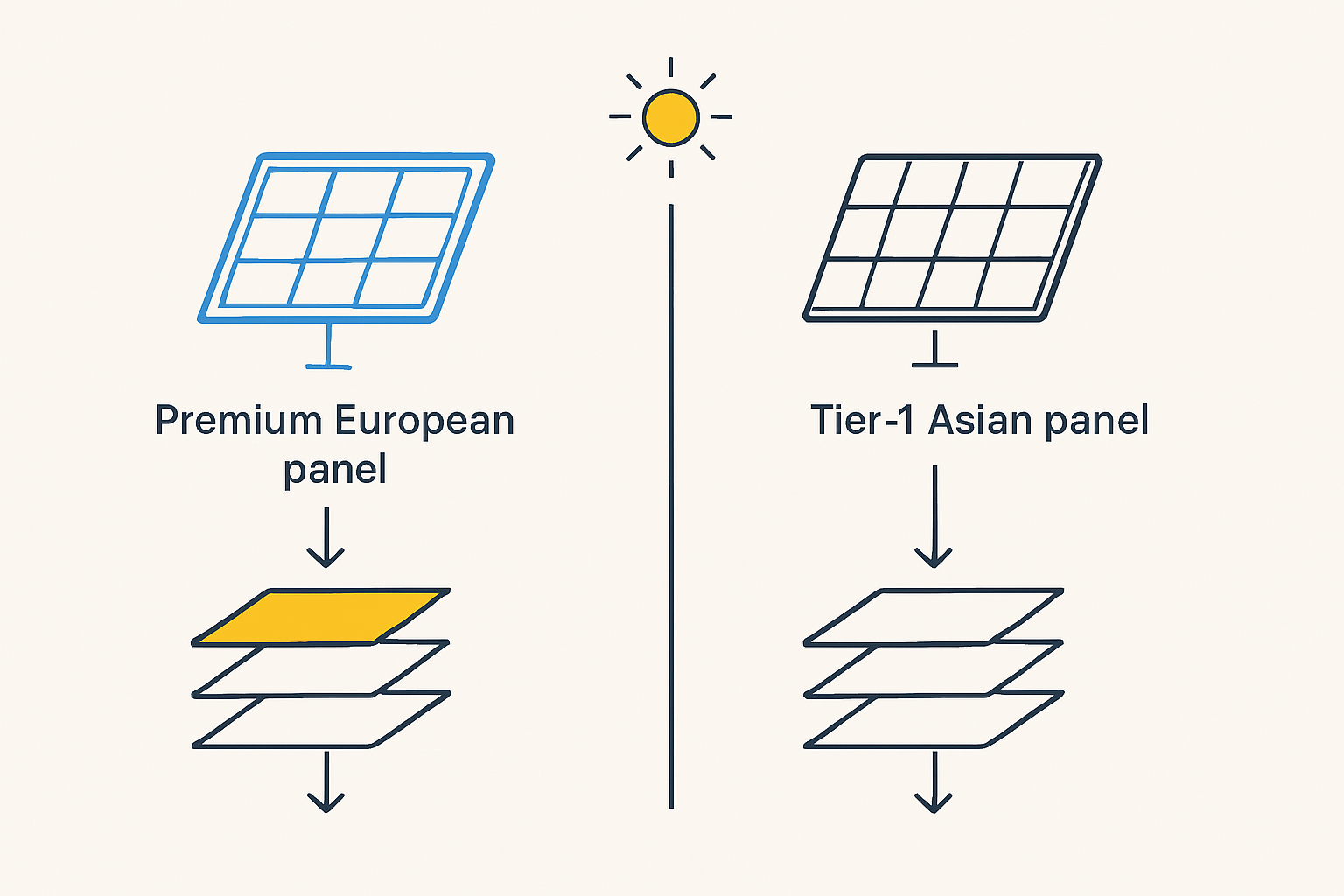
The choice between European and Asian manufacturing equipment is not a simple matter of comparing price tags. It’s a strategic decision that will define a factory’s operational efficiency, cost structure, and profitability for the next decade.
By moving beyond the initial quotation and applying a Total Cost of Ownership framework, investors can see the complete financial picture. This disciplined approach shifts the focus from finding the cheapest machine to identifying the most profitable and reliable long-term production asset. That diligence forms the foundation of a resilient and successful manufacturing business.