A high-performance solar module is a sophisticated piece of engineering. Its long-term reliability and safety, however, often depend on one of its smallest and most overlooked components: the junction box. As solar module technology has rapidly advanced toward higher power outputs and split-cell designs, the technical demands on this critical component have grown substantially. What was once a simple electrical housing has become a key factor in module performance and durability.
For entrepreneurs and investors entering the solar manufacturing space, understanding the nuances of the modern junction box isn’t a minor detail—it’s fundamental to producing a reliable and competitive product. This article breaks down the key specifications to evaluate when sourcing junction boxes for today’s high-current, high-efficiency solar modules.
The Shift in Module Technology and Its Impact on the Junction Box
Until recently, a standard solar module operated with a maximum current of around 10 amperes (A). The junction boxes were designed accordingly, equipped with bypass diodes rated for this level of electrical load. However, the industry’s push for greater efficiency and power has changed the landscape entirely.
The technology behind the solar panel manufacturing process has advanced considerably, leading to two major innovations:
- Larger Wafers and Higher Currents: The adoption of larger silicon wafers (such as M10 and G12) has enabled modules to generate much higher currents, now commonly in the 15-20A range. This increase places far more electrical and thermal stress on all components, especially the bypass diodes within the junction box.
- Half-Cut or Split-Cell Designs: To reduce internal electrical resistance and improve performance, manufacturers now routinely cut cells in half. A standard 144-cell module is effectively two 72-cell modules connected in parallel. This configuration alters the internal circuitry and requires a different approach to bypass protection.
These shifts mean that a junction box designed for an older 10A module is fundamentally inadequate for a modern 18A half-cut module. Sourcing the right component, therefore, requires a deeper understanding of its technical specifications.
Key Technical Parameters for Modern Junction Boxes
When evaluating junction boxes for high-power modules, several parameters are critical to ensuring safety, reliability, and long-term performance. These are governed by international standards, primarily IEC 62790 for junction boxes and IEC TS 62979 for bypass diodes.
Diode Rating: More Than Just Amperes
The bypass diode acts as a safety valve. When a cell or group of cells is shaded, the diode activates, allowing current to flow around the shaded area and preventing dangerous “hot spots” that can damage the module. For today’s modules, simply matching the diode’s ampere rating to the module’s short-circuit current (Isc) is not enough.
Key diode parameters include:
- Current Rating: For modules with an Isc of 15-20A, diodes rated for at least 25A or 30A are necessary to provide a sufficient safety margin.
- Forward Voltage (Vf): This is the voltage drop across the diode when it is active. A lower forward voltage is always better, as it means the diode generates less heat during operation, reducing thermal stress.
- Reverse Leakage Current: When inactive, a diode should block current flow. While a small amount of “leakage” is normal, high leakage current can lead to thermal runaway and premature failure. Lower values indicate a higher quality diode.
Thermal Management: The Critical Role of Heat Dissipation
A bypass diode generates significant heat when activated. If this heat is not dissipated effectively, the diode’s temperature can quickly exceed its safe operating limit, leading to permanent failure. This is the single most common failure mode for junction boxes.
Effective thermal management depends on the entire thermal path, from the diode to the outside air. The quality of the potting compound—the silicone-based material filling the junction box—is paramount. A high-quality compound provides excellent heat transfer from the diode to the junction box casing, which in turn dissipates the heat into the environment. In contrast, a poor-quality compound acts as an insulator, trapping heat and accelerating component degradation.

The overall thermal resistance (RthJ-A) is a key metric indicating how effectively the entire assembly dissipates heat. A lower value signifies better thermal performance and higher reliability.
The Rise of the Split Junction Box
To address the challenges of half-cut cell designs and improve heat management, the industry has widely adopted the split junction box. Instead of one central box, this design typically uses three smaller, separate boxes. The central box houses the middle diode, while two outer boxes house the remaining diodes.
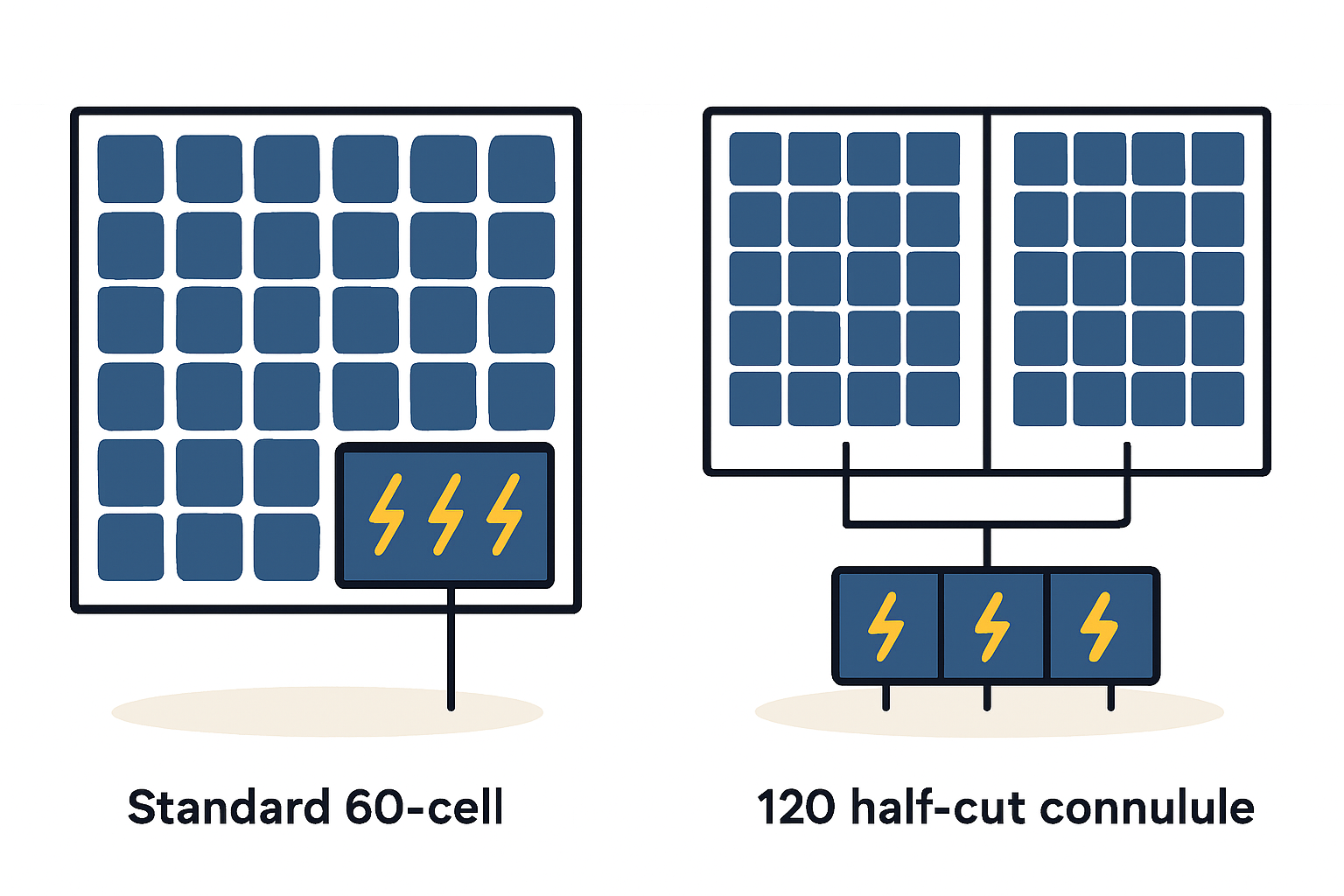
This design offers several distinct advantages:
- Improved Heat Dissipation: By physically separating the diodes, heat is distributed over a wider area of the module’s backsheet, preventing thermal stress from concentrating in one spot.
- Reduced Power Loss: The split design allows for shorter internal bypass circuits, slightly reducing resistive losses and improving overall module efficiency.
- Enhanced Reliability: The lower operating temperature of each diode significantly increases its lifespan and reduces the probability of failure.
This design is now standard for most modules produced with an automated solar panel assembly line due to its clear benefits for high-power applications.
Sourcing and Quality Control: A Strategic Business Decision
The junction box typically accounts for less than 2% of a solar module’s total material cost. However, its failure can lead to a complete loss of power from the module string, resulting in warranty claims, reputational damage, and significant financial losses. Therefore, sourcing junction boxes should be treated as a risk management activity, not a cost-reduction exercise.
When establishing a production facility, it is crucial to:
- Vet Suppliers Rigorously: Work with established manufacturers who can provide comprehensive test data and valid certifications.
- Verify Certifications: Ensure that the junction boxes are certified to IEC 62790 and the diodes to IEC TS 62979. Request and validate these certification documents.
- Prioritize Thermal Performance: Ask for thermal performance data from potential suppliers. A supplier who cannot provide this data may not fully understand the requirements for high-power modules.
Experience from J.v.G. turnkey projects shows that implementing a strict incoming quality control process for critical components like junction boxes is essential for ensuring the long-term bankability of the final product.
Frequently Asked Questions (FAQ)
What is a bypass diode and why is it important?
A bypass diode is an electronic component inside the junction box that acts as an alternate path for electricity. If a portion of the solar module is shaded, the diode activates, allowing current from the unshaded parts of the module to “bypass” the underperforming section. This prevents the shaded cells from overheating and causing permanent damage, known as a “hot spot.”
Can I use an older junction box model for a new high-power module design?
This is highly inadvisable. An older junction box was likely designed for lower currents (e.g., 10A) and won’t have the thermal dissipation capacity required for modern high-current modules (15-20A). Using an underspecified junction box creates a significant risk of overheating and premature failure, which could void the module’s warranty and pose a safety hazard.
What does the ‘IP rating’ (e.g., IP68) on a junction box mean?
The IP (Ingress Protection) rating defines the level of sealing effectiveness against intrusion from foreign bodies like dust and moisture. The first digit (6) indicates total protection against dust, while the second digit (8) signifies protection against long-term immersion in water under specified conditions. An IP67 or IP68 rating is standard for high-quality junction boxes, ensuring they can withstand harsh environmental conditions for 25+ years.
How does a split junction box connect to the rest of the system?
Externally, a split junction box functions identically to a traditional one. It has standard positive (+) and negative (-) output cables with connectors (e.g., MC4-compatible) that link to the next module in the string. The complexity of the split design is entirely internal; for an installer or system designer, the connection process is the same.
Conclusion and Next Steps
The junction box has evolved from a simple passive component into an active, critical element for the safety and performance of modern solar modules. As module currents and complexity continue to increase, a thorough understanding of diode specifications, thermal management, and design configurations like the split junction box is no longer optional—it is essential for any business aiming to produce or procure high-quality, reliable solar panels.
Paying close attention to this small component yields significant returns in product longevity and brand reputation. For those planning a new manufacturing venture, understanding the full solar panel manufacturing equipment list is the next logical step. Structured guidance can demystify these technical details, helping business professionals make informed decisions as they enter the dynamic solar industry.