
A solar module is designed to withstand decades of harsh weather while consistently generating electricity. This durability is a testament to high-precision manufacturing, yet one of the most significant risks to its 25-year lifespan stems not from a complex automated machine, but from the human-led process of assembling its core layers. A minor, almost invisible, error during the manual layup stage can cascade into complete product failure years later, leading to costly warranty claims and significant damage to a manufacturer’s reputation.
This article examines the critical layup stage, which occurs just before lamination. We explore how an operator’s precision in handling and aligning materials directly influences production yield and the long-term risk of delamination—one of the most severe failure modes for a photovoltaic module. For any investor or manager planning to enter the solar manufacturing industry, understanding this connection is essential.
Understanding the Layup and Lamination Process
Before a solar module becomes a single, solid unit, it begins as a delicate stack of separate materials. The process of assembling this stack is known as “layup.” An operator manually or semi-automatically assembles the layers in a specific order, creating a “sandwich” that is ready for the lamination machine.
The typical composition includes:
- Tempered Glass: The top, protective layer.
- EVA Film (Ethylene Vinyl Acetate): The first adhesive and encapsulant layer.
- Solar Cell Matrix: The interconnected strings of solar cells that generate power.
- EVA Film: The second adhesive layer.
- Backsheet: The final protective layer, typically made of a polymer composite.
Once these layers are correctly positioned, the entire assembly is moved into a laminator. Inside, a combination of heat, pressure, and vacuum fuses the EVA films, bonding all layers together into a monolithic, weatherproof panel. The process is irreversible and defines the module’s structural integrity.
The Critical Human Element: Where Precision Matters Most
While modern solar factories use significant automation, the layup station remains a crucial point of human intervention. The operator’s skill, attention to detail, and adherence to strict protocols are paramount, as even small deviations can introduce defects that compromise the final product.
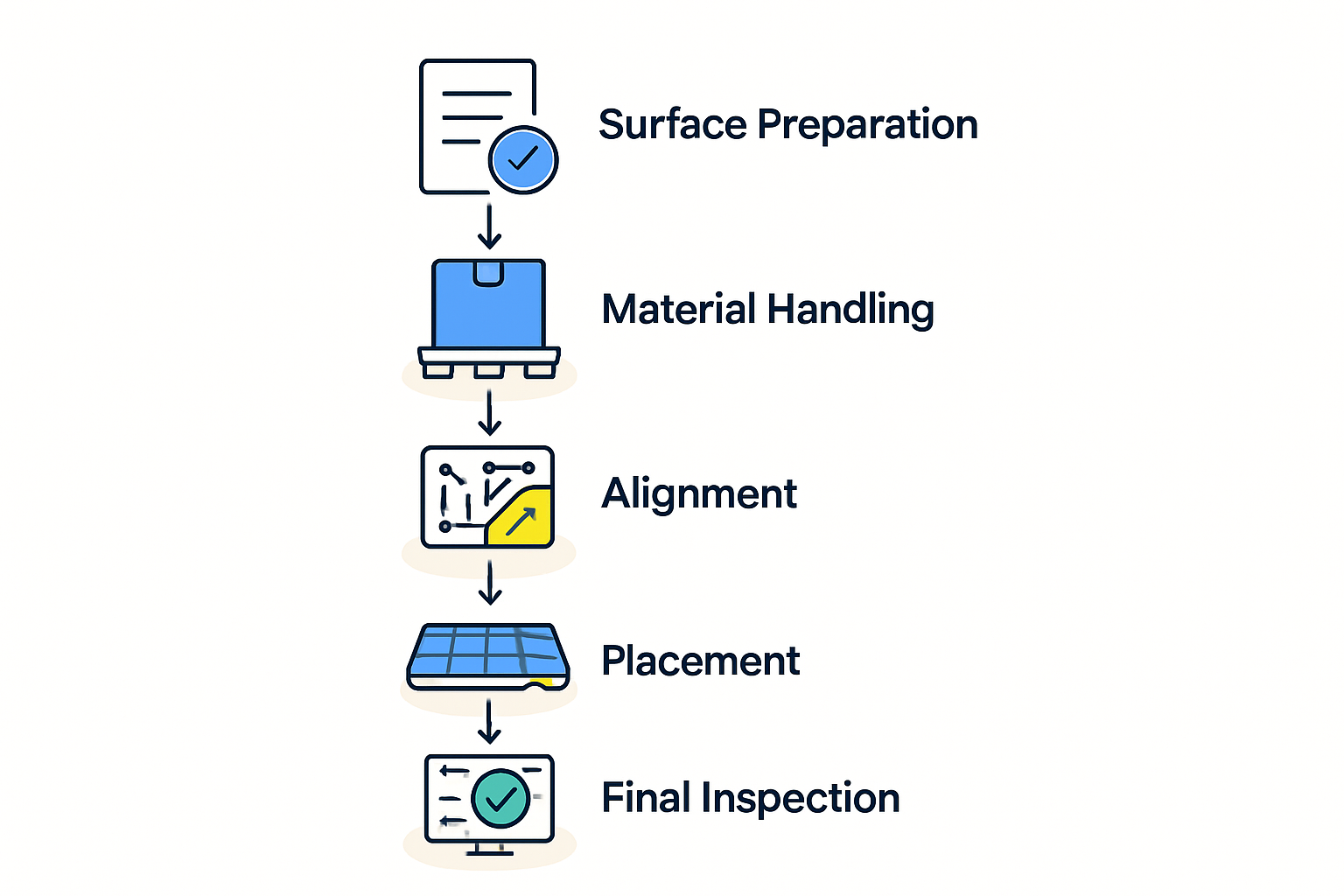
Contamination Control
To ensure proper adhesion, the surfaces of the glass, cells, and EVA film must be perfectly clean. Contaminants introduced by an operator—such as dust, clothing fibers, fingerprint oils, or small debris—can create microscopic voids. During lamination, these voids prevent the EVA from bonding completely. Over years of exposure to heat and humidity in the field, these weak points can become entry points for moisture, initiating delamination. This underscores the necessity of cleanroom-like conditions and disciplined operator conduct, including the mandatory use of gloves and appropriate attire.
Alignment of Components
The precise placement of the solar cell matrix is essential. A slight misalignment of just one or two millimeters can have serious consequences:
- Mechanical Stress: If a cell string is too close to the module’s edge, it can create a stress point during lamination. This can lead to microcracks in the cells, which are often invisible to the naked eye but will degrade the module’s power output over time.
- Electrical Issues: Misaligned busbars or interconnect ribbons can cause poor electrical connections, reducing the module’s efficiency from the moment it is produced.
Handling of Materials
Both solar cells and EVA film are delicate. Solar cells are extremely brittle and can easily develop microcracks if handled improperly. EVA film can be stretched or deformed if not laid down with care. Any such inconsistency introduced during layup is permanently sealed into the module during lamination, creating a built-in weakness that may not become apparent until the module has been in service for several years.
From Minor Error to Major Failure: The Science of Delamination
Delamination is the physical separation of layers within a solar module. It is considered a catastrophic failure because it exposes the sensitive solar cells to the environment, leading to rapid corrosion, moisture ingress, and a complete loss of power generation.
The path from a layup error to future delamination is clear. A fingerprint left on the glass, for instance, prevents the EVA from adhering to that spot. While the module may pass initial quality control tests, the bond is weak. Once installed, the module undergoes daily thermal cycles—heating up in the sun and cooling down at night—which puts constant stress on all layers. The weak spot created by the fingerprint acts as a starting point for delamination, which can then spread as moisture inevitably finds its way into the tiny gap.
While a fingerprint is just one example, similar failure pathways can be triggered by trapped air bubbles, dust particles, or improperly cured EVA resulting from contamination. These issues are among the most common solar module manufacturing defects and are almost always traceable to process control at the layup and lamination stage.
The Business Impact of Layup Inaccuracies
For a factory owner or investor, the consequences of poor layup precision are not merely technical; they are financial and strategic.
- Immediate Yield Loss: Modules with significant layup errors, such as misaligned cells causing shunts or cracks, will fail post-lamination quality checks like electroluminescence testing. These rejected modules represent a direct loss of materials, labor, and machine time, increasing the cost per watt of production.
- Long-Term Warranty Claims: Delamination often occurs five to ten years after installation. With performance warranties extending to 25 years, a systemic layup issue can trigger a wave of expensive field replacements years after the products were sold. This creates a significant, long-tail financial liability.
- Reputation Damage: In a competitive market, brand reputation is a key asset. Widespread field failures can quickly establish a manufacturer as unreliable, making it difficult to secure new projects or financing. For a new entrant, this can be an insurmountable setback.

Mitigating Risk: The Importance of Process Control and Training
Fortunately, these risks are manageable. The solution lies not in expensive technology, but in robust processes and well-trained personnel.
- Standard Operating Procedures (SOPs): Every step of the layup process must be clearly defined, documented, and enforced. This removes ambiguity and ensures consistency across all shifts and operators.
- Comprehensive Operator Training: Training should focus on the “why” behind the procedures. When operators understand how a small fingerprint can lead to a warranty claim five years later, they become active partners in quality control. Experience from J.v.G. turnkey projects shows that this form of in-depth training offers one of the highest returns on investment for a new facility.
- Controlled Work Environment: The layup area should be maintained as a clean, well-lit, and organized space to minimize contamination risk.
By establishing these fundamentals, a manufacturer can build an efficient solar module assembly line where quality is built-in at every step, rather than inspected for at the end.
Frequently Asked Questions (FAQ)
Can the layup process be fully automated to eliminate human error?
Fully automated layup systems exist, particularly for very large-scale factories. However, they require significant capital investment (CAPEX) and are less flexible. For small- to medium-scale factories (20–100 MW), manual or semi-automated layup stations are far more common due to their lower initial cost and adaptability. In these setups, operator skill remains the central factor for quality.
How is layup precision checked before the module enters the laminator?
The primary method is visual inspection by the operator and quality control personnel. Checklists are used to verify the correct alignment of strings, the absence of visible debris, and the proper placement of all layers. Some advanced lines may incorporate machine vision systems for automated optical inspection (AOI), but these cannot reliably detect all forms of contamination.
What is a typical failure rate attributed to layup errors?
This figure varies widely with a factory’s quality control standards, operator training, and process maturity. However, industry analysis consistently identifies layup and lamination as the source of a significant percentage of both in-factory rejects and long-term field failures, particularly delamination and cell cracking.
Layup Precision as a Pillar of Quality
The manual layup process is a powerful reminder that in manufacturing, the simplest steps can often carry the greatest risk. The long-term reliability of a solar module is determined not just by the quality of its raw materials or the sophistication of its lamination machine, but by the diligence and precision of the operator who assembles its core components.
For business professionals entering the solar manufacturing space, focusing intensely on process control, cleanroom discipline, and operator training at this early stage is not merely an operational expense. It is a fundamental investment in product quality, brand reputation, and the long-term financial health of the enterprise.