
For any entrepreneur entering the solar module manufacturing industry, one of the most pivotal early decisions is choosing the right level of automation for the production line. It’s a classic business trade-off: a higher initial capital investment in machinery versus a lower upfront cost that brings higher long-term operational expenses, primarily from direct labor. This decision influences not just factory headcount but also product quality, throughput, and the ultimate measure of competitiveness—the cost-per-watt.
While a manual assembly line may seem financially accessible, a fully automated facility can offer a superior return on investment over the project’s lifetime. To make an informed, strategic choice that aligns with their business goals, investors need to understand this balance. This guide outlines the key considerations, comparing different automation levels to help.
The Core Trade-Off: Capital vs. Operational Expenditure
The choice of automation level is fundamentally a financial balancing act between Capital Expenditure (Capex) and Operational Expenditure (Opex).
- Capital Expenditure (Capex): This represents the initial, one-time investment in purchasing the solar module manufacturing equipment and setting up the facility. Fully automated lines have a high Capex, while manual lines have a low one.
- Operational Expenditure (Opex): This includes the ongoing costs required to run the factory, such as wages for direct labor, energy consumption, raw materials, and maintenance.
A common mistake is to focus solely on minimizing the initial Capex without fully modeling the long-term impact of Opex. Direct labor costs, which can account for 5% to 10% of the final module cost, are a primary driver of Opex. A higher investment in automation directly reduces this recurring expense, often leading to a more profitable operation in the long run.
Three Tiers of Production Line Automation
Solar manufacturing facilities typically fall into one of three tiers of automation, each with distinct implications for investment, labor, and output.
The Manual Production Line
A manual solar panel production line relies heavily on human operators for most processes, including cell stringing, layup, and bussing.
- Investment: Offers the lowest initial Capex, making it attractive for pilot projects or markets with limited capital.
- Labor: Requires the largest workforce. A single shift can involve dozens of operators, leading to high, recurring labor costs and significant management overhead.
- Throughput & Quality: This approach yields the lowest output and is more susceptible to human error, which can cause microcracks and quality inconsistencies. Its viability is also declining as solar cell sizes (e.g., M10, G12) increase, making delicate manual handling extremely difficult and risky.
The Semi-Automated Production Line
This is often considered the most balanced approach for small- to medium-scale factories, typically in the 50 MW to 150 MW annual capacity range.
- Investment: Requires a moderate Capex. Critical, precision-dependent steps like cell stringing and soldering are automated, while tasks such as framing and junction box application may remain manual or semi-manual.
- Labor: Reduces direct labor compared to a manual line but still requires a significant number of operators for material handling and final assembly.
- Throughput & Quality: Offers a substantial increase in speed and consistency over a manual line. Automating the most delicate processes improves module quality and reduces material waste.
The Fully Automated Production Line
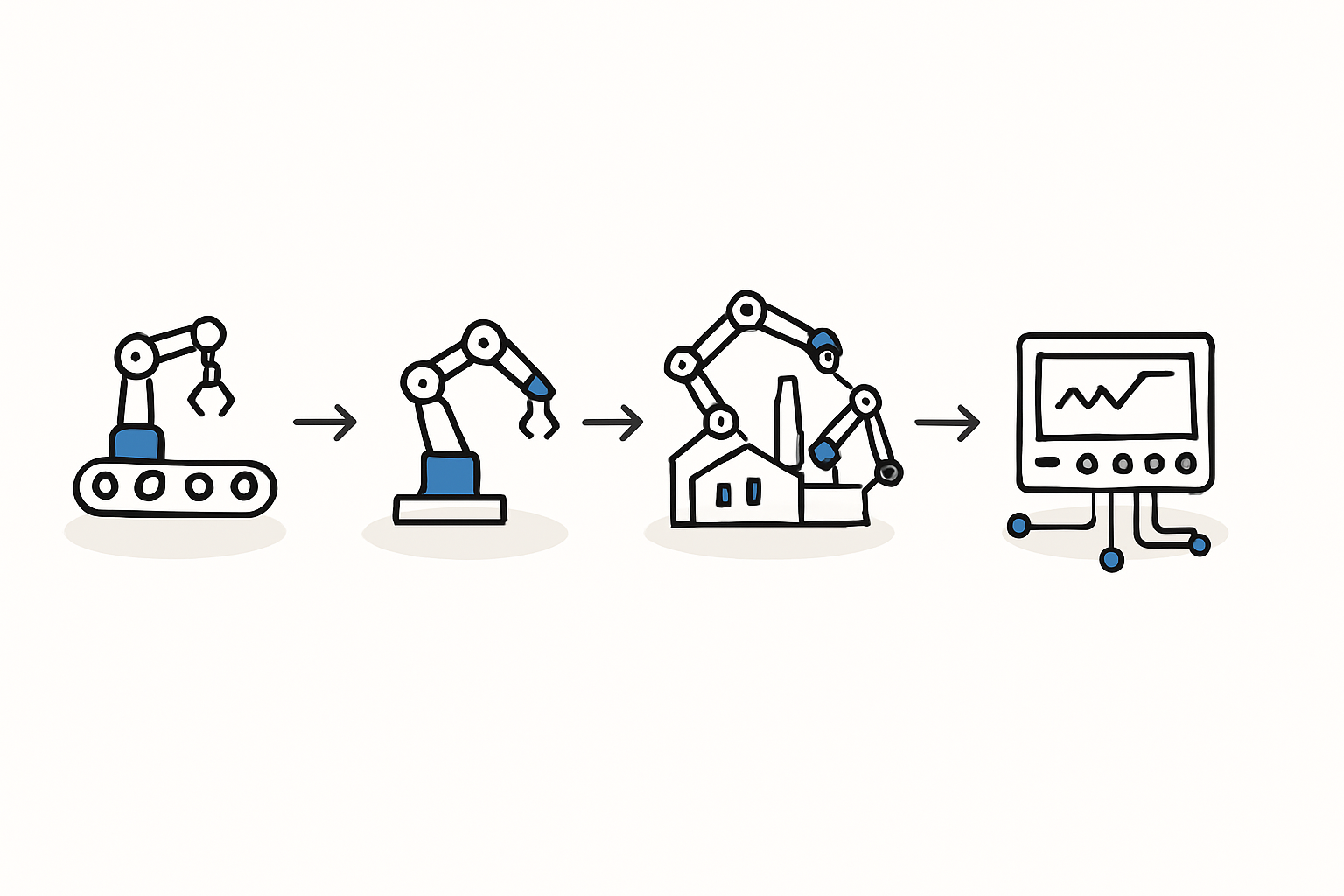
Designed for large-scale manufacturing (typically 300 MW and above), a fully automated line uses robotics and integrated systems to handle nearly every step of the process with minimal human intervention.
- Investment: Requires the highest initial Capex. This includes advanced robotic arms for cell handling, automated bussing machines, and integrated conveyor systems.
- Labor: Drastically reduces direct labor needs. Research indicates that full automation can cut the direct labor force by up to 75% compared to a manual line. Staff roles shift primarily to supervision, quality control, and maintenance.
- Throughput & Quality: Achieves the highest throughput and the most consistent product quality. This is the gold standard for minimizing defects and maximizing module efficiency.
A Deeper Dive: Analyzing the Financial and Quality Impact
The decision on automation goes beyond a simple Capex calculation. Its impact is seen across the key performance indicators that determine a factory’s long-term viability.
Direct Labor Costs vs. Throughput
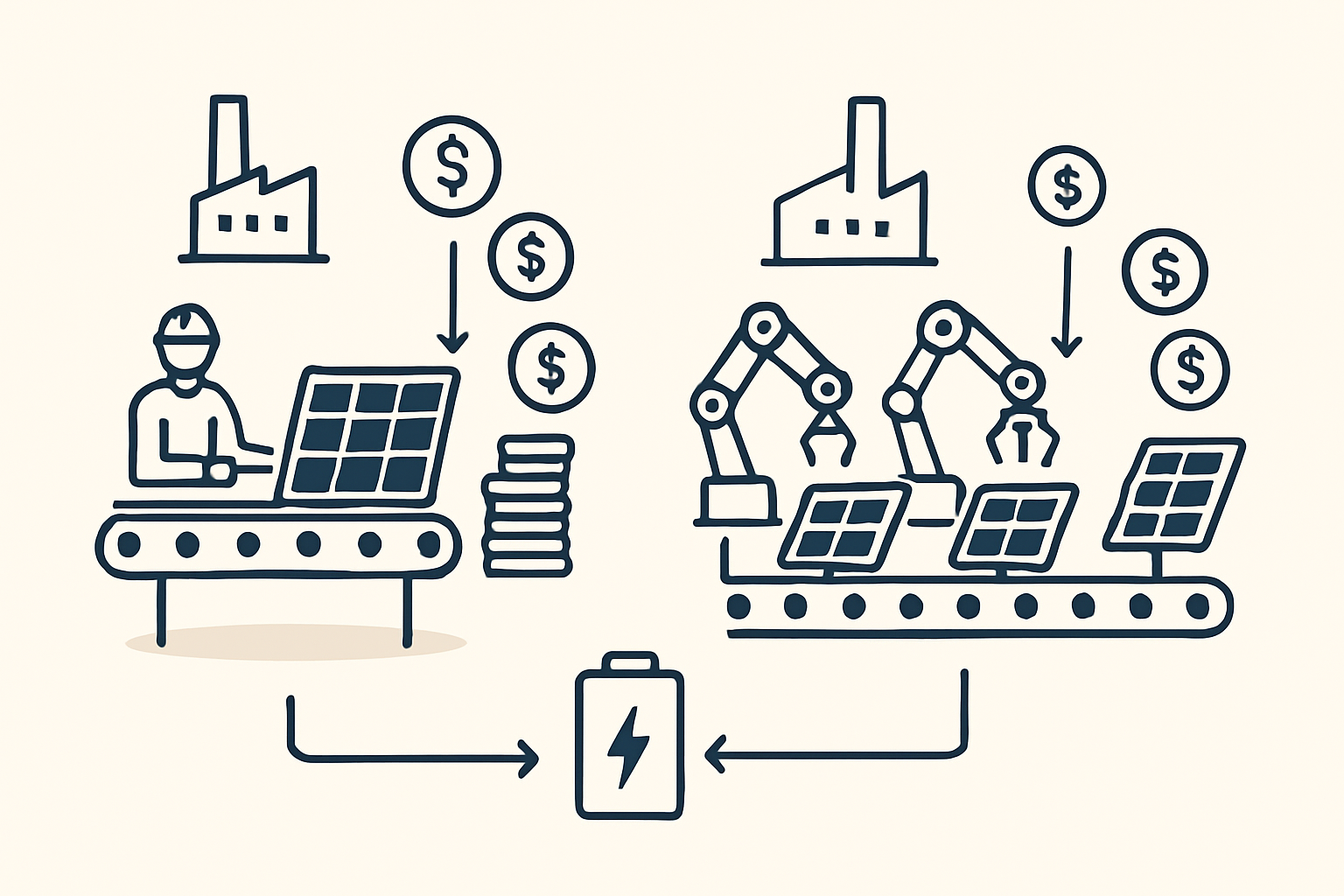
As automation increases, the number of operators required per megawatt of output decreases significantly. A higher upfront investment in machinery directly translates to lower recurring salary costs—a powerful lever for improving profitability, especially in regions with higher wages.
The analysis illustrates the inverse relationship between Capex and Opex. While a fully automated line requires the most significant initial outlay, its lower operational costs and higher throughput can lead to a faster path to profitability and a more competitive market position.
The Ultimate Metric: Cost-per-Watt ($/Wp)
The most important metric for a solar manufacturer is the final cost to produce one watt of power capacity ($/Wp). Automation impacts this in several critical ways:
- Reduced Material Waste: Automated systems are more precise than manual handling, reducing cell breakage and other material losses.
- Higher Module Efficiency: Consistent, automated soldering and bussing processes can reduce cell-to-module (CTM) power loss. Industrial data shows this can yield a 1-2% improvement, meaning each module produces more power from the same input materials.
- Increased Yield: Higher throughput and fewer defects mean a greater number of high-quality, saleable modules are produced per day, lowering the fixed cost allocated to each unit.
When planning your factory, a detailed analysis of the projected cost of setting up a solar panel factory should forecast how automation will drive down your long-term cost-per-watt.
Quality, Reliability, and Bankability
In the solar industry, quality is paramount. A module’s long-term performance and reliability—often called its “bankability”—determine its market value. Microcracks, which are tiny, often invisible fractures in solar cells, are a primary cause of long-term power degradation.
Automated, robotic handling systems are significantly gentler and more precise than human hands, especially with today’s large and ultra-thin solar cells. Production data shows that robotic handling can reduce the incidence of microcracks by over 50%. This directly translates into a more reliable, higher-quality product that can command a better price and build a stronger brand reputation.
Making the Right Decision for Your Project
The optimal level of automation isn’t one-size-fits-all. The decision depends on a strategic evaluation of several factors:
- Target Capacity: For production under 50 MW, a semi-automated line often provides the best balance. For capacities above 300 MW, full automation is generally the most logical path.
- Local Labor Market: In regions with high labor costs, the financial case for automation is stronger. In areas with lower wage structures, a semi-automated approach might remain competitive for longer.
- Capital Availability: The amount of investment capital available is a primary constraint that will heavily influence the initial choice.
- Long-Term Strategy: If the goal is to become a regional market leader known for quality and scale, investing in higher levels of automation from the start is a strategic advantage.
For many investors, the deciding factor is the return on that investment. The payback period for the additional Capex required for automation, realized through labor savings and efficiency gains, is typically between three and five years. This calculation is a fundamental part of any robust solar panel business plan.
Frequently Asked Questions (FAQ)
Q1: What is the main operational bottleneck in a manual solar production line?
The cell tabbing and stringing process is almost always the primary bottleneck. This delicate soldering process is slow and requires immense precision, making it difficult for human operators to perform quickly and consistently without causing defects. This is why the stringer machine is one of the first pieces of equipment to be automated.
Q2: Does “fully automated” mean there are no human workers in the factory?
No. A fully automated factory still requires a skilled workforce for system supervision, loading raw materials, performing quality assurance checks, conducting machine maintenance, and packaging finished products. The nature of the work shifts from repetitive manual labor to more technical, oversight-focused roles.
Q3: How does automation affect the skill requirements for employees?
It shifts the demand from low-skilled manual laborers to technicians and engineers with skills in mechatronics, robotics, and process control. Investing in training for the local workforce is a critical component of launching a successful automated factory.
Q4: Can a factory be upgraded from semi-automated to fully automated later?
Yes, this is a common and viable strategy. A production line can be designed with a modular approach, allowing for the future integration of robotic loaders, automated conveyors, and other advanced systems as the business grows and more capital becomes available. Planning for this scalability from the beginning is a wise approach.
Conclusion: An Investment in Future Competitiveness
Choosing the right level of automation is a foundational decision that shapes the operational and financial future of a solar manufacturing plant. It isn’t merely an equipment purchase but a strategic investment in efficiency, quality, and long-term market competitiveness.
Based on experience from J.v.G. Technology GmbH turnkey projects, a thorough analysis of local labor costs, target capacity, and long-term business goals is essential before making a commitment. While a semi-automated line offers a balanced entry point for many, the global trend is undeniably towards higher levels of automation to ensure the quality and cost-effectiveness required to succeed. A partner providing a turnkey solar manufacturing line can offer detailed financial modeling to help clarify which approach best aligns with your project’s specific circumstances.