
A solar module is only as reliable as its weakest component
While cells and glass often get the most attention, two seemingly minor parts—the junction box and the encapsulant—are common sources of long-term failure. For a new manufacturing business, sourcing these components without a rigorous qualification process poses a significant financial and reputational risk. The 2023 PVEL Module Reliability Scorecard, for instance, highlights that junction box failures remain a persistent issue, with 10% of manufacturers experiencing failures in damp heat testing—a test that directly stresses encapsulant and backsheet integrity.
This article provides a structured framework for qualifying and auditing suppliers of these critical components. It’s a guide for business professionals entering the solar industry, offering a clear, actionable process to secure their supply chain and protect their investment. Mastering this process is a fundamental step for anyone learning how to start a solar panel manufacturing business.
Why Component Quality Is a Critical Business Risk
In solar module manufacturing, initial production costs are just one part of the financial equation. Long-term performance and reliability ultimately determine a product’s profitability over its 25-year warranty period. A single faulty component, when scaled across thousands of modules, can trigger widespread field failures, costly warranty claims, and irreparable damage to a company’s brand.
Research from institutions like the National Renewable Energy Laboratory (NREL) consistently places junction box failures and encapsulant degradation (delamination, discoloration) among the top causes of module failure in the field. Data from PVEL reinforces this, showing that even among established manufacturers, 30% had at least one failure during thermal cycling tests, which stress solder joints and material bonds affected by encapsulants.
Sourcing these components based on price alone is a common but dangerous mistake for new market entrants. A robust supplier qualification framework isn’t an administrative burden; it’s a core risk management strategy.
The Two Pillars of Supplier Qualification
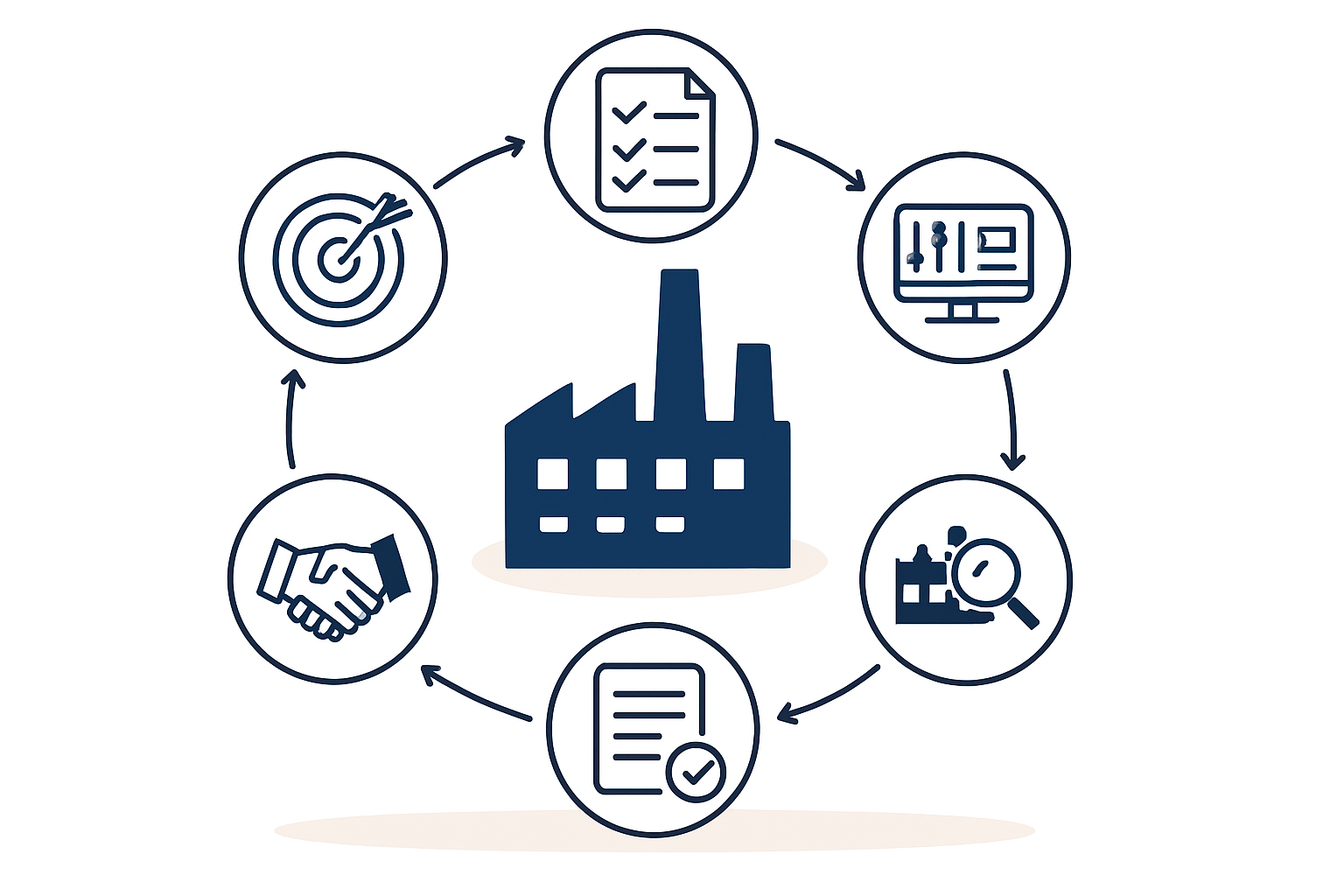
A comprehensive supplier qualification process rests on two pillars: a remote technical audit and an on-site factory audit.
- Technical & Documentary Audit: This initial phase involves reviewing the supplier’s certifications, quality management systems, and internal testing protocols. It can be done remotely and serves as a first-line filter.
- On-Site Factory & Process Audit: If the supplier passes the documentary stage, an in-person visit is essential to verify that their documented processes are followed on the factory floor.
Based on experience from J.v.G. turnkey projects, attempting to bypass the on-site audit is one of the most common shortcuts that leads to future problems.
Part 1: The Technical and Documentary Audit
Before committing resources to an on-site visit, a thorough review of the supplier’s documentation reveals a great deal about their professionalism and commitment to quality.
Verifying Certifications (IEC/UL)
First, confirm that the components are certified to international standards. For solar components, the key standards are from the IEC (International Electrotechnical Commission) and UL (Underwriters Laboratories).
- Junction Boxes: Look for certification to IEC 62790.
- Encapsulants (and other materials): These are certified as part of the complete module under IEC 61215 (performance) and IEC 61730 (safety).
Actionable Insight: Don’t just accept a PDF of a certificate. Verify the certificate number directly with the issuing body (e.g., TÜV, VDE, UL). This confirms the certificate is current and hasn’t been revoked.
Reviewing the Quality Management System (QMS)
A credible supplier should operate under a formal QMS, most commonly ISO 9001. Request a copy of their quality manual. This document should outline their procedures for:
- Traceability: How do they track raw materials from their suppliers through to the finished product batch they send to you?
- Non-conforming Product: What is their process for identifying, isolating, and handling defective products?
- Corrective Actions: How do they analyze the root cause of a defect and prevent it from happening again?
A well-documented QMS is a strong indicator of a mature and reliable manufacturing operation.
Evaluating Material Batch Testing Protocols
Ask for the supplier’s internal quality control data. They should be able to provide batch-specific test reports for both incoming raw materials and their outgoing finished products. For example:
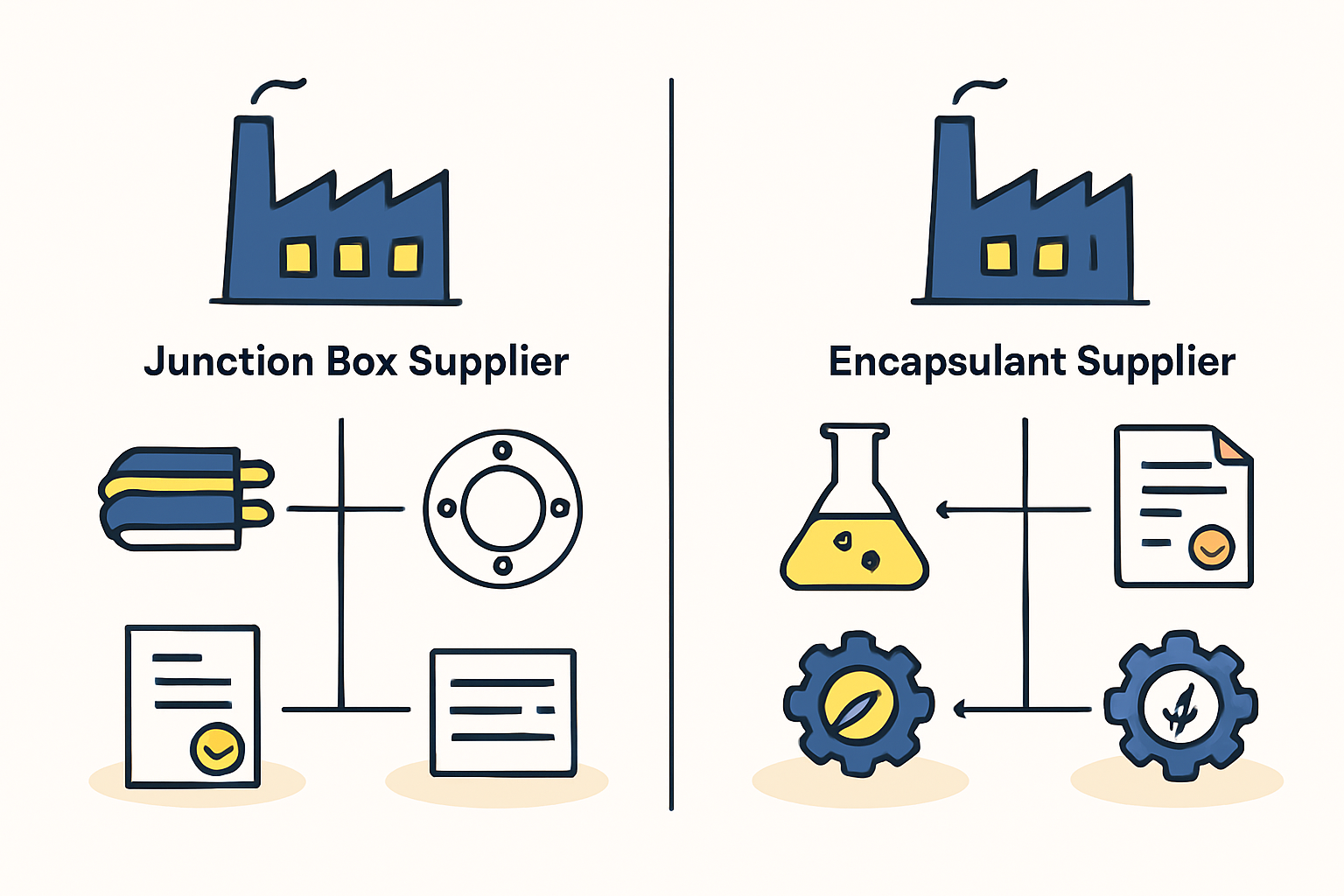
- Junction Box Supplier: Should provide data on bypass diode forward voltage (Vf) and reverse current (Ir), cable pull-out force, and IP rating tests.
- Encapsulant Supplier: Should provide data on gel content, peel strength, light transmittance, and volume resistivity for each production batch.
A supplier who is hesitant or unable to provide this data should be considered a high risk.
Part 2: The On-Site Factory Audit Checklist
If a supplier passes the documentary audit, the next step is an in-person inspection. This visit allows you to verify that their written procedures match their practices on the production floor.

Production Environment and Housekeeping
A clean, well-organized factory often reflects a well-run operation. During the visit, observe:
- Cleanliness: Are floors clean? Are workstations organized? Dust and debris can lead to contamination and defects.
- Climate Control: Are temperature and humidity controlled, especially in areas where sensitive materials are stored or processed?
- ESD (Electrostatic Discharge) Protection: Are proper ESD grounding measures in place where electronic components like diodes are handled?
Raw Material Storage and Handling
Pay close attention to how a supplier manages their raw materials.
- Storage Conditions: Are materials like encapsulant films or potting compounds stored according to the manufacturer’s recommendations (e.g., temperature-controlled, protected from UV light)?
- FIFO (First-In, First-Out): Does the supplier have a system to ensure that older material stock is used before newer stock? This prevents the use of expired materials.
Process Controls and Calibration
Consistency in production is key to quality.
- Machine Calibration: Are production machines (e.g., injection molding for junction box housings, diode testing equipment) on a regular calibration schedule? Ask to see calibration records.
- Parameter Monitoring: Are critical process parameters (e.g., temperature, pressure, curing time) monitored and logged for each production run? This is a vital part of the overall solar panel manufacturing process.
In-Line and Final Quality Checks
Observe the quality control points throughout the production line.
- Incoming Quality Control (IQC): Do they test raw materials they receive? For example, do they test a sample of diodes before they are assembled into junction boxes?
- In-Process Quality Control (IPQC): Are there checks at intermediate steps? For example, checking the seal of a junction box lid before potting.
- Outgoing Quality Control (OQC): What final tests are performed on the finished product before it is packaged and shipped?
Specific Considerations for Key Components
While the general framework applies to all suppliers, junction boxes and encapsulants have unique failure modes that require special attention.
Qualifying Junction Box Suppliers
A junction box provides a secure terminal for the module’s electrical output and houses the bypass diodes that protect cells from hotspot damage. Key areas to audit include:
- Diode Quality: This is the most critical element. Investigate their diode supplier and their incoming testing procedures. Diode failure is a leading cause of junction box-related fires.
- Potting Compound: The material used to seal the junction box must be free of voids and bubbles to prevent moisture ingress.
- Cable Gland and Adhesion: The seal where the cables exit the box must be robust. The adhesive used to attach the box to the module backsheet must be rated for long-term outdoor exposure. PVEL has specifically noted adhesion loss as a common failure mode.
Qualifying Encapsulant Suppliers (EVA & POE)
The encapsulant (typically EVA or POE film) bonds the glass, cells, and backsheet together while also protecting the cells from moisture and mechanical stress.
- Material Purity: The raw polymer resin must be of high quality. Ask about the supplier of the resin and any additives used (e.g., UV stabilizers, cross-linking agents).
- Gel Content: This test measures the degree of cross-linking after lamination. Insufficient gel content leads to poor adhesion and mechanical instability.
- Peel Strength: The material must bond strongly to both the glass and the backsheet to prevent delamination, a failure mode common in damp heat tests. This is especially important in regions with high humidity and temperature fluctuations, such as parts of Africa and Southeast Asia.
From Qualification to Partnership
Supplier qualification isn’t a one-time event. Once a supplier is approved, the relationship must be actively managed through:
- Regular Audits: Conduct periodic follow-up audits, perhaps annually or biennially.
- Batch-to-Batch Monitoring: Continue to require a Certificate of Analysis (CoA) with every shipment to ensure consistency.
- Open Communication: Build a relationship where the supplier feels comfortable reporting any process deviations or material changes.
By implementing this structured framework, a new solar module manufacturer can significantly reduce the risk of component-related failures and build a foundation for a reliable product and a sustainable business. This due diligence is an integral part of planning a successful turnkey solar panel manufacturing line.
Frequently Asked Questions (FAQ)
What is the difference between EVA and POE encapsulants?
EVA (Ethylene Vinyl Acetate) has been the industry standard for decades. It’s cost-effective and well-understood. POE (Polyolefin Elastomer) is a newer material that offers superior resistance to moisture ingress and potential-induced degradation (PID), making it a preferred choice for high-efficiency modules like bifacial and n-type designs.
How often should a supplier audit be conducted?
For a new supplier, an initial on-site audit is mandatory before placing a large order. After qualification, a follow-up audit is recommended every 1-2 years, or immediately if a quality issue arises.
Can a small factory rely solely on supplier certifications?
No. A certificate proves that a component can meet a standard, but it doesn’t guarantee that every batch produced will meet that standard. A certificate is a starting point, not a substitute for your own due diligence and incoming quality control.
What are the most common failure modes for junction boxes?
The most common and dangerous failure is bypass diode failure, which can lead to overheating and fire risk. Other common failures include adhesive failure (the box detaches from the module), moisture ingress due to poor seals, and connector failures.
Is it more cost-effective to use cheaper, uncertified components?
No. The small upfront savings are insignificant compared to the potential costs of large-scale warranty claims, product recalls, and damage to brand reputation. Investing in quality components from audited suppliers is one of the most cost-effective decisions a manufacturer can make.