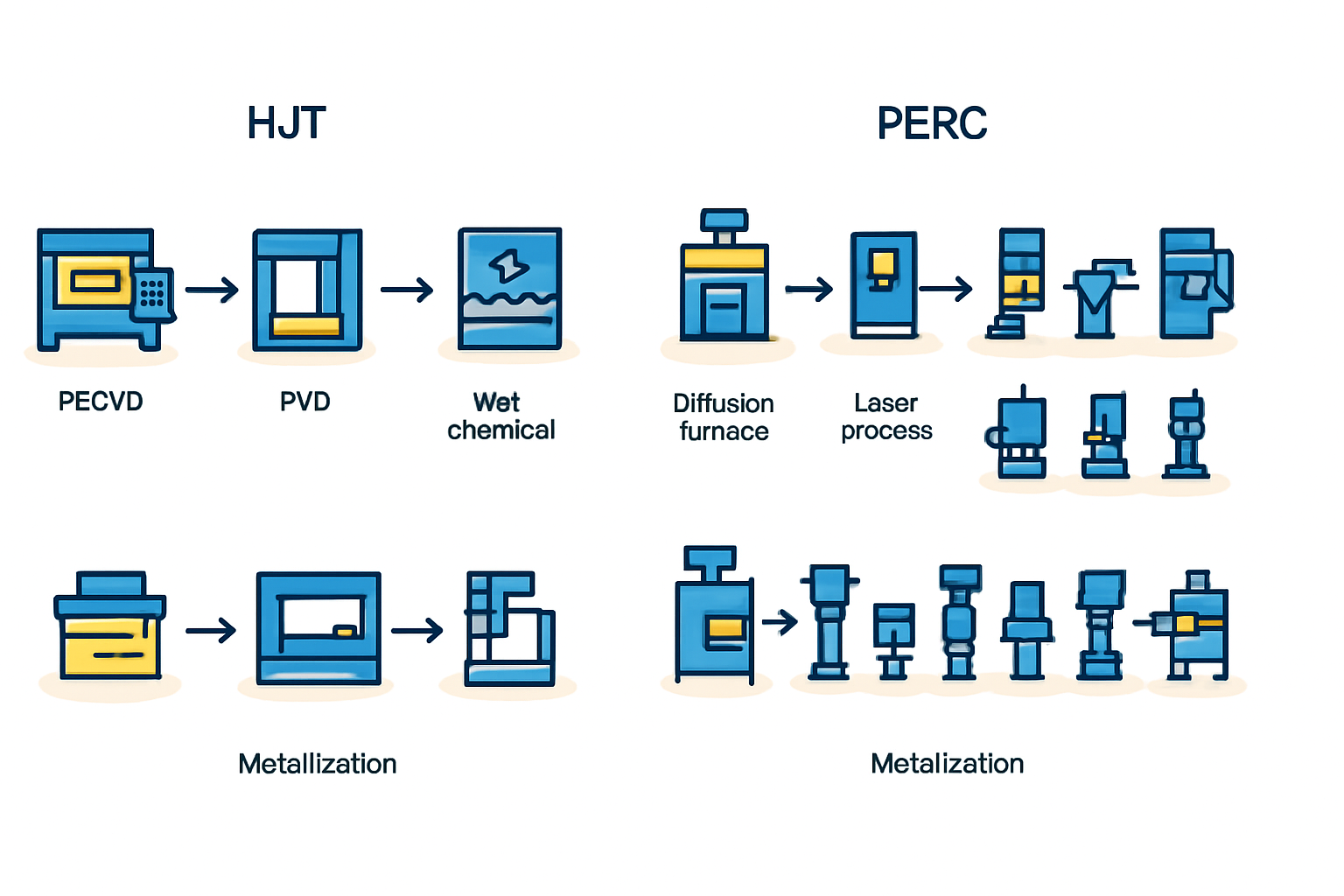
An investor considering entering the solar manufacturing sector will inevitably face a critical decision: which technology to adopt? For years, PERC (Passivated Emitter and Rear Cell) has been the industry standard—a reliable and well-understood process. However, a more advanced technology, Heterojunction (HJT), stands out for its promise of higher efficiencies and superior performance.
This raises a fundamental question for prospective investors: What does it actually take to manufacture an HJT module? Is it a simple upgrade, or does it require a completely different factory setup?
The answer lies in understanding the specialized machinery at the heart of the HJT process. While a PERC line relies on high-temperature diffusion furnaces, an HJT line is defined by its sophisticated, low-temperature deposition systems. This article breaks down the key equipment that distinguishes an HJT production line and explores the operational implications for new entrants.
From PERC to HJT: A Fundamental Shift in Cell Technology
To appreciate the machinery, it’s essential to first understand the core difference in the solar cell itself. A standard PERC cell is built on a p-type silicon wafer, using high-temperature processes (over 800°C) to create its electronic structure.
HJT technology takes a more elegant and advanced approach. It uses a high-quality n-type monocrystalline silicon wafer. Instead of high-heat diffusion, the HJT process deposits microscopically thin layers of amorphous silicon on both sides of the wafer. This creates a unique structure, or “heterojunction,” that is exceptionally effective at capturing sunlight and minimizing energy loss.
This fundamental architectural difference is why a PERC line cannot simply be “upgraded” to HJT. The manufacturing philosophy and the core equipment are entirely distinct. The key advantages driving HJT adoption—such as industry-leading efficiency, a superior temperature coefficient, and excellent bifacial performance—are all direct results of this unique, low-temperature manufacturing process.
The Core of the HJT Line: Specialized Deposition Equipment
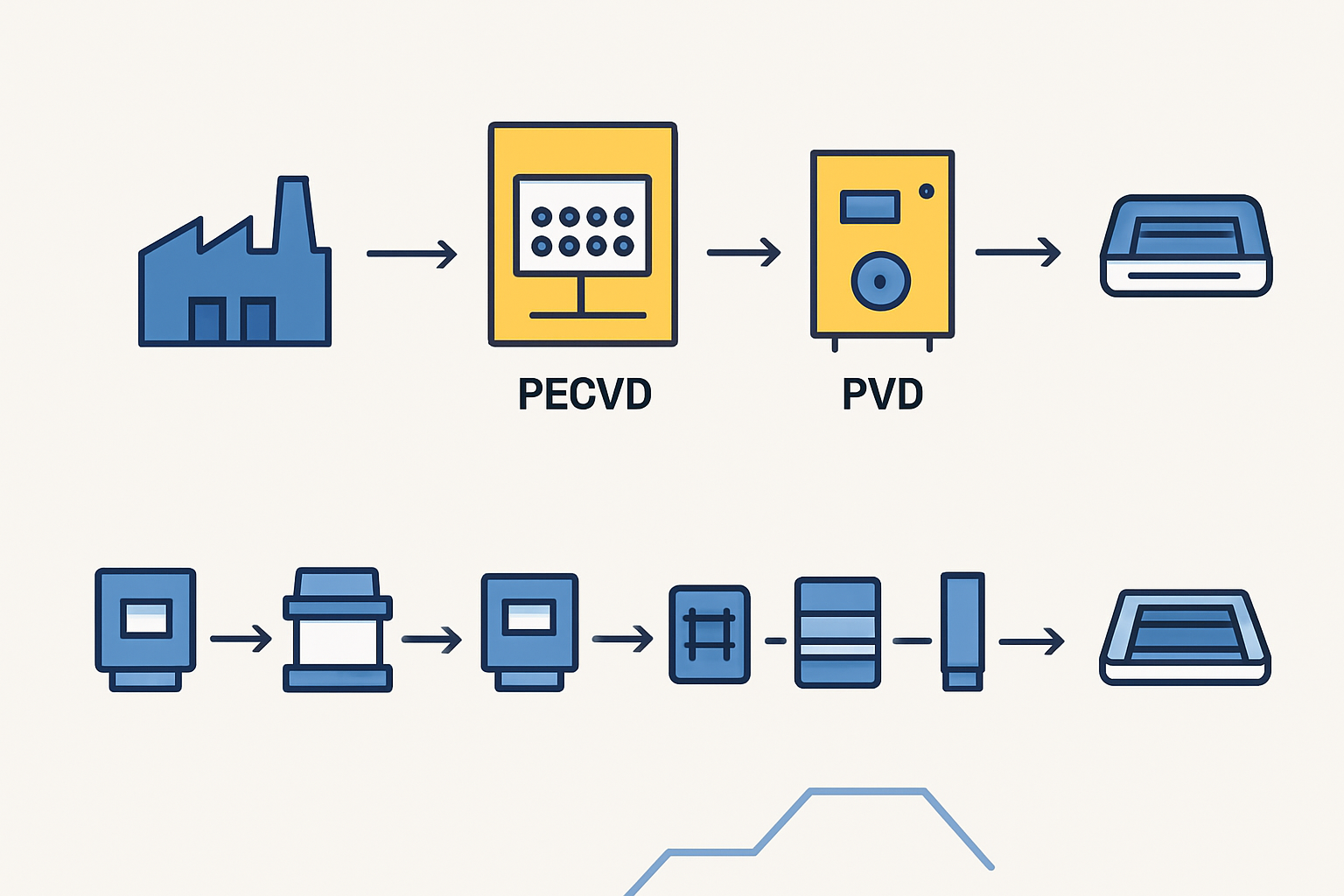
Two types of machinery form the technological core of any HJT solar cell production line: PECVD and PVD systems. These machines are responsible for creating the delicate, high-performance layers that define the HJT cell.
Plasma-Enhanced Chemical Vapor Deposition (PECVD)
The PECVD machine performs the first critical step in forming the heterojunction: applying the intrinsic and doped amorphous silicon layers.
Inside a vacuum chamber, the PECVD system introduces specific gases (like silane and hydrogen) and uses a plasma field to activate them. This allows the gases to decompose and deposit an ultra-thin, perfectly uniform film onto the n-type silicon wafer. This process is repeated to create multiple layers, each only a few nanometers thick.
Think of it as an atomic-level coating process. The precision required is immense, as the quality of these layers directly dictates the cell’s final efficiency. A key benefit of this method is its low processing temperature (below 200°C), which preserves the high quality of the silicon wafer and prevents the degradation associated with high-heat methods. For a comprehensive overview of the different steps involved in production, it is useful to understand the complete solar module manufacturing process.
Physical Vapor Deposition (PVD)
After the amorphous silicon layers are deposited, the cell needs a transparent conductive layer to allow sunlight to pass through while enabling electricity to be extracted efficiently. This is where the PVD machine, often using a technique called sputtering, comes into play.
Inside the PVD system, a target material—typically Indium Tin Oxide (ITO)—is bombarded with ions. This causes atoms from the target to be “sputtered” off and deposited onto the solar cell as a thin, transparent, and highly conductive film. This Transparent Conductive Oxide (TCO) layer is critical for HJT’s performance, especially its high bifaciality, as it allows the cell to generate power from light hitting its rear side as well.
The quality and uniformity of the TCO layer are paramount for minimizing electrical resistance and maximizing current collection, further contributing to the cell’s high efficiency.

How HJT Machinery Integrates into the Production Workflow
An HJT production line follows a noticeably different workflow than a PERC line. The initial stages of wafer cleaning and texturing are similar, but the core processes diverge significantly.
A Simplified HJT Workflow:
- Wet Chemistry: N-type wafers are cleaned and textured to optimize light absorption.
- PECVD: Deposition of intrinsic and doped amorphous silicon layers on both sides of the wafer.
- PVD (Sputtering): Deposition of the TCO layers on both sides.
- Metallization: Screen printing of silver paste to form the electrical contacts (busbars and fingers).
- Testing and Sorting: Each cell is tested for performance and sorted into efficiency grades.
While the absence of high-temperature diffusion furnaces simplifies the factory’s thermal budget, it introduces the complexity of managing high-vacuum deposition systems. Experience from J.v.G. turnkey projects shows that operating PECVD and PVD machines successfully demands a higher level of technical skill from operators and maintenance staff compared to traditional equipment.
Business and Operational Implications
For an investor, the choice of machinery directly impacts capital expenditure, operational strategy, and supply chain management.
- Higher Capital Expenditure (CAPEX): HJT production lines, particularly the PECVD and PVD equipment, represent a significantly higher initial investment than a standard PERC line of the same capacity. This premium pays for the technology needed to produce higher-efficiency, premium modules.
- Fewer Steps, Higher Process Control: While the HJT process has fewer steps, the deposition stages are extremely sensitive to impurities and parameter deviations. This demands a higher-class cleanroom environment and stringent process control protocols.
- Specialized Workforce: Operating and maintaining high-vacuum deposition equipment requires specialized training. A factory’s human resources plan must account for finding or training technicians with skills in vacuum technology, plasma physics, and process monitoring.
- Supply Chain Considerations: An HJT factory requires a reliable supply of high-quality n-type wafers. Materials like indium (for the ITO target in PVD) and specialized gases (for PECVD) also become critical inputs. A robust solar supply chain management strategy is essential for uninterrupted production.
Frequently Asked Questions (FAQ) for Prospective Investors
What is the primary advantage of HJT that justifies the higher equipment cost?
The main advantage is superior module performance. This includes higher cell efficiency, a lower temperature coefficient (meaning it performs better in hot climates, which is relevant for many projects in Africa and the Middle East), and no Light Induced Degradation (LID) or Light and elevated Temperature Induced Degradation (LeTID). This translates to a higher energy yield over the module’s lifetime, commanding a premium price in the market.
Can an existing PERC production line be converted to an HJT line?
No, a conversion is not feasible. The core technologies are fundamentally different. A PERC line is built around high-temperature diffusion furnaces, while an HJT line relies on low-temperature PECVD and PVD vacuum systems. An investment in HJT means setting up a new, dedicated production line.
How does the required factory footprint for HJT compare to PERC?
The overall factory footprint for a similar capacity (e.g., 500 MW) is comparable. While HJT lines have fewer process steps, the PECVD and PVD machines are large, complex systems that require significant space and dedicated utility infrastructure.
What are the main risks associated with an HJT investment?
The primary risks are the higher initial CAPEX and technological complexity. Securing financing and developing a skilled technical team are critical success factors. A detailed feasibility study and a comprehensive solar factory business plan are indispensable for mitigating these risks.
Conclusion: Planning Your Entry into High-Efficiency Module Production
Choosing to manufacture HJT modules is a strategic decision to enter the premium segment of the solar market. It represents a commitment to producing a technologically superior product that delivers higher performance and long-term value.
However, this path requires a clear understanding that the investment goes beyond standard equipment. The core of an HJT factory—its PECVD and PVD systems—demands higher capital outlay, a more skilled workforce, and meticulous process control. For the discerning investor, this technological barrier to entry also represents an opportunity to establish a competitive advantage in a growing market for high-efficiency solar solutions. The journey begins not just with capital, but with a deep appreciation for the advanced manufacturing technology required.