Exploring the Kyrgyzstan solar plant debate in Kochkor District
A proposed solar power plant in Kyrgyzstan’s Kochkor District has ignited a significant debate, pitting the national government’s urgent need for renewable energy against the deep-rooted traditions and livelihoods of the local community. While the project is part of a broader national strategy to address energy shortages, public hearings and parliamentary discussions have revealed a complex conflict over land use. This initiative is one of several recent efforts, as Kyrgyzstan expands solar energy with new IFC-backed plants, making the outcome in Kochkor a critical test case.
The Core of the Kyrgyzstan solar plant debate: Pastures vs. Panels
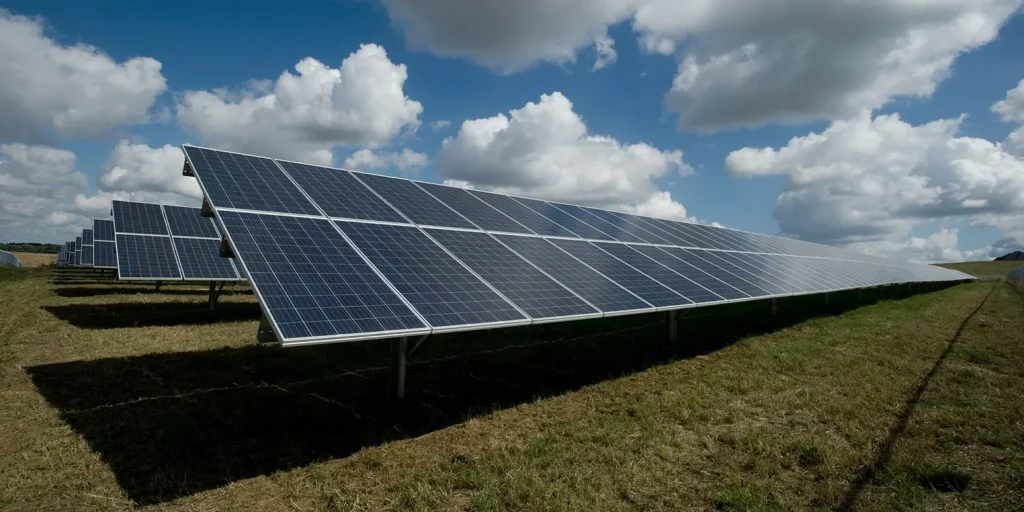
The debate escalated following contentious public hearings and was later brought to the floor of the Jogorku Kenesh (parliament) in late 2025. The proposed site in the Orto-Tokoy area, between the villages of Kara-Suu and Semiz-Bel, lies on vital pastureland.
Locals argue that this land is essential for grazing livestock, which forms the backbone of the regional economy. “There are 200 families with 1,300 cattle grazing in this area,” one farmer stated at a public hearing. “If we lose this land, it will severely impact our way of life.”
These concerns were echoed in parliament by Deputy Gulsunkan Junushalieva, who stated that the solar power station was being constructed on pastures against the will of the residents of Ortok village. She noted that while locals may have initially agreed, opposition grew as construction began to occupy significant grazing areas.
A Divided Hearing and a Firm Government Stance on the Kyrgyzstan solar plant debate
An earlier public hearing at the House of Culture in Kochkor village drew around 350 attendees and quickly became contentious. When Kochkor district governor, Akylbek Kachykov, asked for a show of hands, only about 20 supported the project, while nearly 150 stood in opposition. The governor abruptly ended the hearing, citing a lack of consensus.
The government, however, has highlighted the country’s critical energy situation. Adylbek Kasymaliev, the head of the cabinet, expressed dissatisfaction with the opposition, emphasizing Kyrgyzstan’s severe electricity deficit. He noted the country needs 19 billion kWh annually but only produces 14 billion, forcing it to import 4.5 billion kWh from neighboring countries. This push for energy independence is a key part of the Eurasian Development Bank’s renewable energy strategy, which has designated the Kyrgyzstan solar power plant as a project of key importance.
Energy Minister Talaybek Ibraev acknowledged the dispute, stating that while initial negotiations had secured resident agreement, dissatisfaction arose after work began. He reported that in response to the conflict, the construction was relocated to another site provided by local authorities.
The Bigger Picture: Technology, Investment, and Energy Security in the Kyrgyzstan solar plant debate
The successful rollout of a modern Kyrgyzstan solar energy program relies on sophisticated technology and logistics. Understanding the basics of solar panel manufacturing and the complex solar panel manufacturing process reveals the intricate engineering behind these massive power plants. From sourcing solar panel raw materials to deploying advanced solar panel manufacturing machines, the scale of such projects is immense.
This national push is fueled by significant Kyrgyzstan solar investment, aimed at stabilizing energy costs and creating skilled jobs. By reducing its reliance on imported fuels, the goal is to enhance energy security and buffer the economy from volatile global energy prices, which is why these impressive 2024 projects were launched. A detailed solar panel manufacturing plant cost breakdown shows that such large-scale international projects are critical for achieving economies of scale.
The Path Forward in the Kyrgyzstan solar plant debate
The Kochkor solar project controversy underscores the central challenge facing Kyrgyzstan: balancing the urgent need for clean energy with the rights and livelihoods of local communities. While the government has emphasized the national energy crisis and has even relocated the project site, skepticism among residents persists.
The outcome of this debate will have lasting implications for Kyrgyzstan’s energy policy. Can the government successfully implement its ambitious renewable energy goals while ensuring that local communities are partners, not casualties, in the process? The answer will shape the nation’s energy future and its relationship with its citizens. As the situation evolves, the people of Kochkor continue to advocate for a resolution that respects their land and their way of life.
To learn more about the fundamentals of solar power and its global impact, explore our free e-course on solar energy.