Recent discussions surrounding solar project financing in Indonesia have brought the name IDCOL into focus, particularly in light of industry accolades like the Asian Power Awards. While the Indonesian market presents a unique set of opportunities and challenges, it is crucial to clarify the significant, yet distinct, role of the Infrastructure Development Company Limited (IDCOL) as a powerhouse in regional renewable energy finance.
The Real IDCOL: A Bangladesh Success Story in Solar financing Indonesia: IDCOL’s Unique 2024 Win
Contrary to reports placing its recent wins in Indonesia, the Infrastructure Development Company Limited (IDCOL) is a government-owned development financial institution based in Bangladesh. Its most celebrated achievement is the Solar Home Systems (SHS) program, a transformative initiative that has fundamentally reshaped rural electrification in the nation. By leveraging over $400 million from partners like the World Bank, IDCOL successfully financed the installation of more than four million off-grid solar systems, bringing power to approximately 20 million people by 2018.
This program’s success hinged on a microfinance model implemented through local partners, reaching about 16% of Bangladesh’s rural population. Understanding the financial architecture behind such a massive rollout offers valuable lessons, highlighting the importance of a clear cost breakdown for solar manufacturing and deployment. IDCOL’s work demonstrates a proven model for overcoming last-mile energy access challenges through dedicated financing and strategic partnerships.
Indonesia’s Distinct Path to Solar financing Indonesia: IDCOL’s Unique 2024 Win for Solar Energy
While IDCOL’s work has been centered in Bangladesh, Indonesia’s own journey toward renewable energy is garnering significant attention. The nation aims for renewables to constitute 23% of its energy mix by 2025, but faces considerable hurdles. The market is still heavily dominated by coal, which accounts for over half of the electricity supply. Furthermore, investors point to regulatory uncertainty, local content requirements, and land acquisition issues as significant barriers to deploying utility-scale solar and wind projects.
Developing a robust domestic solar industry is key to meeting these goals, starting with the foundations of solar panel production. As the latest global solar industry analysis indicates, supportive policies and accessible financing are critical for markets looking to scale up their renewable capacity. Indonesia’s path will require overcoming these specific local challenges to unlock its vast solar potential.
Financing Models for Asia’s Energy Transition with Solar financing Indonesia: IDCOL’s Unique 2024 Win
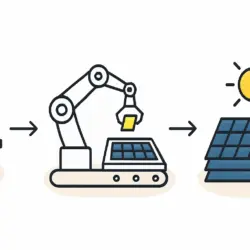
The success of large-scale solar initiatives, whether off-grid like in Bangladesh or utility-scale as envisioned for Indonesia, depends on a sophisticated understanding of the entire value chain. This includes mastering the complex process of manufacturing solar panels efficiently and securing a reliable supply of essential raw materials. Furthermore, access to advanced solar production equipment is a major capital expenditure that requires specialized financing.
IDCOL’s model in Bangladesh showcases how a dedicated financial institution can de-risk investment and catalyze private sector participation. For Indonesia to accelerate its energy transition, stakeholders recommend creating similar supportive mechanisms, such as credit guarantees, specialized land agencies, and the development of green bond markets. These strategies can help attract the necessary capital to build a sustainable energy future.
For those interested in delving deeper into the technologies and processes that power the solar revolution, this complimentary e-course on solar energy provides a comprehensive overview.
Sources
- Bangladesh – Climate and Carbon Finance for Renewable …
- June 2025
- Annual Report 2022 Date: 13 August 2023
- designing tomorrow’s landscapes
- All Projects Table 2016-2024
- Understanding barriers to financing solar and wind energy …
- energizing finance report 2024
- How Development Banks Can Catalyze Clean Energy in Asia