Entering the solar module manufacturing industry presents a significant opportunity, but it begins with a foundational decision many new investors overlook. The critical choice is not simply which machines to buy, but which solar cell technology to build your entire operation around.
This single decision dictates the factory layout, capital expenditure, operational costs, and the long-term competitiveness of your business. Many equipment suppliers present turnkey lines as a simple menu of production capacities. However, a successful solar factory is an integrated system, and the core of that system is the cell technology. This guide explains how to approach this critical decision—moving from technology selection to equipment configuration and factory planning—to ensure your investment is both profitable and future-proof.
The Technology-First Approach to Factory Design
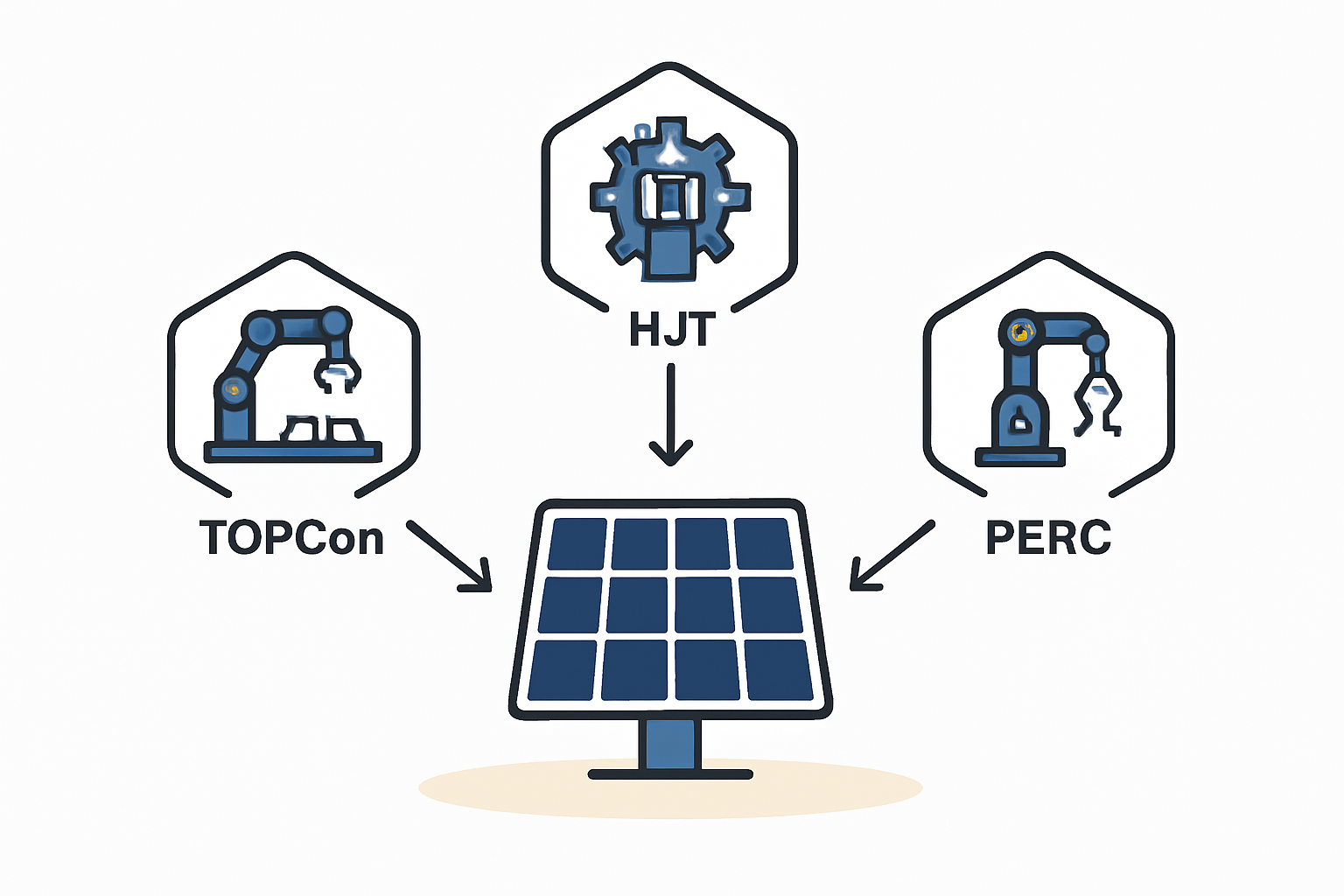
The most critical mistake an investor can make is to select production machinery before committing to a specific solar cell technology, be it PERC, TOPCon, or HJT. Each technology follows a distinct process flow, requiring specialized equipment and a unique factory layout. Attempting to build a generic line leads to inefficiency, higher-than-expected costs, and limitations on future upgrades.
The choice of cell technology is the central pillar of the factory design. It influences:
- Equipment Selection: A TOPCon line requires different deposition and handling machines compared to an HJT line.
- Factory Footprint: The number and size of machines, along with necessary buffer zones, change the required building dimensions.
- Process Flow and Automation: The sequence of production steps is unique to each technology, dictating the optimal layout for material movement.
- Utility Requirements: Power, water, and specialized gas needs vary significantly between, for example, high-temperature PERC processes and lower-temperature HJT processes.
- Future Upgradeability: Starting with a technology like PERC offers a potential future upgrade path to TOPCon, but this must be planned for in the initial layout.
Thinking technology-first transforms the conversation from “what machines do I need for 100 MW?” to “what is the optimal machine and layout configuration for a 100 MW TOPCon facility?” This strategic approach, backed by decades of J.v.G. turnkey project experience, is fundamental to de-risking the investment.
How Cell Technology Dictates Your Production Line
To illustrate the differences, consider the core manufacturing philosophies of today’s leading cell technologies.
PERC (Passivated Emitter and Rear Cell)
For years, PERC has been the industry standard—a mature, well-understood process. A PERC line is characterized by high-temperature diffusion furnaces and specific equipment for rear-side passivation. While cost-effective, its efficiency potential is approaching its physical limits.
TOPCon (Tunnel Oxide Passivated Contact)
Often seen as the logical successor to PERC, TOPCon offers a significant efficiency gain. A TOPCon line builds upon the PERC foundation but requires additional, highly specialized equipment for creating the ultra-thin tunnel oxide and polysilicon layers. This adds complexity and cost but delivers a more competitive final product. An investor planning for the future might consider a PERC line that is upgradable to TOPCon.
HJT (Heterojunction Technology)
HJT represents a different technological path altogether. It is a lower-temperature process that avoids the high-heat furnaces of PERC and TOPCon. This requires completely different machinery for amorphous silicon deposition (PECVD/PVD) and transparent conductive oxide (TCO) coating. While HJT modules can offer superior performance, the equipment is distinct, and there is no direct upgrade path from a PERC/TOPCon line.
The choice between these paths is a strategic one, balancing initial investment, target market, and long-term business goals.
Turnkey Line Solutions: From Blueprint to Production
A turnkey production line provides all the necessary machinery, integration, and process knowledge to begin manufacturing. While capacities vary from small-scale 50 MW setups to 1 GW+ gigafactories, the principles of a well-designed line remain the same. The equipment list must be engineered to work as a cohesive system, optimized for the chosen cell technology.
Below is a representative configuration for a popular entry-level capacity.
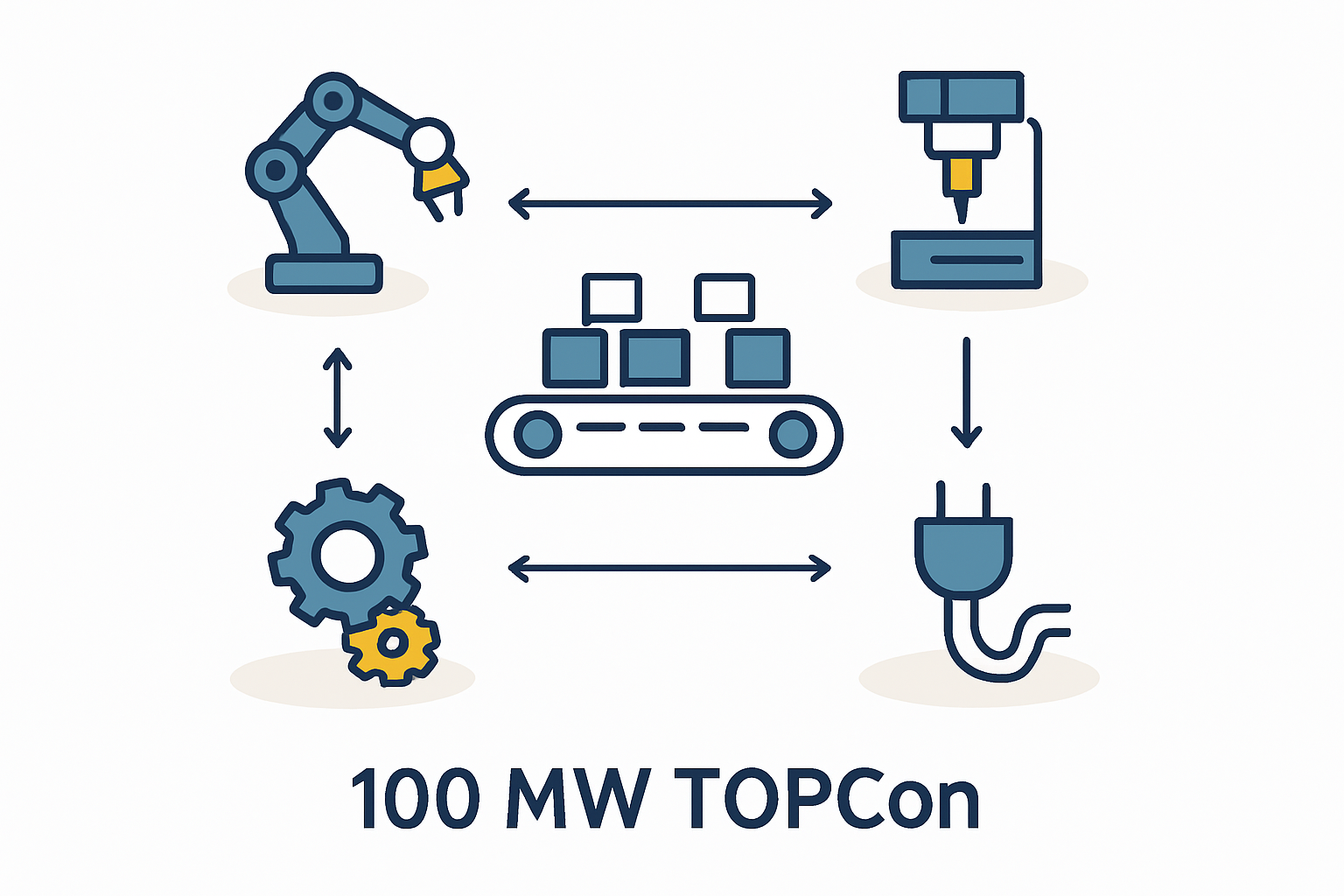
Example Configuration: 100 MW TOPCon Production Line
A semi-automated 100 MW line is a common starting point for new market entrants. It balances investment cost with efficient output, typically requiring between 25 and 40 operators per shift, depending on the final automation level.
Core Equipment:
- Glass Loading and Washing Station: Prepares the front glass for assembly.
- Automatic Laser Scribing and Cell Cutting: Prepares solar cells for stringing, often required for half-cut cell designs.
- Automatic Stringer Machine: Solders cells together into strings, a critical process for module performance.
- Automatic Layup and Bussing Station: Assembles the strings, encapsulant, and backsheet into the complete module sandwich.
- Automatic Laminator: Uses heat and pressure to encapsulate the module, protecting it from the elements.
- Framing and Junction Box Station: Adds the aluminum frame and junction box to the laminated module.
- Sun Simulator / IV Tester: Measures the electrical performance of the finished module to classify it by power output.
- EL (Electroluminescence) Tester: Inspects for micro-cracks and other invisible defects in the cells.
- Hi-Pot Tester: Ensures electrical insulation and safety.
Technology Focus (TOPCon):
This line is configured specifically for TOPCon module assembly. For instance, the stringer machine is calibrated for the unique metallization pattern and handling requirements of TOPCon cells, which can be more sensitive than standard PERC cells. Similarly, the EL testing parameters and sun simulator are optimized to accurately measure the higher efficiency and distinct electrical characteristics of TOPCon technology. The entire process flow is designed to protect the integrity of the advanced cell structure throughout assembly. Understanding these nuances is key, and further detail is available in our complete guide to solar panel manufacturing machines.
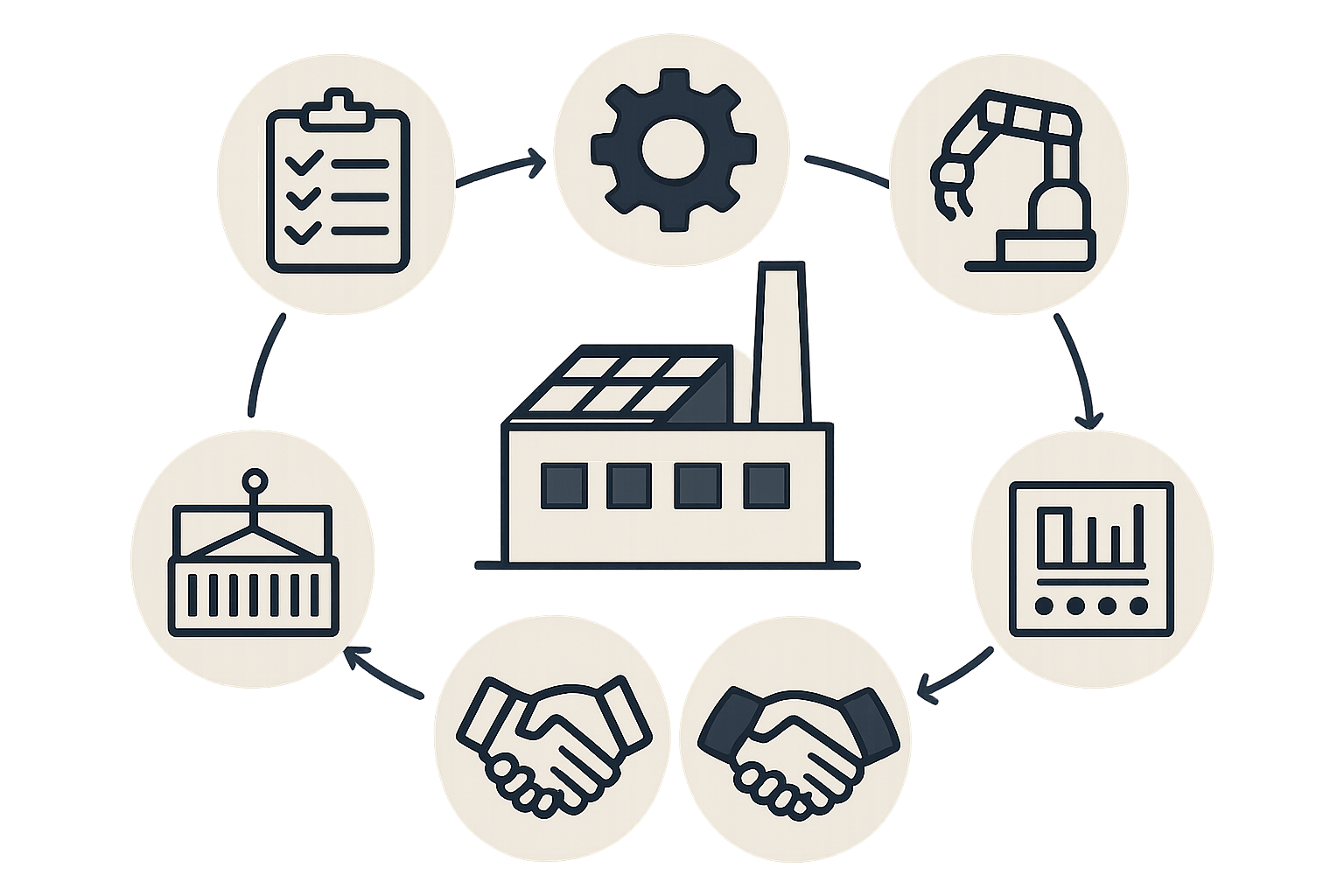
A Proven Framework for Implementation: The J.v.G. 6-Phase Process
Selecting the right equipment is only one part of the journey. A successful factory launch requires a structured, proven process that covers everything from initial financial modeling to operator training and final certification. This disciplined approach minimizes risk and ensures the project stays on schedule and within budget.
The J.v.G. 6-Phase Process was developed to guide new investors through every stage of establishing a solar factory, providing clarity and expert oversight from start to finish. This framework ensures that no critical detail is missed, from calculating initial investment requirements to achieving full-scale production.
Frequently Asked Questions
What is the typical factory footprint for a 100 MW line?
A 100 MW semi-automated line typically requires a building of approximately 3,000 to 4,000 square meters. This includes space for the production line itself, raw material storage, finished goods warehousing, and administrative offices. The final size depends heavily on the level of automation and the specific layout.
How does automation level affect operator count and OPEX?
Higher automation reduces the number of operators needed per shift, lowering long-term operational expenditure (OPEX). For instance, moving from manual to automatic bussing can eliminate several positions. However, it increases the initial capital expenditure (CAPEX). The optimal level of automation depends on local labor costs, desired production quality, and the investor’s financial strategy.
Can a PERC line be upgraded to TOPCon later?
Yes, this is a common and strategically sound upgrade path. A PERC line can be designed from the outset with the space and utility connections needed for future TOPCon equipment. This “TOPCon-ready” approach allows a manufacturer to enter the market with a lower initial investment and upgrade to a higher-efficiency technology as market demand evolves.
What are the main differences in utility requirements for HJT vs. TOPCon lines?
TOPCon lines retain high-temperature processes similar to PERC, requiring significant electrical power for diffusion furnaces. HJT lines operate at much lower temperatures (around 200°C), reducing thermal energy needs. However, they require specialized gases (like silane) and high-purity water, which have their own distinct infrastructure and safety considerations.
How does J.v.G. support projects in challenging climates?
Drawing on extensive experience in markets across the Middle East and Africa, J.v.G. offers specialized DESERT and TROPIC Technology. This involves adapting module designs and production processes to ensure long-term performance and reliability in environments with high temperatures, humidity, and solar irradiation. This is a crucial consideration for ensuring the bankability of modules produced in these regions.